• Fri frakt över 249 kr
  • •
  • Snabba leveranser
  • •
  • Billiga böcker
Kundservice

Du är på sajten för privatpersoner.

Företag, bibliotek eller offentlig verksamhet?

Du handlar på classic.bokus.com, där alla dina funktioner finns intakta.
Till classic.bokus.com
Bokus logotyp. Gå till startsidan.
  • Erbjudanden
  • Nyheter
  • Student
  • Topplistor
  • Barn & ungdom
  • Bokus Play
  • E-böcker
  • Pocketböcker
  • Spel & pussel

10% rabatt på allt med kod NYSTART10 →

Sidfot

Mina sidor

    Hjälp

    • Kundservice
    • Vanliga frågor och svar
    • Frakt och leverans
    • Retur vid ångerrätt
    • Reklamera vara
    • Betalning
    • Köpvillkor
    • Allmänna villkor
    • Information om webbplatsens tillgänglighet

    Om Bokus

    • Om oss
    • Pressrum
    • För studenter
    • För företag
    • För bibliotek och offentlig verksamhet
    • För leverantörer
    • Hållbarhet

    Populärt

    • Aktuella erbjudanden
    • Presentkort
    • Studentlitteratur
    • Nya böcker
    • Topplistor
    • Signerade böcker
    • Engelska böcker

    Inspiration

    • Boktips
    • BookTok
    • Populära bokserier
    • Barnbokskaraktärer
    • Populära författare
    Logotyp för Bokus
    Följ oss på Facebook (extern länk)Följ oss på Instagram (extern länk)Följ oss på YouTube (extern länk)Följ oss på TikTok (extern länk)
    bokus @ CookiesAnpassa cookiesIntegritetspolicyKöpvillkor
    Till Citymail hemsida (extern länk)Till Budbee hemsida (extern länk)Till Postnord hemsida (extern länk)Till Schenker hemsida (extern länk)Till Early Bird hemsida (extern länk)Till Walleys hemsida (extern länk)
    1. Medicin
    2. Medicin: icke kliniska discipliner
    3. Fysiologi

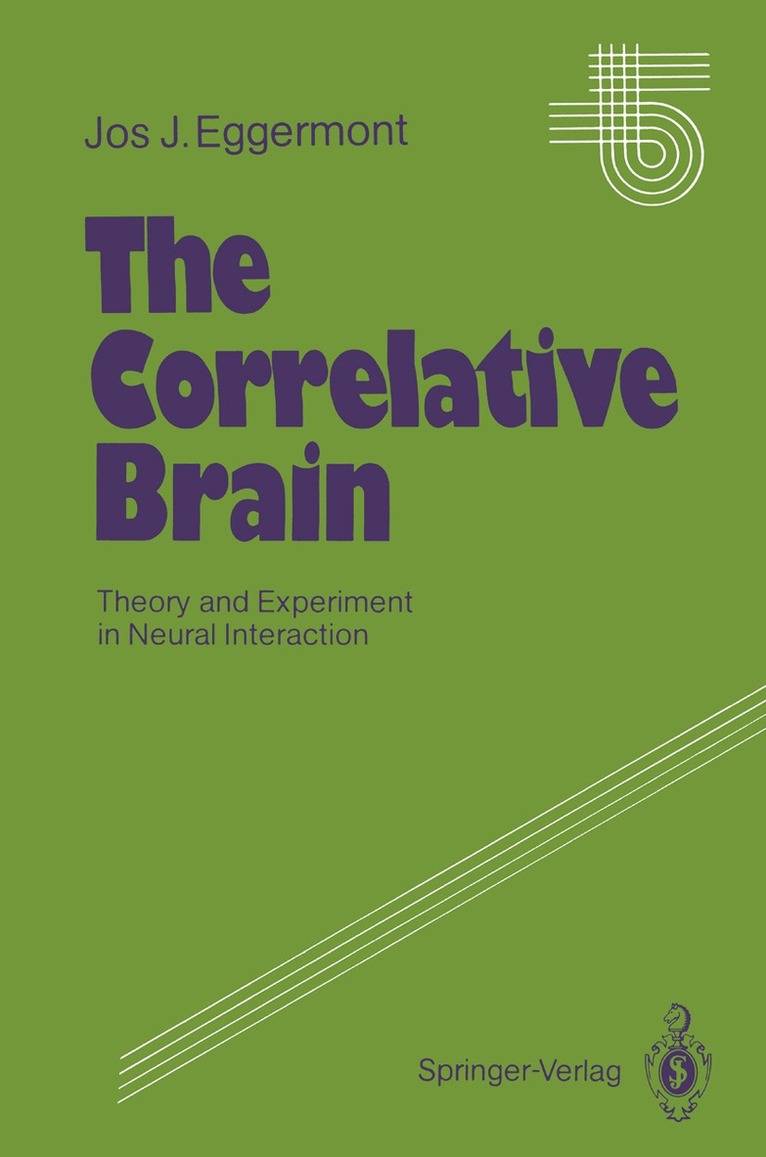
    Correlative Brain

    Theory and Experiment in Neural Interaction

    AvJos J. Eggermont

    Häftad, Engelska, 2012

    Del 16 i serien Studies of Brain Function

    1 117 kr

    Beställningsvara. Skickas inom 10-15 vardagar. Fri frakt över 249 kr.

    Fler format och utgåvor

    E-bok

    1 455 kr

    Beskrivning

    This monograph is the result of a course given to graduate students and to the faculty of the Dept. of Medical Physics and Biophysics of Nijmegen University, Nijmegen, The Netherlands, in the fall of 1984 and 1985. The course was intended to put together experi­ ment, theory, and analysis methods in order to study neural in­ teraction and coding in the brain. The following pages give a survey of neural interaction and its experimental substrate: cor­ related neural activity. The basic reason for restricting myself to vertebrate brains was to keep the material concise. As the text developed, however, it became more of a review, than a research monograph, in the attempt to balance theoretical and experimen­ tal aspects in brain research. Consequently, the book can be read from various points of view: that of requiring an overview of theories and theoretical principles, or an overview of experimental studies in neural interaction and the methods that can be used, or with the conviction that theory and experiment cannot be separat­ ed. In the latter case the book should be read from beginning to end. A way to read through the theoretical sections and the ex­ perimental sections of the book is presented in the following flow chart; Theory: /Chap. 2 -Chap. 4 -Chap. 5 ___ ~ Introduction -+ Chap. 1 \, Chap. 10 -+ Chap. 14 Experim~Chap. 3 -Chap. 6 -Chap. 7 -Chap. 8 ~ Chap.

    Produktinformation

    • Utgivningsdatum:2012-05-21
    • Mått:155 x 235 x 18 mm
    • Vikt:493 g
    • Format:Häftad
    • Språk:Engelska
    • Serie:Studies of Brain Function
    • Antal sidor:307
    • Förlag:Springer-Verlag Berlin and Heidelberg GmbH & Co. KG
    • ISBN:9783642510359

    Utforska kategorier

    • Fysiologi inom Medicin
    • Systemvetenskap och AI inom Data och IT
    • Tillämpad fysik inom Naturvetenskap och teknik

    Innehållsförteckning

    • 1 Single-Unit Analysis Versus Population Response Analysis.- 2 Outline of this Book.- 1 Information Coding.- 1.1 Information Coding and Transmission by Single Cells and Cell Populations.- 1.2 Cooperative Effects and Ensemble Coding.- 2 Spontaneous Activity.- 2.1 Noise or Information Carrier?.- 2.2 Quantification and Representation.- 2.3 The Auditory System.- 2.4 The Visual System.- 2.5 Other Brain Areas.- 2.6 Synthesis of Spontaneous Activity Phenomenology.- 3 Receptive Fields.- 3.1 Receptotopic and Nonreceptotopic Receptive Fields.- 3.2 Center-Surround Structure.- 3.3 Receptive Field Changes in Central Neurons: Feature Detectors?.- 3.4 Temporal Properties of the Receptive Field.- 4 Single-Neuron Models.- 4.1 Diffusion Models.- 4.2 Discrete Input Models.- 4.3 Neural Interaction — Black Box — Models.- 5 Neural Network Models.- 5.1 Neurons as Logical Switching Elements.- 5.2 Little-Neurons as Network Elements: Introduction of Probability.- 5.3 Statistical Theories of Memory.- 5.4 Statistical Neuromechanics.- 5.5 Neural Field Theories.- 5.6 Interaction in Neural Nets.- 6 Multiple Separate Recordings from Neural Nets.- 6.1 Recording from Multiple Sites in the Brain.- 6.2 Separating Multiple-Unit Spike Trains.- 7 Representation and Detection of Correlated Neural Activity.- 7.1 Representation of Multiple-Site Recorded Continuous Neural Activity.- 7.2 Representation of Multiunit Spike Trains.- 7.3 Cross-Correlation.- 7.4 Joint Peri-Stimulus-Time Scattergrams.- 7.5 A Hierarchy of Multiunit Representations.- 7.6 Correlation Analysis of Larger Numbers of Neural Units.- 7.7 Are Higher-Order Correlation Analyses Necessary?.- 7.8 Correcting Cross-Correlations for Effects of Stimulus Coupling 142.- 8 Correlated Neuronal Activity Observed in the Vertebrate Brain.- 8.1 The VisualSystem.- 8.2 The Auditory System.- 8.3 The Somatosensory System.- 8.4 Simultaneous Versus Sequential Single-Unit Recording.- 8.5 The Motor System.- 8.6 Comparison Between the Sensory and Motor Systems.- 8.7 Correlated Neural Activity and the State of the Animal.- 8.8 Correlated Neural Activity and Cognition.- 9 System Identification from Neural Correlation.- 9.1 Identification on the Basis of Continuous Input and Output Signals.- 9.2 Identification on the Basis of Continuous Input and Discrete Output.- 9.3 Identification Based upon Discrete Input and Discrete Output.- 9.4 Identification Based upon Discrete Input and Continuous Output.- 9.5 When Systems Identification Does Not Work.- 10 Plasticity — The Capacity to Change.- 10.1 The Developing Brain.- 10.2 The Adult Brain.- 10.3 Mechanisms and Models for Modifiable Synapses.- 11 Learning — The Cerebellum.- Box L, Anatomy, Physiology and Pharmacology of the Cerebellum.- 11.3 The Cerebellum as a Space-Time Metric.- 12 Learning — The Hippocampus.- 12.1 Types of Memory.- 12.2 Brain Structures Involved in Memory.- 12.3 A Mechanism of Memory Formation in the Hippocampus.- 12.4 Formal Models of Memory Formation.- 12.5 A Model for the Role of the Hippocampus in Memory.- 13 Learning — The Neocortex.- 13.1 The Neocortex: Pinnacle or Way-Station?.- 13.2 Development Aspects of Neocortical Organizations.- 13.3 The Neocortex as a Self-Organizing System.- 14 The Correlative Brain.- 14.1 Correlation, the Basic Mechanism of the Brain?.- 14.2 Topographic and Functional Brain Maps.- 14.3 Top-Down and Bottom-Up Approaches to Brain Function.- References.