• Fri frakt över 249 kr
  • •
  • Snabba leveranser
  • •
  • Billiga böcker
Kundservice

Du är på sajten för privatpersoner.

Företag, bibliotek eller offentlig verksamhet?

Du handlar på classic.bokus.com, där alla dina funktioner finns intakta.
Till classic.bokus.com
Bokus logotyp. Gå till startsidan.
  • Erbjudanden
  • Nyheter
  • Student
  • Topplistor
  • Barn & ungdom
  • Bokus Play
  • E-böcker
  • Pocketböcker
  • Spel & pussel

10% rabatt på allt med kod: NYSTART10 →

Sidfot

Mina sidor

    Hjälp

    • Kundservice
    • Vanliga frågor och svar
    • Frakt och leverans
    • Retur vid ångerrätt
    • Reklamera vara
    • Betalning
    • Köpvillkor
    • Allmänna villkor
    • Information om webbplatsens tillgänglighet

    Om Bokus

    • Om oss
    • Pressrum
    • För studenter
    • För företag
    • För bibliotek och offentlig verksamhet
    • För leverantörer
    • Hållbarhet

    Populärt

    • Aktuella erbjudanden
    • Presentkort
    • Studentlitteratur
    • Nya böcker
    • Topplistor
    • Signerade böcker
    • Engelska böcker

    Inspiration

    • Boktips
    • BookTok
    • Populära bokserier
    • Barnbokskaraktärer
    • Populära författare
    Logotyp för Bokus
    Följ oss på Facebook (extern länk)Följ oss på Instagram (extern länk)Följ oss på YouTube (extern länk)Följ oss på TikTok (extern länk)
    bokus @ CookiesAnpassa cookiesIntegritetspolicyKöpvillkor
    Till Citymail hemsida (extern länk)Till Budbee hemsida (extern länk)Till Postnord hemsida (extern länk)Till Schenker hemsida (extern länk)Till Early Bird hemsida (extern länk)Till Walleys hemsida (extern länk)
    1. Naturvetenskap och teknik
    2. Matematik och naturvetenskap
    3. Kemi
    4. Organisk kemi

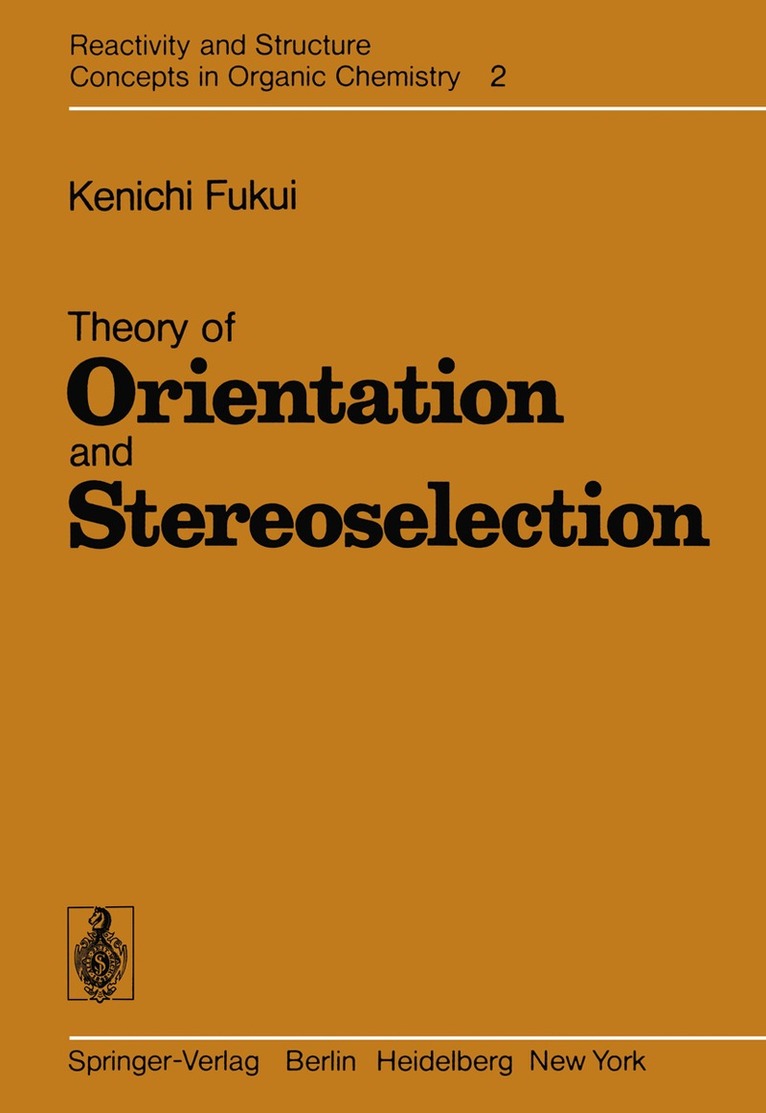
    Theory of Orientation and Stereoselection

    AvK. Fukui

    Häftad, Engelska, 2012

    Del 2 i serien Reactivity and Structure: Concepts in Organic Chemistry

    547 kr

    Beställningsvara. Skickas inom 10-15 vardagar. Fri frakt över 249 kr.

    Fler format och utgåvor

    E-bok

    710 kr

    Beskrivning

    Many organic chemists will agree with me that the old "electronic theory" has for a long time been inadequate for the interpretation of various new findings in chemistry, particularly for those of reactivity. Considering the outstanding progress which has been made during the past 20 years in the interpretation of these facts, aided by the molecular orbital theory, the time has finally come for a new book showing what is within and what is beyond the reach of quantum-chemical methods. It was therefore highly suitable that Dr. F. L. Boschke of the Springer­ Verlag suggested to me to make a contribution to a volume in the series "Topics in Current Chemistry" in February 1969. The article was published as Vol. 15, No 1 in June 1970. This new book is an expanded version of the article written in 1970. In this present volume several of the most up-to-date findings which have been gained in organic chemistry since then have been added. It is highly probable that a certain "theoretical" design in the experimenta­ lists' mind may have been the reason for these developments, whether they themselves are aware of it or not. Theory produces new experimental ideas and conversely, a host of experimental data add another vista to new theories. Due to the mutual beneficial effect of theory and experiment this book will always retain its value, although the quantum-chemical approach to the theory of reactivity is, of course, still in the develop­ mental stage.

    Produktinformation

    • Utgivningsdatum:2012-11-26
    • Mått:170 x 244 x 9 mm
    • Vikt:269 g
    • Format:Häftad
    • Språk:Engelska
    • Serie:Reactivity and Structure: Concepts in Organic Chemistry
    • Antal sidor:134
    • Förlag:Springer-Verlag Berlin and Heidelberg GmbH & Co. KG
    • ISBN:9783642619199

    Utforska kategorier

    • Organisk kemi inom Naturvetenskap och teknik

    Innehållsförteckning

    • 1. Molecular Orbitals.- 2. Chemical Reactivity Theory.- 3. Interaction of Two Reacting Species.- 4. Principles Governing the Reaction Pathway.- 5. General Orientation Rule.- 6. Reactivity Indices.- 7. Various Examples.- 8. Singlet—Triplet Selectivity.- 9. Pseudoexcitation.- 10. Three-species Interaction.- 11. Orbital Catalysis.- 12. Thermolytic Generation of Excited States.- 13. Reaction Coordinate Formalism.- 14. Correlation Diagram Approach.- 15. The Nature of Chemical Reactions.- Appendix I. Principles Governing the Reaction Path — An MO-Theoretical Interpretation.- Appendix II. Orbital Interaction between Two Molecules.- References.- Author Index.