• Fri frakt över 249 kr
  • •
  • Snabba leveranser
  • •
  • Billiga böcker
Kundservice

Du är på sajten för privatpersoner.

Företag, bibliotek eller offentlig verksamhet?

Du handlar på classic.bokus.com, där alla dina funktioner finns intakta.
Till classic.bokus.com
Bokus logotyp. Gå till startsidan.
  • Erbjudanden
  • Student
  • Topplistor
  • Barn & ungdom
  • Bokus Play
  • E-böcker
  • Ljudböcker
  • Pocketböcker
  • Spel och pussel

Pocketfynda! Hundratals böcker för 49 kr/st →

Sidfot

Mina sidor

    Hjälp

    • Kundservice
    • Vanliga frågor och svar
    • Frakt och leverans
    • Retur vid ångerrätt
    • Reklamera vara
    • Betalning
    • Köpvillkor
    • Allmänna villkor
    • Information om webbplatsens tillgänglighet

    Om Bokus

    • Om oss
    • Pressrum
    • För studenter
    • För företag
    • För bibliotek och offentlig verksamhet
    • För leverantörer
    • Hållbarhet

    Populärt

    • Aktuella erbjudanden
    • Presentkort
    • Studentlitteratur
    • Nya böcker
    • Topplistor
    • Signerade böcker
    • Engelska böcker

    Inspiration

    • Boktips
    • BookTok
    • Barnbokskaraktärer
    • Populära författare
    Logotyp för Bokus
    Följ oss på Facebook (extern länk)Följ oss på Instagram (extern länk)Följ oss på YouTube (extern länk)Följ oss på TikTok (extern länk)
    bokus @ CookiesAnpassa cookiesIntegritetspolicyKöpvillkor
    Till Citymail hemsida (extern länk)Till Budbee hemsida (extern länk)Till Postnord hemsida (extern länk)Till Schenker hemsida (extern länk)Till Early Bird hemsida (extern länk)Till Walleys hemsida (extern länk)
    1. Ekonomi och Ledarskap
    2. Nationalekonomi

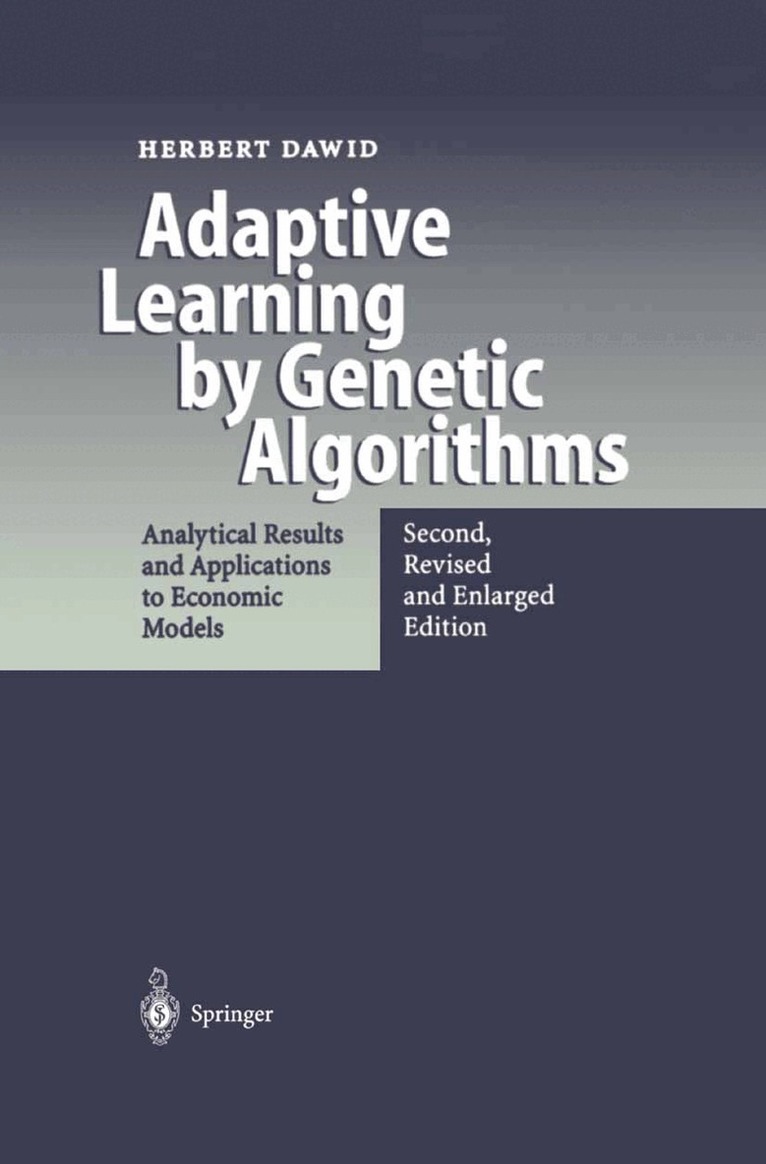
    Adaptive Learning by Genetic Algorithms

    Analytical Results and Applications to Economic Models

    AvHerbert Dawid

    Häftad, Engelska, 2012

    1 078 kr

    Beställningsvara. Skickas inom 10-15 vardagar. Fri frakt över 249 kr.

    Fler format och utgåvor

    Inbunden

    1 078 kr

    E-bok

    1 413 kr

    E-bok

    1 174 kr

    Beskrivning

    The fact that I have the opportunity to present a second edition of this monograph is an indicator for the growing size of the community concerned with agent-based computational economics. The rapid developments in this field make it very difficult to keep a volume like this, which is partly devoted to surveying the literature, up to date. I have done my best to incorporate the relevant new developments in this revised edition but it is in the nature of such a work that the selection of material covered is biased by the authors personal interest and his informational constraints. My apologies go to all researchers in this field whose work is not or not adequately represented in this book. Besides the correction of some errors and typos several additions have been made. In the literature survey sections 2.4 (which was also reorganized) and 3.5 new material was added. I have also added a new section in chapter 3 which deals with the question how well empirically observed phenomena can be explained by GA simulations. A new section in chapter 6 presents a rather extensive analysis of the behavior of a two population GA in the framework of a sealed bid double auction market. Further minor additions and changes were made throughout the text.

    Produktinformation

    • Utgivningsdatum:2012-08-20
    • Mått:155 x 235 x 13 mm
    • Vikt:341 g
    • Format:Häftad
    • Språk:Engelska
    • Antal sidor:200
    • Upplaga:2
    • Förlag:Springer-Verlag Berlin and Heidelberg GmbH & Co. KG
    • ISBN:9783642621062

    Utforska kategorier

    • Nationalekonomi inom Ekonomi och Ledarskap
    • Tillämpad datateknik inom Data och IT
    • Beräkning och matematisk analys inom Naturvetenskap och teknik

    Innehållsförteckning

    • 1. Introduction.- 2. Bounded Rationality and Artificial Intelligence.- 2.1 Bounded Rationality in Economics.- 2.2 Artificially Intelligent Agents in Economic Systems.- 2.3 Learning Techniques of Artificially Intelligent Agents.- 2.4 Some Applications of CI Methods in Economic Systems.- 2.5 Potentiality and Problems of CI Techniques in Economics.- 3. Genetic Algorithms.- 3.1 What are Genetic Algorithms?.- 3.2 The Structure of Genetic Algorithms.- 3.3 Genetic Operators.- 3.4 Genetic Algorithms with a Non-Standard Structure.- 3.5 Some Analytical Approaches to Model Genetic Algorithms.- 3.6 Do Genetic Algorithms Describe Adaptive Learning?.- 4. Genetic Algorithms with a State Dependent Fitness Function.- 4.1 State Dependency in Economic Systems.- 4.2 A Markov Model for Systems with a State Dependent Fitness Function.- 4.3 The Difference Equations Describing the GA.- 4.4 Deviation from the Markov Process.- 4.5 A Numerical Example.- 4.6 Stability of the Uniform States.- 4.7 Two-Population Models.- 5. Genetic Learning in Evolutionary Games.- 5.1 Equilibria and Evolutionary Stability.- 5.2 Learning in Evolutionary Games.- 5.3 Learning by a Simple Genetic Algorithm.- 5.4 Two-Population Contests.- 6. Simulations with Genetic Algorithms in Economic Systems.- 6.1 A Model of a Competitive Market.- 6.2 An Overlapping Generations Model with Fiat Money.- 6.3 A Sealed Bid Double Auction Market.- 7. Stability and Encoding.- 7.1 The Cobweb Example Revisited.- 7.2 Impact of a Change in Encoding and Scaling.- 7.3 A Method for Finding Economic Equilibria.- 8. Conclusions.- A. Basic Definitions and Results Used.- A.1 Time Homogeneous Markov Chains.- A.2 Nonlinear Difference Equations and Stability.- B. Calculation of the Equilibria of the Evolutionary Games in Chapter 5.- B.1 Rock-Scissor-Paper Games.- B.2 The GA Deceptive Game GAD.- B.3 The Games G1 and G2.- C. Proof of Proposition 6.3.1.- References.- List of Figures.- List of Tables.