
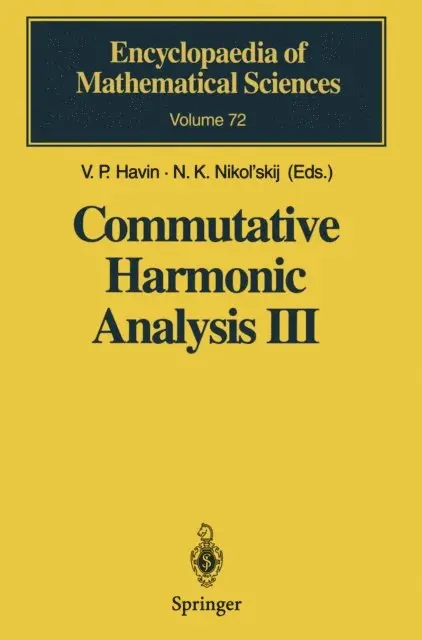
Commutative Harmonic Analysis III
Generalized Functions. Application
Häftad, Engelska, 2012
Del 72 i serien Encyclopaedia of Mathematical Sciences
556 kr
Beställningsvara. Skickas inom 10-15 vardagar. Fri frakt över 249 kr.
Beskrivning
The theory of generalized functions is a general method that makes it possible to consider and compute divergent integrals, sum divergent series, differentiate discontinuous functions, perform the operation of integration to any complex power and carry out other such operations that are impossible in classical analysis. Such operations are widely used in mathematical physics and the theory of differential equations, where the ideas of generalized func tions first arose, in other areas of analysis and beyond. The point of departure for this theory is to regard a function not as a mapping of point sets, but as a linear functional defined on smooth densi ties. This route leads to the loss of the concept of the value of function at a point, and also the possibility of multiplying functions, but it makes it pos sible to perform differentiation an unlimited number of times. The space of generalized functions of finite order is the minimal extension of the space of continuous functions in which coordinate differentiations are defined every where. In this sense the theory of generalized functions is a development of all of classical analysis, in particular harmonic analysis, and is to some extent the perfection of it. The more general theories of ultradistributions or gener alized functions of infinite order make it possible to consider infinite series of generalized derivatives of continuous functions.
Produktinformation
Utforska kategorier
Innehållsförteckning
Hoppa över listan

Mer från samma serie
Del 5
Dynamical Systems V
V.I. Arnold, V.S. Afrajmovich, Yu.S. Il'yashenko, L.P. Shil'nikov, V.I. Arnold
Inbunden, 1994
1 106 kr
Del 141
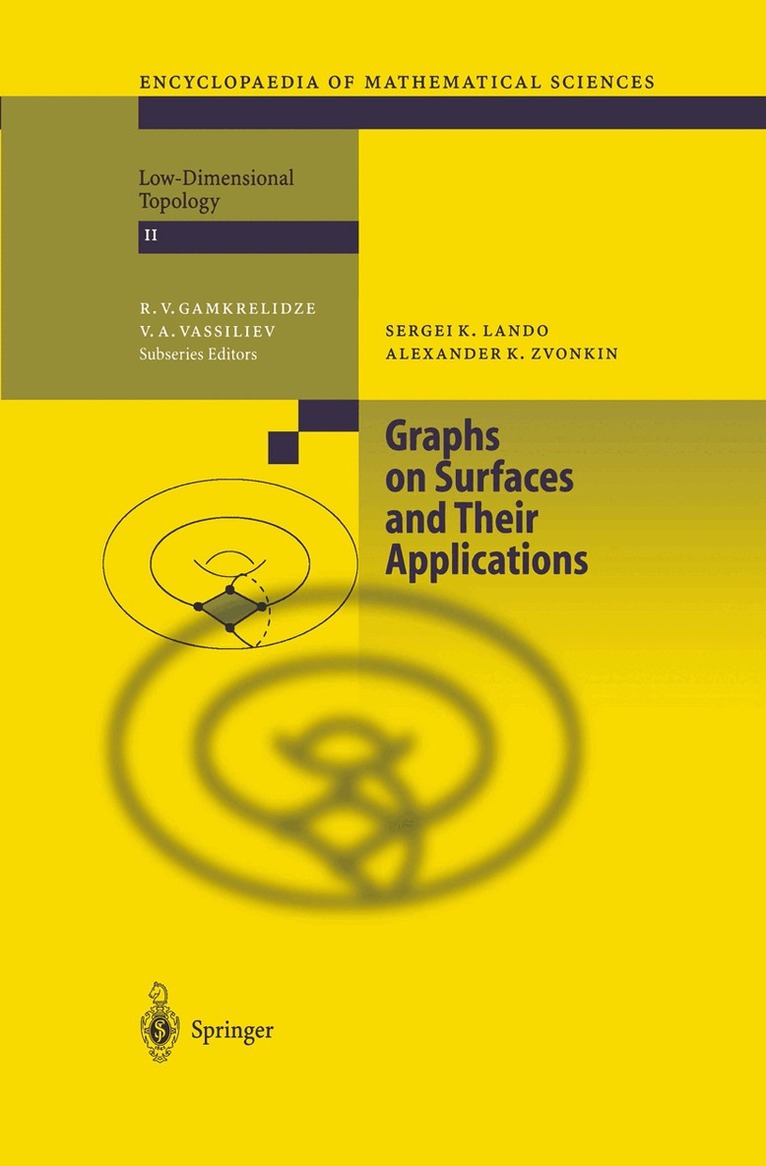
Graphs on Surfaces and Their Applications
Sergei K. Lando, Alexander K. Zvonkin, R.V. Gamkrelidze, V.A. Vassiliev
Inbunden, 2003
2 205 kr
Del 1
Dynamical Systems I
D.V. Anosov, S.Kh. Aranson, V.I. Arnold, I.U. Bronshtein, V.Z. Grines, Yu.S. Ilyashenko, D.V. Anosov, V.I. Arnold
Inbunden, 1988
1 106 kr
Del 12
Del 16
Del 15
Del 20
Lie Groups and Lie Algebras I
V.V. Gorbatsevich, A.L. Onishchik, E.B. Vinberg, A.L. Onishchik
Inbunden, 1993
1 106 kr
Hoppa över listan
Du kanske också är intresserad av
- 10% rabatt på allt
Del 63
Foundations of the Classical Theory of Partial Differential Equations
Yu.V. Egorov, M.A. Shubin, Yu.V. Egorov, M.A. Shubin
Häftad, 1998
556 kr
Del 25