• Fri frakt över 249 kr
  • •
  • Snabba leveranser
  • •
  • Billiga böcker
Kundservice

Du är på sajten för privatpersoner.

Företag, bibliotek eller offentlig verksamhet?

Du handlar på classic.bokus.com, där alla dina funktioner finns intakta.
Till classic.bokus.com
Bokus logotyp. Gå till startsidan.
  • Erbjudanden
  • Nyheter
  • Student
  • Topplistor
  • Barn & ungdom
  • Bokus Play
  • E-böcker
  • Pocketböcker
  • Spel & pussel

10% rabatt på allt med kod: NYSTART10 →

Sidfot

Mina sidor

    Hjälp

    • Kundservice
    • Vanliga frågor och svar
    • Frakt och leverans
    • Retur vid ångerrätt
    • Reklamera vara
    • Betalning
    • Köpvillkor
    • Allmänna villkor
    • Information om webbplatsens tillgänglighet

    Om Bokus

    • Om oss
    • Pressrum
    • För studenter
    • För företag
    • För bibliotek och offentlig verksamhet
    • För leverantörer
    • Hållbarhet

    Populärt

    • Aktuella erbjudanden
    • Presentkort
    • Studentlitteratur
    • Nya böcker
    • Topplistor
    • Signerade böcker
    • Engelska böcker

    Inspiration

    • Boktips
    • BookTok
    • Populära bokserier
    • Barnbokskaraktärer
    • Populära författare
    Logotyp för Bokus
    Följ oss på Facebook (extern länk)Följ oss på Instagram (extern länk)Följ oss på YouTube (extern länk)Följ oss på TikTok (extern länk)
    bokus @ CookiesAnpassa cookiesIntegritetspolicyKöpvillkor
    Till Citymail hemsida (extern länk)Till Budbee hemsida (extern länk)Till Postnord hemsida (extern länk)Till Schenker hemsida (extern länk)Till Early Bird hemsida (extern länk)Till Walleys hemsida (extern länk)
    1. Naturvetenskap och teknik
    2. Matematik och naturvetenskap
    3. Matematik
    4. Talteori

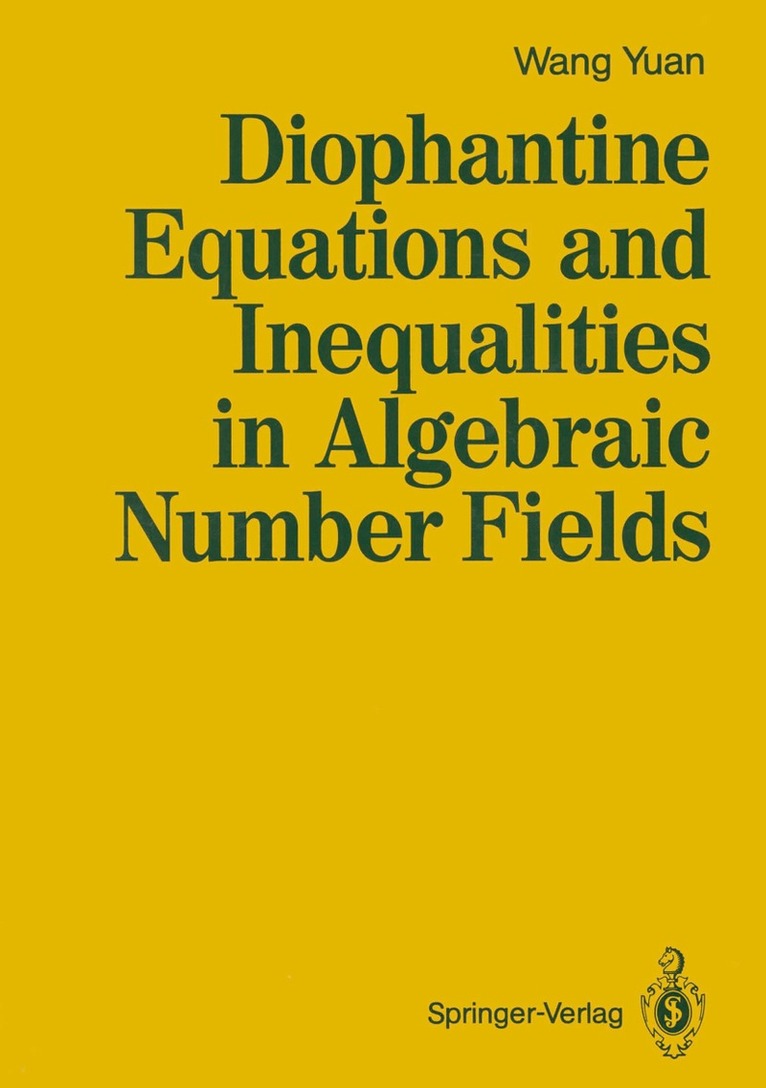
    Diophantine Equations and Inequalities in Algebraic Number Fields

    AvYuan Wang

    Häftad, Engelska, 2012

    547 kr

    Beställningsvara. Skickas inom 10-15 vardagar. Fri frakt över 249 kr.

    Fler format och utgåvor

    Inbunden

    870 kr

    E-bok

    712 kr

    Beskrivning

    The circle method has its genesis in a paper of Hardy and Ramanujan (see [Hardy 1])in 1918concernedwiththepartitionfunction andtheproblemofrep- resenting numbers as sums ofsquares. Later, in a series of papers beginning in 1920entitled "some problems of'partitio numerorum", Hardy and Littlewood (see [Hardy 1]) created and developed systematically a new analytic method, the circle method in additive number theory. The most famous problems in ad- ditive number theory, namely Waring's problem and Goldbach's problem, are treated in their papers. The circle method is also called the Hardy-Littlewood method. Waring's problem may be described as follows: For every integer k 2 2, there is a number s= s( k) such that every positive integer N is representable as (1) where Xi arenon-negative integers. This assertion wasfirst proved by Hilbert [1] in 1909. Using their powerful circle method, Hardy and Littlewood obtained a deeper result on Waring's problem. They established an asymptotic formula for rs(N), the number of representations of N in the form (1), namely k 1 provided that 8 2 (k - 2)2 - +5. Here

    Produktinformation

    • Utgivningsdatum:2012-10-18
    • Mått:170 x 242 x 11 mm
    • Vikt:339 g
    • Format:Häftad
    • Språk:Engelska
    • Antal sidor:170
    • Förlag:Springer-Verlag Berlin and Heidelberg GmbH & Co. KG
    • ISBN:9783642634895

    Utforska kategorier

    • Talteori inom Naturvetenskap och teknik

    Innehållsförteckning

    • 1. The Circle Method and Waring’s Problem.- 1.1 Introduction.- 1.2 Farey Division.- 1.3 Auxiliary Lemmas.- 1.4 Major Arcs.- 1.5 Singular Integral.- 1.6 Singular Series.- 1.7 Proof of Lemma 1.12.- 1.8 Proof of Theorem 1.1.- Notes.- 2. Complete Exponential Sums.- 2.1 Introduction.- 2.2 Several Lemmas.- 2.3 Mordell’s Lemma.- 2.4 Fundamental Lemma.- 2.5 Proof of Theorem 2.1.- 2.6 Proof of Theorem 2.2.- Notes.- 3. Weyl’s Sums.- 3.1 Introduction.- 3.2 Proof of Theorem 3.1.- 3.3 A Lemma on Units.- 3.4 The Asymptotic Formula for N(a,T).- 3.5 A Sum.- 3.6 Mitsui’s Lemma.- 3.7 Proof of Theorem 3.3.- 3.8 Proof of Lemma 3.6.- 3.9 Continuation.- Notes.- 4. Mean Value Theorems.- 4.1 Introduction.- 4.2 Proof of Theorem 4.1.- 4.3 Proof of Theorem 4.2.- 4.4 A Lemma on the Set D.- 4.5 A Lemma on the Set D(x).- 4.6 Fundamental Lemma.- 4.7 Proof of Lemma 4.1.- Notes.- 5. The Circle Method in Algebraic Number Fields.- 5.1 Introduction.- 5.2 Lemmas.- 5.3 Asympotic Expansion forSi (?, T).- 5.4 Further Estimates on Basic Domains.- 5.5 Proof of Theorem 5.1.- 5.6 Proof of Theorem 5.2.- Notes.- 6. Singular Series and Singular Integrals.- 6.1 Introduction.- 6.2 Product Form for Singular Series.- 6.3 Singular Series and Congruences.- 6.4 p-adic Valuations.- 6.5 k-th Power Residues.- 6.6 Proof of Theorem 6.1.- 6.7 Monotonic Functions.- 6.8 Proof of Theorem 6.2.- Notes.- 7. Waring’s Problem.- 7.1 Introduction.- 7.2 The Ring Jk.- 7.3 Proofs of Theorems 7.1 and 7.2.- 7.4 Proof of Theorem 7.3.- 7.5 Proof of Theorem 7.4.- Notes.- 8. Additive Equations.- 8.1 Introduction.- 8.2 Reductions.- 8.3 Contraction.- 8.4 Derived Variables.- 8.5 Proof of Theorem 8.1.- 8.6 Proof of Theorem 8.2.- 8.7 Bounds for Solutions.- Notes.- 9. Small Nonnegative Solutions of Additive Equations.- 9.1 Introduction.- 9.2Hurwitz’s Lemma.- 9.3 Reductions.- 9.4 Continuation.- 9.5 Farey Division.- 9.6 Supplementary Domain.- 9.7 Basic Domains.- 9.8 Proof of Theorem 9.1.- Notes.- 10. Small Solutions of Additive Equations.- 10.1 Introduction.- 10.2 Reductions.- 10.3 Continuation.- 10.4 Farey Division.- 10.5 Supplementary Domain.- 10.6 Basic Domains.- 10.7 Proof of Theorem 10.1.- Notes.- 11. Diophantine Inequalities for Forms.- 11.1 Introduction.- 11.2 A Single Additive Form.- 11.3 A Variant Circle Method.- 11.4 Continuation.- 11.5 Proof of Lemma 11.1.- 11.6 Linear Forms.- 11.7 A Single Form.- 11.8 Proof of Theorem 11.1.- Notes.- References I.- References II.