• Fri frakt över 249 kr
  • •
  • Snabba leveranser
  • •
  • Billiga böcker
Kundservice

Du är på sajten för privatpersoner.

Företag, bibliotek eller offentlig verksamhet?

Du handlar på classic.bokus.com, där alla dina funktioner finns intakta.
Till classic.bokus.com
Bokus logotyp. Gå till startsidan.
  • Erbjudanden
  • Nyheter
  • Student
  • Topplistor
  • Barn & ungdom
  • Bokus Play
  • E-böcker
  • Pocketböcker
  • Spel & pussel

10% rabatt på allt med kod: NYSTART10 →

Sidfot

Mina sidor

    Hjälp

    • Kundservice
    • Vanliga frågor och svar
    • Frakt och leverans
    • Retur vid ångerrätt
    • Reklamera vara
    • Betalning
    • Köpvillkor
    • Allmänna villkor
    • Information om webbplatsens tillgänglighet

    Om Bokus

    • Om oss
    • Pressrum
    • För studenter
    • För företag
    • För bibliotek och offentlig verksamhet
    • För leverantörer
    • Hållbarhet

    Populärt

    • Aktuella erbjudanden
    • Presentkort
    • Studentlitteratur
    • Nya böcker
    • Topplistor
    • Signerade böcker
    • Engelska böcker

    Inspiration

    • Boktips
    • BookTok
    • Populära bokserier
    • Barnbokskaraktärer
    • Populära författare
    Logotyp för Bokus
    Följ oss på Facebook (extern länk)Följ oss på Instagram (extern länk)Följ oss på YouTube (extern länk)Följ oss på TikTok (extern länk)
    bokus @ CookiesAnpassa cookiesIntegritetspolicyKöpvillkor
    Till Citymail hemsida (extern länk)Till Budbee hemsida (extern länk)Till Postnord hemsida (extern länk)Till Schenker hemsida (extern länk)Till Early Bird hemsida (extern länk)Till Walleys hemsida (extern länk)
    1. Naturvetenskap och teknik
    2. Teknik och industri
    3. Elektronik och kommunikationer

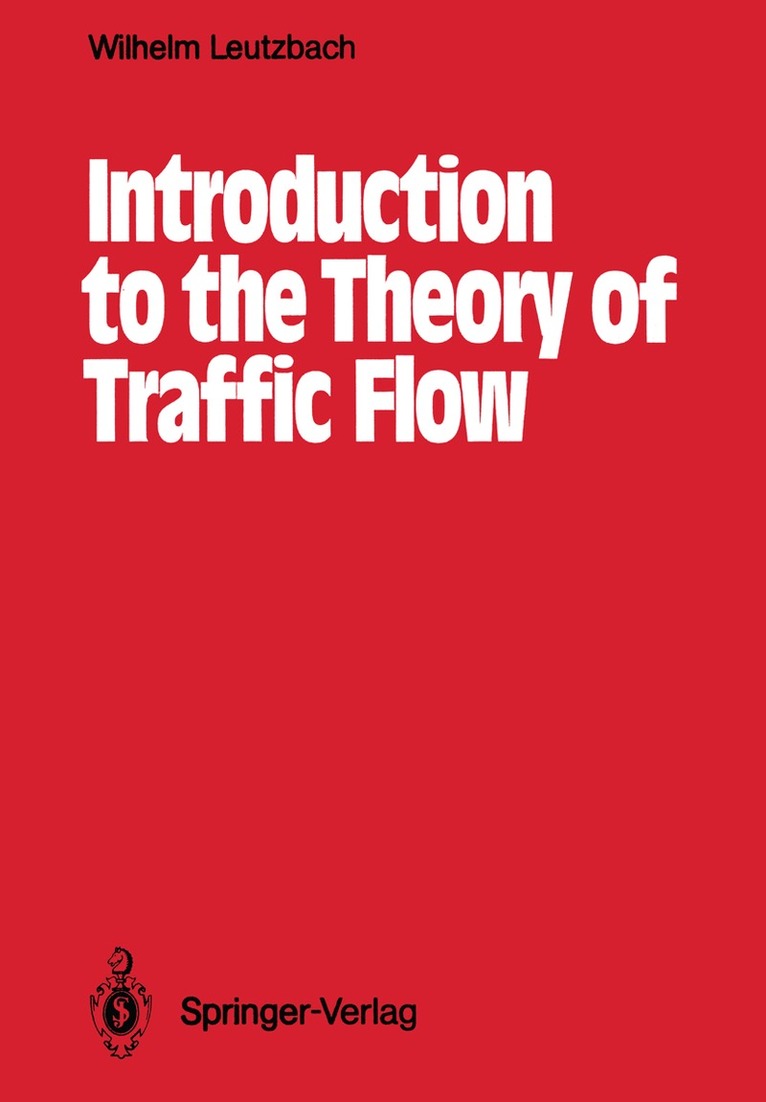
    Introduction to the Theory of Traffic Flow

    AvWilhelm Leutzbach

    Häftad, Engelska, 2012

    547 kr

    Beställningsvara. Skickas inom 10-15 vardagar. Fri frakt över 249 kr.

    Fler format och utgåvor

    E-bok

    710 kr

    Beskrivning

    This book describes a coherent approach to the explanation of the movement of individual vehicles or groups of vehicles. To avoid possible misunderstandings, some preliminary remarks are called for. 1. This is intended to be a textbook. It brings together methods and approaches that are widely distributed throughout the literature and that are therefore difficult to assess. Text citations of sources have been avoided; literature references are listed together at the end of the book. 2. The book is intended primarily for students of engineering. It describes the theoretical background necessary for an understanding of the methods by which links in a road network are designed and dimensioned or by which traffic is controlled; the methods themselves are not dealt with. It may also assist those actually working in such sectors to interpret the results of traffic flow measure­ ments more accurately than has hitherto been the case. 3. The book deals with traffic flow on links between nodes, and not at nodes themselves. Many readers will probably regret this, since nodes are usually the bottlenecks which limit the capacity of the road network. A book dedicated to the node would be the obvious follow-up. A separation of link and node is justified, however, partly because the quantity of material has to be kept within reasonable bounds and partly because the treatment of traffic flow at nodes requires additional mathematical techniques (in particular, those relating to queueing theory).

    Produktinformation

    • Utgivningsdatum:2012-04-17
    • Mått:170 x 244 x 13 mm
    • Vikt:389 g
    • Format:Häftad
    • Språk:Engelska
    • Antal sidor:204
    • Förlag:Springer-Verlag Berlin and Heidelberg GmbH & Co. KG
    • ISBN:9783642648052

    Utforska kategorier

    • Elektronik och kommunikationer inom Naturvetenskap och teknik
    • Motorfordon inom Naturvetenskap och teknik

    Innehållsförteckning

    • I. The Motion of a Single Vehicle.- I.1. Kinematics of a Single Vehicle.- I.2. Statistics of the Motion of an Individual Vehicle.- II. The Motion of Several Vehicles on a Road.- II.1. Distributions and Their Parameters.- II.2. Parameters for Describing a Traffic Stream.- II.3 Description of the States of Traffic.- References.- List of Symbols.