• Fri frakt över 249 kr
  • •
  • Snabba leveranser
  • •
  • Billiga böcker
Kundservice

Du är på sajten för privatpersoner.

Företag, bibliotek eller offentlig verksamhet?

Du handlar på classic.bokus.com, där alla dina funktioner finns intakta.
Till classic.bokus.com
Bokus logotyp. Gå till startsidan.
  • Erbjudanden
  • Nyheter
  • Student
  • Topplistor
  • Barn & ungdom
  • Bokus Play
  • E-böcker
  • Pocketböcker
  • Spel & pussel

10% rabatt på allt med kod: NYSTART10 →

Sidfot

Mina sidor

    Hjälp

    • Kundservice
    • Vanliga frågor och svar
    • Frakt och leverans
    • Retur vid ångerrätt
    • Reklamera vara
    • Betalning
    • Köpvillkor
    • Allmänna villkor
    • Information om webbplatsens tillgänglighet

    Om Bokus

    • Om oss
    • Pressrum
    • För studenter
    • För företag
    • För bibliotek och offentlig verksamhet
    • För leverantörer
    • Hållbarhet

    Populärt

    • Aktuella erbjudanden
    • Presentkort
    • Studentlitteratur
    • Nya böcker
    • Topplistor
    • Signerade böcker
    • Engelska böcker

    Inspiration

    • Boktips
    • BookTok
    • Populära bokserier
    • Barnbokskaraktärer
    • Populära författare
    Logotyp för Bokus
    Följ oss på Facebook (extern länk)Följ oss på Instagram (extern länk)Följ oss på YouTube (extern länk)Följ oss på TikTok (extern länk)
    bokus @ CookiesAnpassa cookiesIntegritetspolicyKöpvillkor
    Till Citymail hemsida (extern länk)Till Budbee hemsida (extern länk)Till Postnord hemsida (extern länk)Till Schenker hemsida (extern länk)Till Early Bird hemsida (extern länk)Till Walleys hemsida (extern länk)
    1. Medicin
    2. Andra medicinska specialiteter
    3. Patologi

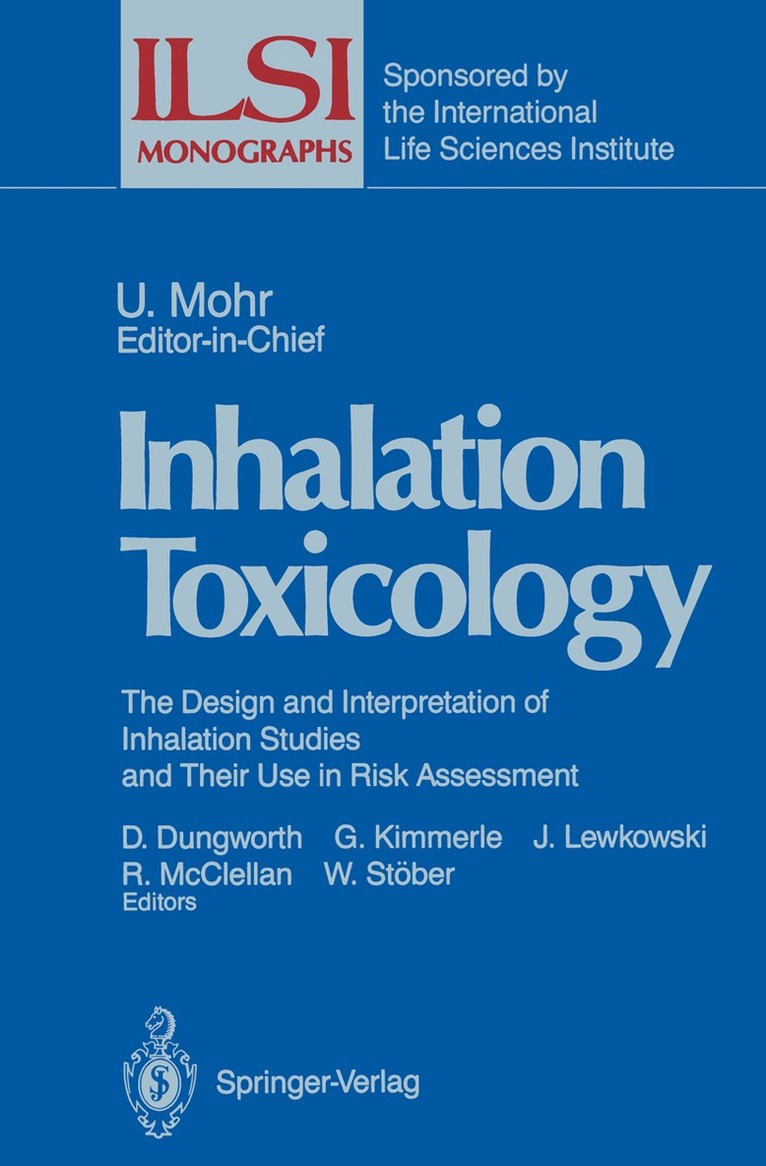
    Inhalation Toxicology

    The Design and Interpretation of Inhalation Studies and Their Use in Risk Assessment

    AvUlrich Mohr

    Häftad, Engelska, 2011

    Del i serien ILSI Monographs

    1 119 kr

    Beställningsvara. Skickas inom 10-15 vardagar. Fri frakt över 249 kr.

    Beskrivning

    The International Life Sciences Institute (ILSI), a nonprofit, public foundation, was established in 1978 to advance the sciences of nutrition, toxicology, and food safety. ILSI promotes the resolution of health and safety issues in these areas by sponsoring research, conferences, publications, and educational programs. Through ILSI's programs, scientists from government, academia, and industry unite their efforts to resolve issues of critical importance to the public. As part of its commitment to understanding and resolving health and safety issues, ILSI is pleased to sponsor this series of monographs that consolidates new scientific knowledge, defines research needs, and provides a background for the effective application of scientific advances in toxicology and food safety. Alex Malaspina President International Life Sciences Institute Contents Series Foreword . . . . . . . . . . . . . . . . . . . . . . . . . . . . . . . . . . . . . . . . . . . . . . v Contributors . . . . . . . . . . . . . . . . . . . . . . . . . . . . . . . . . . . . . . . . . . . . . . . . . xi Part I. Approaches to Assessing the Toxicity of Airborne Toxicants Chapter 1. Standard-Setting as an Integrative Exercise: Alchemy, Juggling, or Science? . . . . . . . . . . . . . . . . . . . . . . . 1 D. v. Bates Chapter 2. Species Differences in Inhalation Toxicology: Variations in Exposure-Dose Relationships and Macrophage Function. . . . . . . . . . . . . . . . . . . . . . . . . . . . 11 J. D. Brain Chapter 3. Cell Populations of the Respiratory System: Interspecies Diversity in Composition, Distribution, and Morphology . . . . . . . . . . . . . . . . . . . . . . . . 25 e. G. Plopper, A. Mir, J. St. George, N. Tyler, A. Mariassy, D. Wilson, S. Nishio, D. Cranz, J. Heidsiek, and D. Hyde Chapter 4. Comparative Metabolic Basis for the Disposition and Toxic Effects of Inhaled Materials . . . . . . . . . . . . . . . . . 41 A. R. Dahl Part II. Methodological Issues in Designing and Conducting Studies with Laboratory Animals Chapter 5. Exposure Facilities and Aerosol Generation and Characterization for Inhalation Experiments. . . . . . . . . .

    Produktinformation

    • Utgivningsdatum:2011-09-23
    • Mått:155 x 235 x 19 mm
    • Vikt:522 g
    • Format:Häftad
    • Språk:Engelska
    • Serie:ILSI Monographs
    • Antal sidor:318
    • Förlag:Springer-Verlag Berlin and Heidelberg GmbH & Co. KG
    • ISBN:9783642648069

    Utforska kategorier

    • Patologi inom Medicin
    • Lungmedicin inom Medicin

    Innehållsförteckning

    • I. Approaches to Assessing the Toxicity of Airborne Toxicants.- 1. Standard-Setting as an Integrative Exercise: Alchemy, Juggling, or Science?.- 2. Species Differences in Inhalation Toxicology: Variations in Exposure-Dose Relationships and Macrophage Function.- 3. Cell Populations of the Respiratory System: Interspecies Diversity in Composition, Distribution, and Morphology.- 4. Comparative Metabolic Basis for the Disposition and Toxic Effects of Inhaled Materials.- II. Methodological Issues in Designing and Conducting Studies with Laboratory Animals.- 5. Exposure Facilities and Aerosol Generation and Characterization for Inhalation Experiments.- 6. Different Methods Used in Acute and Subchronic Inhalation Studies of Potential Lung Irritants, with Particular Attention to Lung Function Measurements.- 7. Chronic Inhalation Toxicity Studies: Protocols and Pitfalls.- 8. Carcinogenicity Protocols.- III. Interpretation of Toxicokinetic Studies with Airborne Toxicants.- 9. Interspecies Dosimetry of Reactive Gases.- 10. Behavior of Inspired Aerosol Boli in Humans.- 11. Respiratory Tract Clearance of Particles and Substances Dissociated from Particles.- IV. Interpretation of Results Using Laboratory Animals.- 12. Interpretation of Early Lesions in the Mouse Lung: Fibrogenesis and Tbmorigenesis.- 13. Relevance to Humans of Experimentally Induced Pulmonary Tumors in Rats and Hamsters.- 14. Experimentally Induced Emphysema and Long-Term Nitrogen Dioxide Inhalation.- 15. Comparison of Respiratory Function Responses of Laboratory Animals and Humans.- V. Risk Assessment of Airborne Toxicants.- 16. Population Studies in Risk Assessment: Strengths and Weaknesses.- 17. Human Clinical Exposure Studies: Body Box or Pandora’s Box?.- 18. Occupational Exposure Standards in Europe: History,Present Status, and Future Trends.- 19. Current Approaches for Determining Workplace Exposure Limits in the USA.