• Fri frakt över 249 kr
  • •
  • Snabba leveranser
  • •
  • Billiga böcker
Kundservice

Du är på sajten för privatpersoner.

Företag, bibliotek eller offentlig verksamhet?

Du handlar på classic.bokus.com, där alla dina funktioner finns intakta.
Till classic.bokus.com
Bokus logotyp. Gå till startsidan.
  • Erbjudanden
  • Nyheter
  • Student
  • Topplistor
  • Barn & ungdom
  • Bokus Play
  • E-böcker
  • Pocketböcker
  • Spel & pussel

10% rabatt på allt med kod: NYSTART10 →

Sidfot

Mina sidor

    Hjälp

    • Kundservice
    • Vanliga frågor och svar
    • Frakt och leverans
    • Retur vid ångerrätt
    • Reklamera vara
    • Betalning
    • Köpvillkor
    • Allmänna villkor
    • Information om webbplatsens tillgänglighet

    Om Bokus

    • Om oss
    • Pressrum
    • För studenter
    • För företag
    • För bibliotek och offentlig verksamhet
    • För leverantörer
    • Hållbarhet

    Populärt

    • Aktuella erbjudanden
    • Presentkort
    • Studentlitteratur
    • Nya böcker
    • Topplistor
    • Signerade böcker
    • Engelska böcker

    Inspiration

    • Boktips
    • BookTok
    • Populära bokserier
    • Barnbokskaraktärer
    • Populära författare
    Logotyp för Bokus
    Följ oss på Facebook (extern länk)Följ oss på Instagram (extern länk)Följ oss på YouTube (extern länk)Följ oss på TikTok (extern länk)
    bokus @ CookiesAnpassa cookiesIntegritetspolicyKöpvillkor
    Till Citymail hemsida (extern länk)Till Budbee hemsida (extern länk)Till Postnord hemsida (extern länk)Till Schenker hemsida (extern länk)Till Early Bird hemsida (extern länk)Till Walleys hemsida (extern länk)
    1. Naturvetenskap och teknik
    2. Matematik och naturvetenskap
    3. Kemi
    4. Organisk kemi

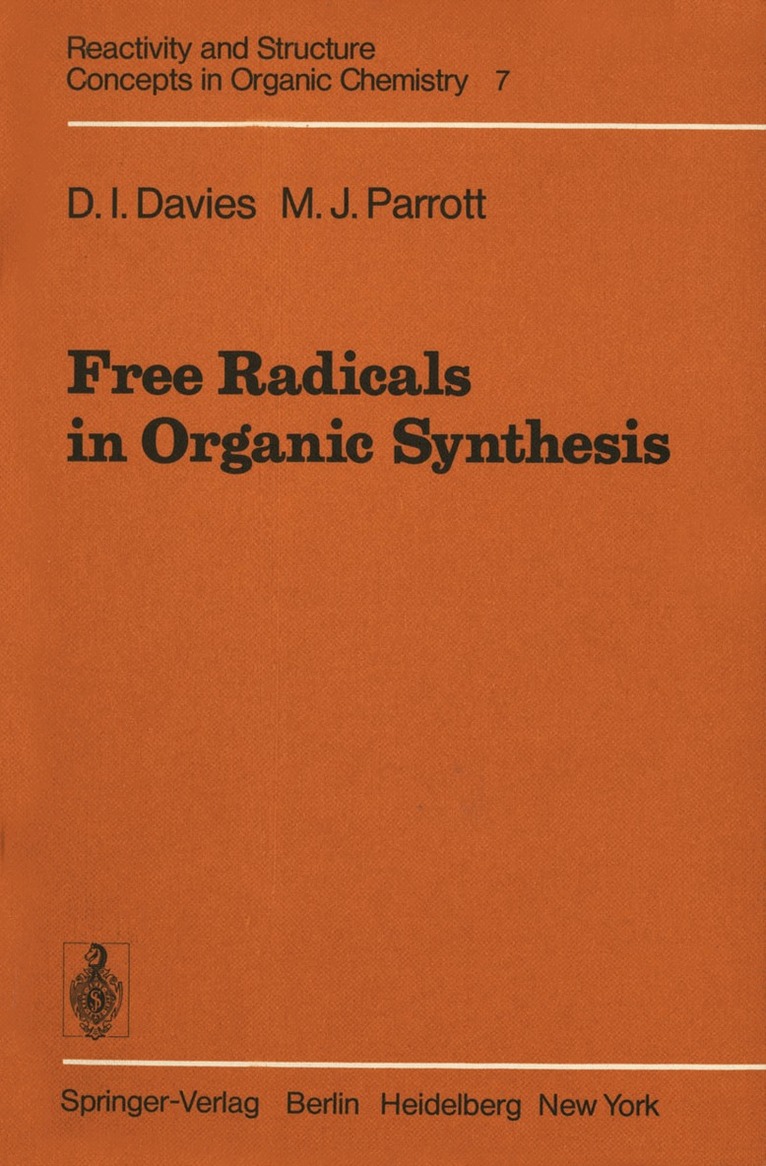
    Free Radicals in Organic Synthesis

    AvD. I. Davies,M. J. Parrott

    Häftad, Engelska, 2011

    Del 7 i serien Reactivity and Structure: Concepts in Organic Chemistry

    1 086 kr

    Beställningsvara. Skickas inom 10-15 vardagar. Fri frakt över 249 kr.

    Beskrivning

    Free Radical Chemistry has a comparatively long history. Before the accep- tance of the quadrivalence of carbon, various attempts were made to prepare trivalent carbon species like methyl and ethyl. Initial investigations involving reaction between alkyl iodides and zinc were thought to be successful \ but were subsequently branded as failures 2. In fact free methyl and ethyl were transient radicals involved in the reactions, but because of their short lifetimes the radicals were not detected, and only the hydrocarbons formed by dimeri- th sation of the radicals were isolated. At the beginning of the 20 century Gom- berg discovered the stable triarylmethyl radicals 3, and then in the 1920's Pa- neth 4 showed that free alkyl radicals could have a short lifetime in the gas phase. Free radicals as intermediates in reactions in solution were largely un- recognised until in 1937 Hey and Waters 5 interpreted a number of reactions, which did not fit into the then developing electronic theory of Organic Chem- istry6,7, by suggesting that they involved the intermediacy of free radicals.The other contemporary pioneer Kharasch 8 also proposed free radicals as interme- diates in certain reactions in solution, many involving organometallic species. However in the 1930 - 1950 period free radicals were not universally accepted as respectable reaction intermediates as evidenced by the initial rejection of the work of Koelsch 9 and the stand against free radicals made by Hodgson 10.

    Produktinformation

    • Utgivningsdatum:2011-12-09
    • Mått:170 x 244 x 11 mm
    • Vikt:335 g
    • Format:Häftad
    • Språk:Engelska
    • Serie:Reactivity and Structure: Concepts in Organic Chemistry
    • Antal sidor:172
    • Förlag:Springer-Verlag Berlin and Heidelberg GmbH & Co. KG
    • ISBN:9783642669248

    Utforska kategorier

    • Organisk kemi inom Naturvetenskap och teknik

    Innehållsförteckning

    • 1. Free Radical Reactions.- 1.1 Introductory Survey.- 1.2 Formation of Radicals.- 1.3 Radical-Radical Reactions.- 1.4 Addition Reactions.- 1.5 Substitution.- 1.6 Fragmentation.- 1.7 Rearrangement.- 1.8 Oxidation.- References.- 2. Alkanes and Alkenes.- References.- 3. Aromatic, Heteroaromatic, and Fluoroaromatic Compounds.- References.- 4. Halogen Compounds.- References.- 5. Alcohols.- References.- 6. Ethers, Peroxides, and Hydroperoxides.- References.- 7. Aldehydes and Ketones.- References.- 8. Carboxylic Acids and Their Derivatives.- References.- 9. Nitrogen-containing Compounds.- References.- 10. Sulfur-containing Compounds.- References.- 11. Organometallic Compounds.- References.- 12. Stable Free Radicals.- References.- 13. Naturally Occurring and Related Compounds.- References.- Author Index.