• Fri frakt över 249 kr
  • •
  • Snabba leveranser
  • •
  • Billiga böcker
Kundservice

Du är på sajten för privatpersoner.

Företag, bibliotek eller offentlig verksamhet?

Du handlar på classic.bokus.com, där alla dina funktioner finns intakta.
Till classic.bokus.com
Bokus logotyp. Gå till startsidan.
  • Erbjudanden
  • Nyheter
  • Student
  • Topplistor
  • Barn & ungdom
  • Bokus Play
  • E-böcker
  • Pocketböcker
  • Spel & pussel

10% rabatt på allt med kod NYSTART10 →

Sidfot

Mina sidor

    Hjälp

    • Kundservice
    • Vanliga frågor och svar
    • Frakt och leverans
    • Retur vid ångerrätt
    • Reklamera vara
    • Betalning
    • Köpvillkor
    • Allmänna villkor
    • Information om webbplatsens tillgänglighet

    Om Bokus

    • Om oss
    • Pressrum
    • För studenter
    • För företag
    • För bibliotek och offentlig verksamhet
    • För leverantörer
    • Hållbarhet

    Populärt

    • Aktuella erbjudanden
    • Presentkort
    • Studentlitteratur
    • Nya böcker
    • Topplistor
    • Signerade böcker
    • Engelska böcker

    Inspiration

    • Boktips
    • BookTok
    • Populära bokserier
    • Barnbokskaraktärer
    • Populära författare
    Logotyp för Bokus
    Följ oss på Facebook (extern länk)Följ oss på Instagram (extern länk)Följ oss på YouTube (extern länk)Följ oss på TikTok (extern länk)
    bokus @ CookiesAnpassa cookiesIntegritetspolicyKöpvillkor
    Till Citymail hemsida (extern länk)Till Budbee hemsida (extern länk)Till Postnord hemsida (extern länk)Till Schenker hemsida (extern länk)Till Early Bird hemsida (extern länk)Till Walleys hemsida (extern länk)
    1. Naturvetenskap och teknik
    2. Matematik och naturvetenskap
    3. Fysik
    4. Materietillstånd

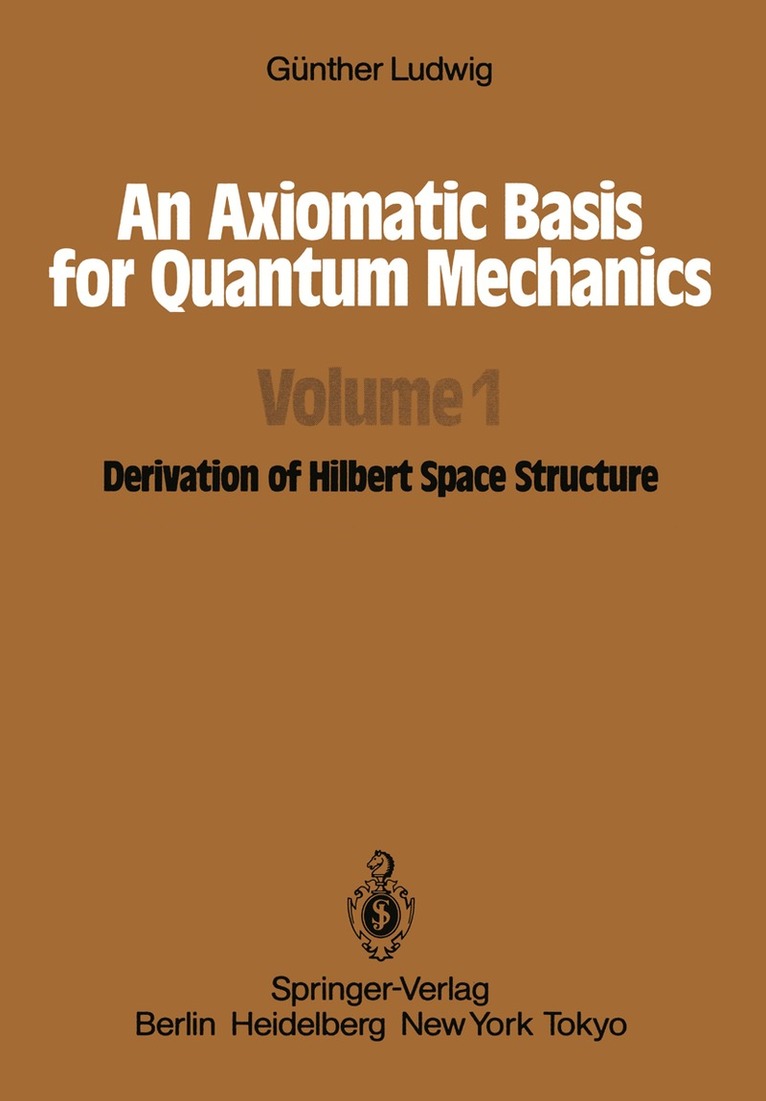
    Axiomatic Basis for Quantum Mechanics

    Volume 1 Derivation of Hilbert Space Structure

    AvG. Ludwig

    Häftad, Engelska, 2011

    546 kr

    Beställningsvara. Skickas inom 10-15 vardagar. Fri frakt över 249 kr.

    Fler format och utgåvor

    E-bok

    710 kr

    Beskrivning

    This book is the first volume of a two-volume work, which is an improved version of a preprint [47] published in German. We seek to deduce the funda­ mental concepts of quantum mechanics solely from a description of macroscopic devices. The microscopic systems such as electrons, atoms, etc. must be detected on the basis of the macroscopic behavior of the devices. This detection resembles the detection of the dinosaurs on the basis offossils. In this first volume we develop a general description of macroscopic systems by trajectories in state spaces. This general description is a basis for the special de­ scription of devices consisting of two parts, where the first part is acting on the second. The microsystems are discovered as systems transmitting the action. Axioms which describe general empirical structures of the interactions between the two parts of each device, give rise to a derivation of the Hilbert space structure of quantum mechanics. Possibly, these axioms (and consequently the Hilbert space structure) may fail to describe other realms than the structure of atoms and mole­ cules, for instance the "elementary particles". This book supplements ref. [2]. Both together not only give an extensive foundation of quantum mechanics but also a solution in principle of the measuring problem.

    Produktinformation

    • Utgivningsdatum:2011-11-17
    • Mått:170 x 244 x 15 mm
    • Vikt:455 g
    • Format:Häftad
    • Språk:Engelska
    • Antal sidor:246
    • Förlag:Springer-Verlag Berlin and Heidelberg GmbH & Co. KG
    • ISBN:9783642700316
    • Översättare:L.F. Boron, L. F. Boron

    Utforska kategorier

    • Materietillstånd inom Naturvetenskap och teknik
    • Kvantfysik inom Naturvetenskap och teknik
    • Maskinteknik och material inom Naturvetenskap och teknik

    Innehållsförteckning

    • I The Problem of Formulating an Axiomatics for Quantum Mechanics.- § 1 Is There an Axiomatic Basis for Quantum Mechanics?.- § 2 Concepts Unsuitable in a Basis for Quantum Mechanics.- § 3 Experimental Situations Describable Solely by Pretheories.- § 4 Mathematical Problems.- § 5 Progress to More Comprehensive Theories.- II Pretheories for Quantum Mechanics.- § 1 State Space and Trajectory Space.- § 2 Preparation and Registration Procedures.- § 3 Trajectory Preparation and Registration Procedures.- § 4 Transformations of Preparation and Registration Procedures.- § 5 The Macrosystems as Physical Objects.- III Base Sets and Fundamental Structure Terms for a Theory of Microsystems.- § 1 Composite Macrosystems.- § 2 Preparation and Registration Procedures for Composite Macrosystems.- § 3 Directed Interactions.- § 4 Action Carriers.- § 5 Ensembles and Effects.- § 6 Objectivating Method of Describing Experiments.- § 7 Transport of Systems Relative to Each Other.- IV Embedding of Ensembles and Effect Sets in Topological Vector Spaces.- § 1 Embedding of K, L in a Dual Pair of Vector Spaces.- § 2 Uniform Structures of the Physical Imprecision on K and L.- § 3 Embedding of K and L in Topologically Complete Vector Spaces.- § 4 ?, ?’, D, D’ Considered as Ordered Vector Spaces.- § 5 The Faces of K and L.- § 6 Some Convergence Theorems.- V Observables and Preparators.- § 1 Coexistent Effects and Observables.- § 4 Coexistent and Complementary Observables.- § 5 Realization of Observables.- § 6 Coexistent De-mixing of Ensembles.- § 7 Complementary De-mixings of Ensembles.- § 8 Realizations of De-mixings.- § 9 Preparators and Faces of K.- § 10 Physical Objects as Action Carriers.- § 11 Operations and Transpreparators.- VI Main Laws of Preparation andRegistration.- § 1 Main Laws for the Increase in Sensitivity of Registrations.- § 2 Relations Between Preparation and Registration Procedures.- § 3 The Lattice G.- § 4 Commensurable Decision Effects.- § 5 The Orthomodularity of G.- § 6 The Main Law for Not Coexistent Registrations.- § 7 The Main Law of Quantization.- VII Decision Observables and the Center.- § 1 The Commutator of a Set of Decision Effects.- § 2 Decision Observables.- § 3 Structures in That Class of Observables Whose Range also Contains Elements of G.- § 4 Commensurable Decision Observables.- § 5 Decomposition of ? and ?’ Relative to the Center Z.- § 6 System Types and Super Selection Rules.- VIII Representation of ?, ?’ by Banach Spaces of Operators in a Hilbert Space.- § 1 The Finite Elements of G.- § 2 The General Representation Theorem for Irreducible G.- § 3 Some Topological Properties of G.- § 4 The Representation Theorem for K, L.- § 5 Some Theorems for Finite-dimensional and Irreducible ?.- A II Banach Lattices.- A III The Axiom AVid and the Minimal Decomposition Property.- A IV The Bishop-Phelps Theorem and the Ellis Theorem.- List of Frequently Used Symbols.- List of Axioms.