• Fri frakt över 249 kr
  • •
  • Snabba leveranser
  • •
  • Billiga böcker
Kundservice

Du är på sajten för privatpersoner.

Företag, bibliotek eller offentlig verksamhet?

Du handlar på classic.bokus.com, där alla dina funktioner finns intakta.
Till classic.bokus.com
Bokus logotyp. Gå till startsidan.
  • Erbjudanden
  • Nyheter
  • Student
  • Topplistor
  • Barn & ungdom
  • Bokus Play
  • E-böcker
  • Pocketböcker
  • Spel & pussel

10% rabatt på allt med kod NYSTART10 →

Sidfot

Mina sidor

    Hjälp

    • Kundservice
    • Vanliga frågor och svar
    • Frakt och leverans
    • Retur vid ångerrätt
    • Reklamera vara
    • Betalning
    • Köpvillkor
    • Allmänna villkor
    • Information om webbplatsens tillgänglighet

    Om Bokus

    • Om oss
    • Pressrum
    • För studenter
    • För företag
    • För bibliotek och offentlig verksamhet
    • För leverantörer
    • Hållbarhet

    Populärt

    • Aktuella erbjudanden
    • Presentkort
    • Studentlitteratur
    • Nya böcker
    • Topplistor
    • Signerade böcker
    • Engelska böcker

    Inspiration

    • Boktips
    • BookTok
    • Populära bokserier
    • Barnbokskaraktärer
    • Populära författare
    Logotyp för Bokus
    Följ oss på Facebook (extern länk)Följ oss på Instagram (extern länk)Följ oss på YouTube (extern länk)Följ oss på TikTok (extern länk)
    bokus @ CookiesAnpassa cookiesIntegritetspolicyKöpvillkor
    Till Citymail hemsida (extern länk)Till Budbee hemsida (extern länk)Till Postnord hemsida (extern länk)Till Schenker hemsida (extern länk)Till Early Bird hemsida (extern länk)Till Walleys hemsida (extern länk)
    1. Medicin
    2. Andra medicinska specialiteter
    3. Psykiatri

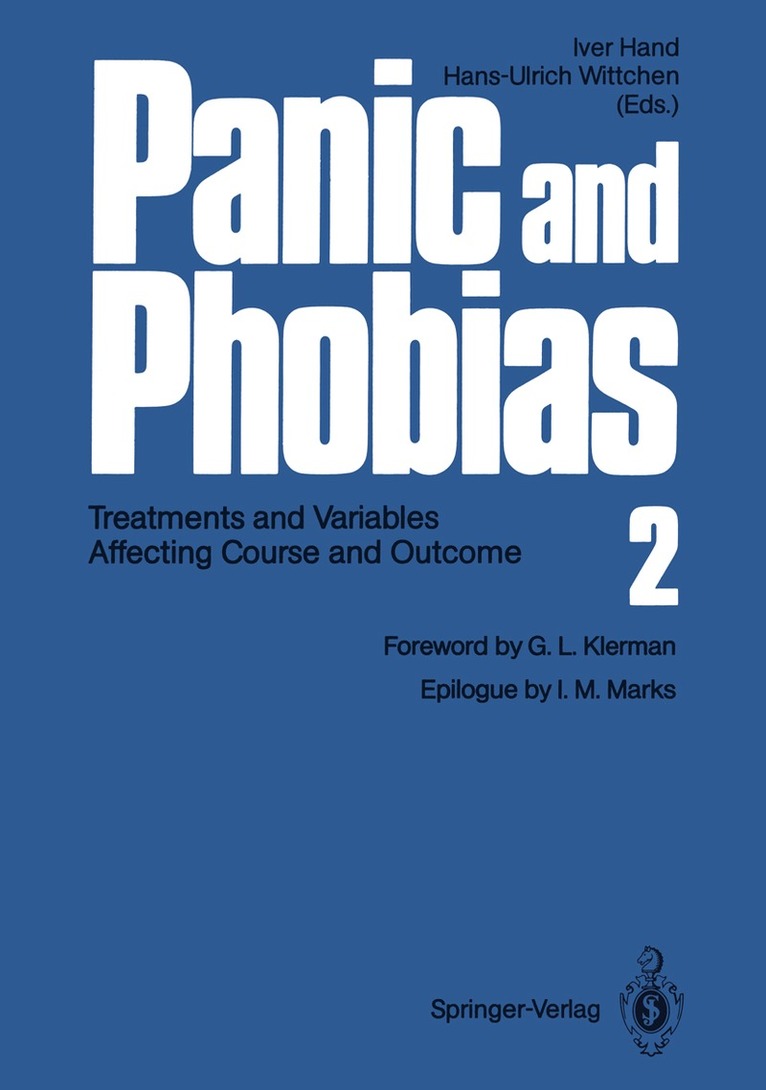
    Panic and Phobias 2

    Treatments and Variables Affecting Course and Outcome

    AvIver Hand,Hans-Ulrich Wittchen

    Häftad, Engelska, 2011

    1 117 kr

    Beställningsvara. Skickas inom 10-15 vardagar. Fri frakt över 249 kr.

    Beskrivning

    Behavioral and biological research in behavioral techniques were developed recent years have produced partially con- already in the early 1970s (Hand et al. tradictory treatment results and recom- 1974) and have proved extremely success- mendations for phobias with and without ful in long-term follow-ups (Hand et al. 1986). The occurrence of panic attacks panic attacks, for panic disorder, and for anxiety disorders in a broader sense. independent of phobic trigger situations The new classification of anxiety disor- is almost never mentioned as an obstacle to the effective behavioral therapy of ders in both DSM-III (1980) and its revision DSM-IIIR (1987), which gives phobias. panic attacks a key role with regard to Until very recently, professional interac- etiology, differential diagnoses, and treat- tion and mutual evaluation regarding ment has not only stimulated research in these contradictory views and results have this field but has also provoked growing been almost non-existent. Together with controversy among clinicians and resear- European and American colleagues, we chers.Biologically oriented authors have addressed these questions in a previous interpreted anxiety disorders with panic volume, examining in more detail the attacks as "endogenous" disorders linked epidemiological, psychopathological, and to depression, claiming pharmacological experimental evidence for each of these treatments to be the essential interven- positions (Hand and Wittchen 1986).

    Produktinformation

    • Utgivningsdatum:2011-12-16
    • Mått:170 x 244 x 17 mm
    • Vikt:522 g
    • Format:Häftad
    • Språk:Engelska
    • Antal sidor:275
    • Förlag:Springer-Verlag Berlin and Heidelberg GmbH & Co. KG
    • Medarbetare:G.L. Klerman
    • ISBN:9783642735455

    Utforska kategorier

    • Psykiatri inom Medicin
    • Psykologi inom Psykologi och pedagogik
    • Psykoterapi som behandlingsmetod inom Medicin

    Innehållsförteckning

    • I: Psychological or Biological Treatments of Panic and Phobias: Current State of the Controversy.- 1. Natural Course and Spontaneous Remissions of Untreated Anxiety Disorders: Results of the Munich Follow-up Study (MFS).- 2. Biology and Pharmacological Treatment of Panic Disorder.- 3. The Mutually Potentiating Effects of Imipramine and Exposure in Agoraphobia.- II: Pharmacological, Cognitive, and Behavioral Treatment of Panic and Phobias: Current State of Research.- 4. Effects of Discontinuation of Antipanic Medication.- 5. Comparison of Alprazolam and Cognitive Behavior Therapy in the Treatment of Panic Disorder: A Preliminary Report.- 6. Cognitive-Behavioral Treatment of Panic.- 7. Cognitive Factors in the Treatment of Anxiety States.- 8. Long-Term Efficacy of Ungraded Versus Graded Massed Exposure in Agoraphobia.- 9. Exposure Treatment of Agoraphobia with Panic Attacks: Are Drugs Essential?.- III: Specific Variables Affecting Mode of Treatment: Experimental Studies on Physiology and Cognition.- 10. Panic Attacks in Nonclinical Subjects.- 11. Panic, Perception, and pCO2.- 12. Selective Information Processing, Interoception, and Panic Attacks.- 13. Tests of a Cognitive Theory of Panic.- 14. What Cognitions Differentiate Panic Disorder from Other Anxiety Disorders?.- 15. Factors Relevant to Lactate Response in Panic Disorder.- 16. Do Anxiety Patients Differ in Autonomic Base Levels and Stress Response from Normal Controls?.- 17. Comorbidity of Panic Disorder and Major Depression: Results from a Family Study.- 18. Anxiety and Sensitization: A Neuropsychological Approach.- IV: Specific Variables Affecting Treatment Outcome of Anxiety Disorders: Clinical, Psychosocial, and Interactional Factors.- 19. Failures in Exposure Treatment of Agoraphobia: Evaluation and Prediction.- 20. Prediction of Outcome Following In Vivo Exposure Treatment of Agoraphobia.- 21. Intra- and Interpersonal Characteristics Predictive of Long-Term Outcome Following Behavioral Treatment of Obsessive-Compulsive Disorders.- 22. Martial Quality and Treatment Outcome in Anxiety Disorders.- 23. Patterns of Patient-Spouse Interaction in Agoraphobics: Assessment by Camberwell Family Interview (CFI) and Impact on Outcome of Self-Exposure Treatment.- Epilogue:.- Overview: Towards Integration in Panic and Phobias.