• Fri frakt över 249 kr
  • •
  • Snabba leveranser
  • •
  • Billiga böcker
Kundservice

Du är på sajten för privatpersoner.

Företag, bibliotek eller offentlig verksamhet?

Du handlar på classic.bokus.com, där alla dina funktioner finns intakta.
Till classic.bokus.com
Bokus logotyp. Gå till startsidan.
  • Erbjudanden
  • Nyheter
  • Student
  • Topplistor
  • Barn & ungdom
  • Bokus Play
  • E-böcker
  • Pocketböcker
  • Spel & pussel

10% rabatt på allt med kod: NYSTART10 →

Sidfot

Mina sidor

    Hjälp

    • Kundservice
    • Vanliga frågor och svar
    • Frakt och leverans
    • Retur vid ångerrätt
    • Reklamera vara
    • Betalning
    • Köpvillkor
    • Allmänna villkor
    • Information om webbplatsens tillgänglighet

    Om Bokus

    • Om oss
    • Pressrum
    • För studenter
    • För företag
    • För bibliotek och offentlig verksamhet
    • För leverantörer
    • Hållbarhet

    Populärt

    • Aktuella erbjudanden
    • Presentkort
    • Studentlitteratur
    • Nya böcker
    • Topplistor
    • Signerade böcker
    • Engelska böcker

    Inspiration

    • Boktips
    • BookTok
    • Populära bokserier
    • Barnbokskaraktärer
    • Populära författare
    Logotyp för Bokus
    Följ oss på Facebook (extern länk)Följ oss på Instagram (extern länk)Följ oss på YouTube (extern länk)Följ oss på TikTok (extern länk)
    bokus @ CookiesAnpassa cookiesIntegritetspolicyKöpvillkor
    Till Citymail hemsida (extern länk)Till Budbee hemsida (extern länk)Till Postnord hemsida (extern länk)Till Schenker hemsida (extern länk)Till Early Bird hemsida (extern länk)Till Walleys hemsida (extern länk)
    1. Naturvetenskap och teknik
    2. Matematik och naturvetenskap
    3. Kemi
    4. Analytisk kemi

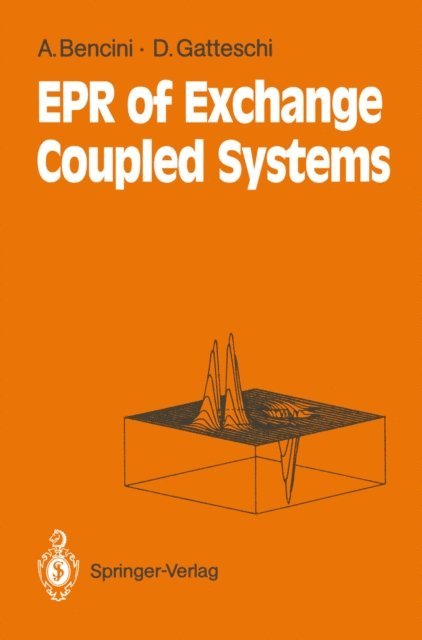
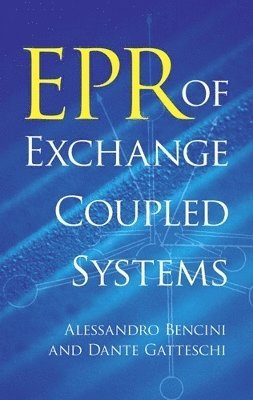
    Electron Paramagnetic Resonance of Exchange Coupled Systems

    AvAlessandro Bencini,Dante Gatteschi

    Häftad, Engelska, 2011

    547 kr

    Beställningsvara. Skickas inom 10-15 vardagar. Fri frakt över 249 kr.

    Beskrivning

    This book is intended to collect in one place as much information as possible on the use of EPR spectroscopy in the analysis of systems in which two or more spins are magnetically coupled. This is a field where research is very active and chemists are elbow-to-elbow with physicists and biologists in the forefront. Here, as in many other fields, the contributions coming from different disciplines are very important, but for active researchers it is sometimes difficult to follow the literature, due to differences in languages, and sources which are familiar to, e. g. , a physicist, are exotic to a chemist. Therefore, an effort is needed in order to provide a unitary description of the many different phenomena which are collected under the title. In order to define the arguments which are treated, it is useful to state clearly what is not contained here. So we do not treat magnetic phenomena in conductors and we neglect ferro- and antiferromagnetic resonance. The basic foundations of EPR spectroscopy are supposed to be known by the reader, while we introduce the basis of magnetic interactions between spins. In the first two chapters we review the foundations of exchange interactions, trying to show how the magnetic parameters are bound to the electronic structure of the interacting centers.

    Produktinformation

    • Utgivningsdatum:2011-12-16
    • Mått:155 x 235 x 17 mm
    • Vikt:464 g
    • Format:Häftad
    • Språk:Engelska
    • Antal sidor:287
    • Förlag:Springer-Verlag Berlin and Heidelberg GmbH & Co. KG
    • ISBN:9783642746017

    Utforska kategorier

    • Analytisk kemi inom Naturvetenskap och teknik
    • Fysikalisk kemi inom Naturvetenskap och teknik
    • Oorganisk kemi inom Naturvetenskap och teknik

    Innehållsförteckning

    • 1 Exchange and Superexchange.- 1.1 The Exchange Interaction.- 1.2 Anderson’s Theory.- 1.3 Molecular Orbital Exchange Models.- 1.4 Quantitative MO Calculations of Singlet-Triplet Splitting.- 2 Spin Hamiltonians.- 2.1 The Spin Hamiltonian Approach.- 2.2 The Magnetic Spin-Spin Interaction.- 2.3 The Exchange Contribution.- 2.4 Biquadratic Terms.- 2.5 Justification of the Spin Hamiltonian Formalism.- 2.6 Exchange Involving Degenerate States.- 2.7 Exchange in Mixed Valence Species.- 3 Spectra of Pairs.- 3.1 The Spin Hamiltonian for Interacting Pairs.- 3.2 Spin Levels in the Strong Exchange Limit.- 3.3 Spectra of Pairs in the Strong Exchange Limit.- 3.4 Spin Levels in the Weak Exchange Limit.- 3.5 Spectra of Pairs in the Weak Exchange Limit.- 3.6 Intermediate Exchange.- 4 Spectra of Clusters.- 4.1 The Spin Hamiltonian for Oligonuclear Systems of Interacting Spins.- 4.2 Spin Levels of Exchange Coupled Clusters in the Strong Exchange Limit.- 4.3 EPR Spectra of Exchange Coupled Clusters in the Strong Exchange Limit.- 5 Relaxation in Oligonuclear Species.- 5.1 Introduction.- 5.2 Theoretical Basis of Spin Relaxation in Pairs.- 5.3 Iridium (IV) Pairs.- 5.4 Copper Pairs.- 5.5 Two-Iron-Two-Sulfur Ferredoxins.- 5.6 Relaxation in Larger Clusters.- 6 Spectra in Extended Lattices.- 6.1 Exchange and Dipolar Interactions in Solids.- 6.2 Exchange Narrowing.- 6.3 Additional Broadening Mechanisms.- 6.4 Exchange Narrowing in Lower Dimensional Systems.- 7 Selected Examples of Spectra of Pairs.- 7.1 Early Transition Metal Ion Pairs.- 7.2 Copper Pairs.- 7.3 Heterometallic Pairs.- 7.4 Organic Biradicals.- 8 Coupled Transition-Metal Ions-Organic Radicals.- 8.1 Introduction.- 8.2 Nitroxides Directly Bound to Metal Ions.- 8.3 Weak Exchange with Nitroxides.- 8.4 Semiquinones.- 9 Biological Systems.-9.1 Introduction.- 9.2 Copper Proteins.- 9.3 Iron Proteins.- 9.4 Exchange-Coupled Species in the Photosynthetic O2-Evolving Complexes.- 10 Low Dimensional Materials.- 10.1 Linear Chain Manganese(II).- 10.2 Linear Chain Copper(II).- 10.3 Two-Dimensional Manganese(II).- 10.4 Two-Dimensional Copper(II).- 11 Excitons.- 11.1 Introduction.- 11.2 Excitons.- 11.3 EPR of Triplet Excitons in Linear Organic Radical Systems.- Appendix A. Second Quantization.- Appendix B. Properties of Angular Momentum Operators and Elements of Irreducible Tensor Algebra..- B.1 Properties of Angular Momentum Operators.- B.2 Addition of Two Angular Momenta. Clebsch-Gordon Coefficients and “3j” Symbols.- B.2.1 Definitions.- B.2.1.1 Equivalent Definitions.- B.2.1.2 Phase Convention and Properties.- B.2.1.3 The “3J” Symbols.- B.2.2 Methods of Calculations.- B.2.2.1 Special Formulae.- B.3 The “6j” Symbols and the Racah W Coefficients.- B.3.1 Definitions.- B.3.2 Properties.- B.3.3 Methods of Calculation.- B.3.3.1 Special Formulae.- B.4 The “9j” Symbols.- B.4.1 Definition.- B.4.2 Properties.- B.4.3 Special Formulae.- B.5. Irreducible Tensor Operators.- B.5.1 Definitions.- B.5.1.1 Compound Irreducible Tensor Operators.- B.5.1.2 Tensor Product of Two First-Rank Irreducible Tensor Operators.- B.5.2 Properties of Irreducible Tensor Operators.- B.5.3 Reduced Matrix Elements of Special Operators.