• Fri frakt över 249 kr
  • •
  • Snabba leveranser
  • •
  • Billiga böcker
Kundservice

Du är på sajten för privatpersoner.

Företag, bibliotek eller offentlig verksamhet?

Du handlar på classic.bokus.com, där alla dina funktioner finns intakta.
Till classic.bokus.com
Bokus logotyp. Gå till startsidan.
  • Erbjudanden
  • Nyheter
  • Student
  • Topplistor
  • Barn & ungdom
  • Bokus Play
  • E-böcker
  • Pocketböcker
  • Spel & pussel

10% rabatt på allt med kod NYSTART10 →

Sidfot

Mina sidor

    Hjälp

    • Kundservice
    • Vanliga frågor och svar
    • Frakt och leverans
    • Retur vid ångerrätt
    • Reklamera vara
    • Betalning
    • Köpvillkor
    • Allmänna villkor
    • Information om webbplatsens tillgänglighet

    Om Bokus

    • Om oss
    • Pressrum
    • För studenter
    • För företag
    • För bibliotek och offentlig verksamhet
    • För leverantörer
    • Hållbarhet

    Populärt

    • Aktuella erbjudanden
    • Presentkort
    • Studentlitteratur
    • Nya böcker
    • Topplistor
    • Signerade böcker
    • Engelska böcker

    Inspiration

    • Boktips
    • BookTok
    • Populära bokserier
    • Barnbokskaraktärer
    • Populära författare
    Logotyp för Bokus
    Följ oss på Facebook (extern länk)Följ oss på Instagram (extern länk)Följ oss på YouTube (extern länk)Följ oss på TikTok (extern länk)
    bokus @ CookiesAnpassa cookiesIntegritetspolicyKöpvillkor
    Till Citymail hemsida (extern länk)Till Budbee hemsida (extern länk)Till Postnord hemsida (extern länk)Till Schenker hemsida (extern länk)Till Early Bird hemsida (extern länk)Till Walleys hemsida (extern länk)
    1. Naturvetenskap och teknik
    2. Matematik och naturvetenskap
    3. Fysik
    4. Klassisk mekanik

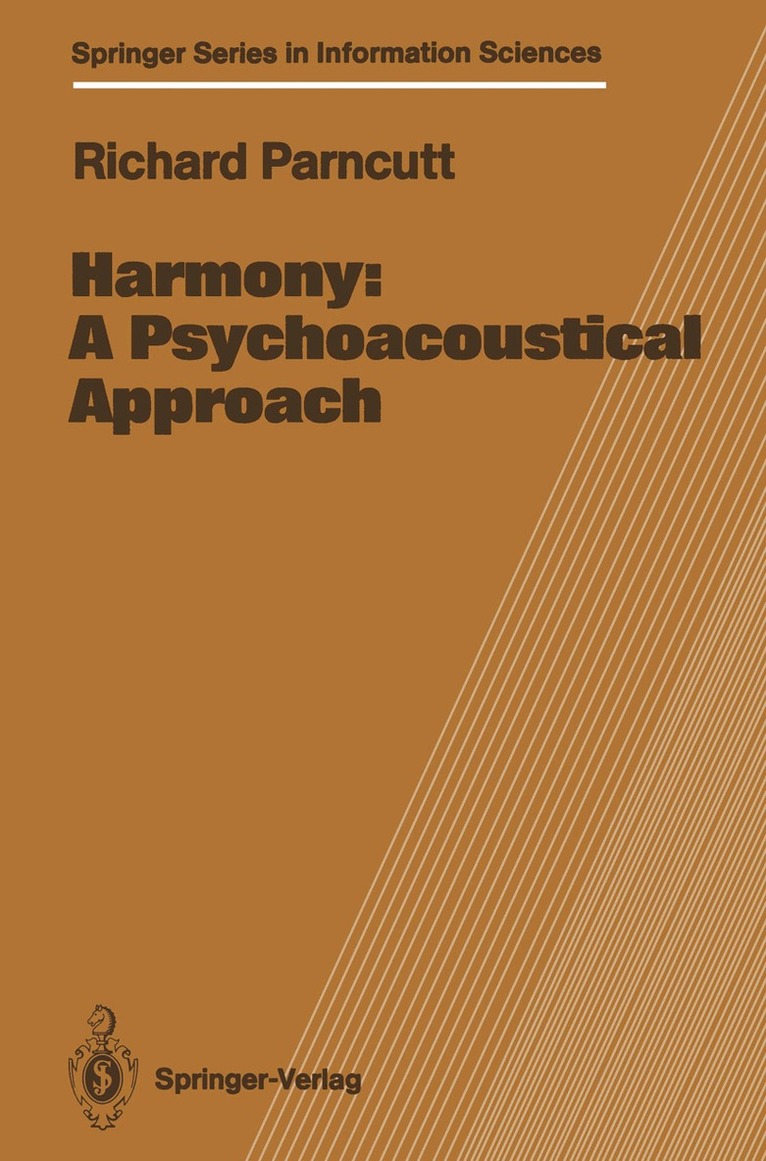
    Harmony: A Psychoacoustical Approach

    AvRichard Parncutt

    Häftad, Engelska, 2011

    Del 19 i serien Springer Series in Information Sciences

    1 408 kr

    Beställningsvara. Skickas inom 10-15 vardagar. Fri frakt över 249 kr.

    Fler format och utgåvor

    E-bok

    1 728 kr

    Beskrivning

    My first encounter with the theory of harmony was during my last year at school (1975). This fascinating system of rules crystallized the intuitive knowledge of harmony I had acquired from years of piano playing, and facilitated memorization, transcription, arrangement and composition. For the next five years, I studied music (piano) and science (Physics) at the Univer­ sity of Melbourne. This "strange combination" started me wondering about the origins of those music theory "rules". To what extent were they determined or influenced by physics? mathematics? physiology? conditioning? In 1981, the supervisor of my honours project in musical acoustics, Neville Fletcher, showed me an article entitled "Pitch, consonance, and harmony", by a certain Ernst Terhardt of the Technical University of Munich. By that stage, I had devoured a considerable amount of (largely unsatisfactory) material on the nature and origins of harmony, which enabled me to recognize the significance of Terhardt's article. But it was not until I arrived in Munich the following year (on Terhardt's invitation) that I began to appreciate the conse­ quences of his "psychoacoustical" approach for the theory of harmony. That is what this book is about. The book presents Terhardt's work against the broad context of music perception research, past and present. Music perception is a multidisciplinary mixture of physics, psychology and music. Where different theoretical ap­ proaches appear contradictory, I try to show instead that they complement and enrich one another.

    Produktinformation

    • Utgivningsdatum:2011-12-13
    • Mått:155 x 235 x 13 mm
    • Vikt:347 g
    • Format:Häftad
    • Språk:Engelska
    • Serie:Springer Series in Information Sciences
    • Antal sidor:212
    • Förlag:Springer-Verlag Berlin and Heidelberg GmbH & Co. KG
    • ISBN:9783642748332

    Utforska kategorier

    • Klassisk mekanik inom Naturvetenskap och teknik

    Innehållsförteckning

    • 1. Background.- 1.1 Music Theory.- 1.2 Physically Based Theories.- 1.3 Psychologically Based Theories.- 1.4 Towards a Psychophysical Theory.- 2. Psychoacoustics.- 2.1 Philosophy of Perception.- 2.2 Auditory Sensation.- 2.3 Extraction of Information.- 2.4 Tone Sensation.- 2.5 Pitch Perception.- 3. Psychomusicology.- 3.1 Conditioning.- 3.2 Consonance.- 3.3 Musical Pitch.- 3.4 Tonality.- 4. Model.- 4.1 General Aspects.- 4.2 Input.- 4.3 Masking and Audibility.- 4.4 Recognition of Harmonic Pitch Patterns.- 4.5 Salience.- 4.6 Sequential Pitch Relationship.- 5. Experiments.- 5.1 General Method.- 5.2 Multiplicity.- 5.3 Pitch Analysis.- 5.4 Similarity of Piano Tones.- 5.5 Similarity of Synthetic Tones I.- 5.6 Similarity of Synthetic Tones II.- 5.7 Similarity of Chords.- 5.8 Discussion.- 6. Applications.- 6.1 Simultaneities.- 6.2 Progression.- 6.3 Pieces.- Glossary of Symbols.- References.