• Fri frakt över 249 kr
  • •
  • Snabba leveranser
  • •
  • Billiga böcker
Kundservice

Du är på sajten för privatpersoner.

Företag, bibliotek eller offentlig verksamhet?

Du handlar på classic.bokus.com, där alla dina funktioner finns intakta.
Till classic.bokus.com
Bokus logotyp. Gå till startsidan.
  • Erbjudanden
  • Student
  • Topplistor
  • Barn & ungdom
  • Bokus Play
  • E-böcker
  • Ljudböcker
  • Pocketböcker
  • Spel och pussel

Pocketfynda! Hundratals böcker för 49 kr/st →

Sidfot

Mina sidor

    Hjälp

    • Kundservice
    • Vanliga frågor och svar
    • Frakt och leverans
    • Retur vid ångerrätt
    • Reklamera vara
    • Betalning
    • Köpvillkor
    • Allmänna villkor
    • Information om webbplatsens tillgänglighet

    Om Bokus

    • Om oss
    • Pressrum
    • För studenter
    • För företag
    • För bibliotek och offentlig verksamhet
    • För leverantörer
    • Hållbarhet

    Populärt

    • Aktuella erbjudanden
    • Presentkort
    • Studentlitteratur
    • Nya böcker
    • Topplistor
    • Signerade böcker
    • Engelska böcker

    Inspiration

    • Boktips
    • BookTok
    • Barnbokskaraktärer
    • Populära författare
    Logotyp för Bokus
    Följ oss på Facebook (extern länk)Följ oss på Instagram (extern länk)Följ oss på YouTube (extern länk)Följ oss på TikTok (extern länk)
    bokus @ CookiesAnpassa cookiesIntegritetspolicyKöpvillkor
    Till Citymail hemsida (extern länk)Till Budbee hemsida (extern länk)Till Postnord hemsida (extern länk)Till Schenker hemsida (extern länk)Till Early Bird hemsida (extern länk)Till Walleys hemsida (extern länk)
    1. Data och IT
    2. Systemvetenskap och AI

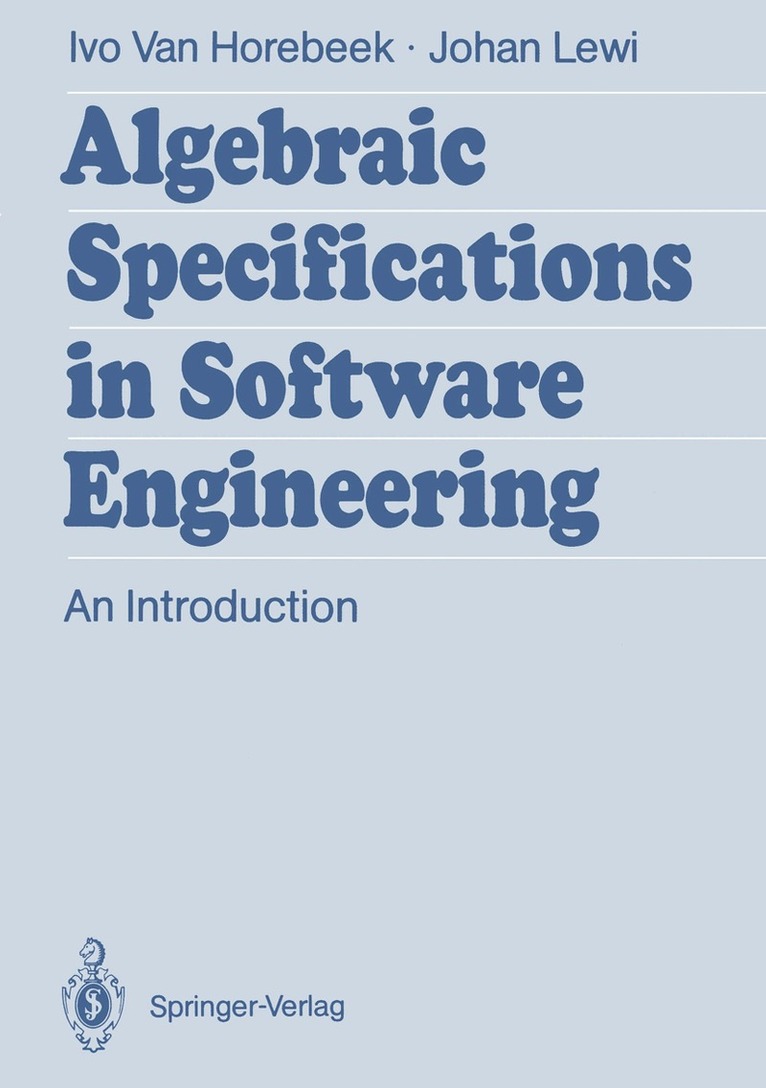
    Algebraic Specifications in Software Engineering

    An Introduction

    AvIvo Van Horebeek,Johan Lewi

    Häftad, Engelska, 2011

    559 kr

    Beställningsvara. Skickas inom 10-15 vardagar. Fri frakt över 249 kr.

    Beskrivning

    "I prefer to view formal methods as tools. the use of which might be helpful." E. W. Dijkstra Algebraic specifications are about to be accepted by industry. Many projects in which algebraic specifications have been used as a design tool have been carried out. What prevents algebraic specifications from breaking through is the absence of introductory descriptions and tools supporting the construction of algebraic specifications. On the one hand. interest from industry will stimulate people to make introductions and tools. whereas on the other hand the existence of introductions and tools will stimulate industry to use algebraic specifications. This book should be seen as a contribution towards creating this virtuous circle. The book will be of interest to software designers and programmers. It can also be used as material for an introductory course on algebraic specifications and software engineering at undergraduate or graduate level. Nowadays. there is general agreement that in large software projects appropriate specifications are a must in order to obtain quality software. Informal specifications alone are certainly not appropriate because they are incomplete. inconsistent. inaccurate and ambiguous and they rapidly become bulky and therefore useless. The only way to overcome this problem is to use formal specifications. An important remark here is that a specification formalism (language) alone is not sufficient. What is also needed is a design method to write specifications in that formalism.

    Produktinformation

    • Utgivningsdatum:2011-12-21
    • Mått:170 x 242 x 20 mm
    • Vikt:629 g
    • Format:Häftad
    • Språk:Engelska
    • Antal sidor:350
    • Förlag:Springer-Verlag Berlin and Heidelberg GmbH & Co. KG
    • ISBN:9783642750328

    Utforska kategorier

    • Systemvetenskap och AI inom Data och IT
    • Programvaruutveckling inom Data och IT
    • Programmeringsböcker inom Data och IT

    Innehållsförteckning

    • 1. Introduction.- 1.1 Software Engineering.- 1.2 Software Life Cycle.- 1.3 Abstract Data Types and Specifications.- 1.4 Why Specifications ?.- 1.5 Why Formal Specifications ?.- 1.6 Algebraic Specifications, an Intuitive Approach.- 1.7 Survey.- 1.8 Historical Remarks on Algebraic Specifications.- 2. Abstract Data Types as Initial Algebras.- 2.1 Many-Sorted Algebra, Signature and Graphical Notation.- 2.2 Homomorphism and Isomorphism.- 2.3 Variable-Free Termlanguage.- 2.4 Word Algebra.- 2.5 Signature, Variety and Termalgebra.- 2.6 Signature and Initial Algebra.- 2.7 Abstract Data Types Defined by a Signature.- 2.8 Termlanguage.- 2.9 Substitution and Ground Substitution.- 2.10 Assignment.- 2.11 Axioms and Presentation.- 2.12 Presentation, Variety and Termalgebra.- 2.13 Equational Reasoning.- 2.14 Presentation and Initial Algebra.- 2.15 Abstract Data Types Defined by a Presentation.- 2.16 Examples.- 2.17 Induction.- 2.18 Hidden Operations and Sorts.- 2.19 Bibliographic Notes.- 3. An Algebraic Specif ication Language.- 3.1 Modularity.- 3.2 Hierarchical Specifications.- 3.3 Notational Extensions.- 3.4 Parameterized Specifications.- 3.5 Clusters.- 3.6 Bibliographic Notes.- 4. Constructive Specifications.- 4.1 Simple Example.- 4.2 Constructive Specifications.- 4.3 Theorems.- 4.4 Equality Operation.- 4.5 Example.- 4.6 Constructor Axioms.- 4.7 Semi-Constructive Specifications.- 4.8 Inconsistency.- 4.9 On Constructing Requirements.- 4.10 Claiming Modules.- 4.11 The Cartesian Product of Sorts.- 4.12 Constructivity and Abstraction.- 4.13 Bibliographic Notes.- 5. A Case Study: the Ferry Problem.- 5.1 Informal Description of tlie Ferry Problem.- 5.2 Formal Specification of the Ferry Problem.- 5.3 The Farmer, the Wolf, the Goat and the Cabbage.- 5.4 The Missionaries and the Cannibals.-5.5 Specification of a Search Strategy.- 5.6 Conclusion.- 6. A Case Study: the Mini-PABX.- 6.1 Object-Oriented Design Method.- 6.2 Modularity.- 6.3 The Abstract Data Type Phone.- 6.4 Error Handling.- 6.5 The Abstract Data Type Mini-PABX.- 6.6 The Scheduling of the Messages.- 6.7 Skeleton of the Mini-PABX.- 6.8 A Two-Party Voice Call.- 6.9 Enquiry Call.- 6.10 User Actions.- 6.11 Conclusion.- 7. Error Handling.- 7.1 The Need for an Error Handling System.- 7.2 Safety Functions.- 7.3 Safety and Unsafety Markers.- 7.4 Method of Error Specification.- 7.5 Safety Conditions.- 7.6 Miscellanies.- 7.7 Bibliographic Notes.- 8. Abstract Implementations.- 8.1 Example of the Stacks.- 8.2 Concepts of Abstract Implementations.- 8.3 Implementation Constraints.- 8.4 Example: Scheme of Stacks.- 8.5 Example: Scheme of Symbol Tables.- 8.6 Properties and Relations.- 8.7 Bibliographic Notes.- Conclusions.- Appendix A: Syntax.- Appendix B: Rapid Prototyping, the Mini-PABX.