• Fri frakt över 249 kr
  • •
  • Snabba leveranser
  • •
  • Billiga böcker
Kundservice

Du är på sajten för privatpersoner.

Företag, bibliotek eller offentlig verksamhet?

Du handlar på classic.bokus.com, där alla dina funktioner finns intakta.
Till classic.bokus.com
Bokus logotyp. Gå till startsidan.
  • Erbjudanden
  • Nyheter
  • Student
  • Topplistor
  • Barn & ungdom
  • Bokus Play
  • E-böcker
  • Pocketböcker
  • Spel & pussel

10% rabatt på allt med kod NYSTART10 →

Sidfot

Mina sidor

    Hjälp

    • Kundservice
    • Vanliga frågor och svar
    • Frakt och leverans
    • Retur vid ångerrätt
    • Reklamera vara
    • Betalning
    • Köpvillkor
    • Allmänna villkor
    • Information om webbplatsens tillgänglighet

    Om Bokus

    • Om oss
    • Pressrum
    • För studenter
    • För företag
    • För bibliotek och offentlig verksamhet
    • För leverantörer
    • Hållbarhet

    Populärt

    • Aktuella erbjudanden
    • Presentkort
    • Studentlitteratur
    • Nya böcker
    • Topplistor
    • Signerade böcker
    • Engelska böcker

    Inspiration

    • Boktips
    • BookTok
    • Populära bokserier
    • Barnbokskaraktärer
    • Populära författare
    Logotyp för Bokus
    Följ oss på Facebook (extern länk)Följ oss på Instagram (extern länk)Följ oss på YouTube (extern länk)Följ oss på TikTok (extern länk)
    bokus @ CookiesAnpassa cookiesIntegritetspolicyKöpvillkor
    Till Citymail hemsida (extern länk)Till Budbee hemsida (extern länk)Till Postnord hemsida (extern länk)Till Schenker hemsida (extern länk)Till Early Bird hemsida (extern länk)Till Walleys hemsida (extern länk)
    1. Data och IT
    2. Systemvetenskap och AI

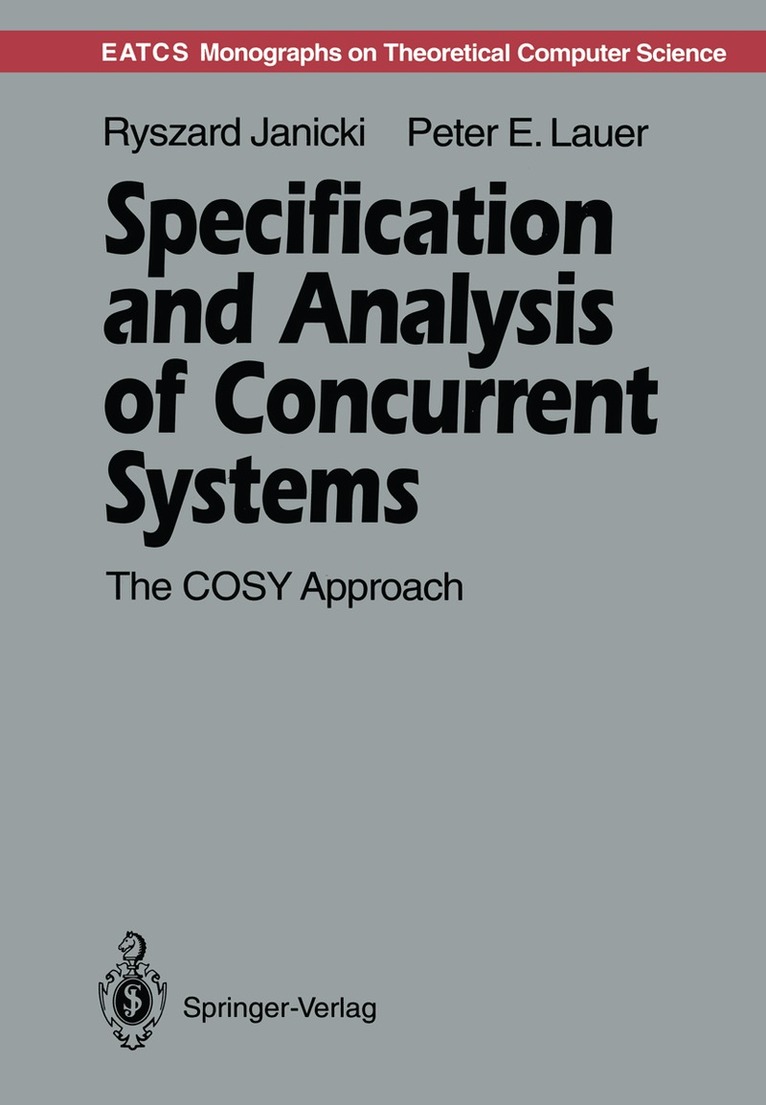
    Specification and Analysis of Concurrent Systems

    The COSY Approach

    AvRyszard Janicki,Peter E. Lauer

    Häftad, Engelska, 2011

    Del i serien Monographs in Theoretical Computer Science. An EATCS Series

    1 117 kr

    Beställningsvara. Skickas inom 10-15 vardagar. Fri frakt över 249 kr.

    Beskrivning

    Concurrent systems abound in human experience but theirfully adequate conceptualization as yet eludes our most ablethinkers. The COSY (ConcurrentSystem) notation and theorywas developed in the last decade as one of a number ofmathematical approaches for conceptualizing and analyzingconcurrent and reactive systems.The COSY approach extends theconventional notions ofgrammar and automaton from formal language and automatatheory to collections of "synchronized" grammars andautomata, permitting system specification and analysis of"true" concurrency without reduction to non-determinism.COSY theory is developed to a great level of detail andconstitutes the first uniform and self-containedpresentationof all results about COSY published in thepast, as well as including many new results.COSY theory is used to analyze a sufficient number oftypical problems involving concurrency, synchronization andscheduling, to allow the reader to apply the techniquespresented tosimilar problems.The COSY model is also related to many alternative models ofconcurrency, particularly Petri Nets, CommunicatingSequential Processes and the Calculus of CommunicatingSystems.

    Produktinformation

    • Utgivningsdatum:2011-12-29
    • Mått:170 x 242 x 27 mm
    • Vikt:847 g
    • Format:Häftad
    • Språk:Engelska
    • Serie:Monographs in Theoretical Computer Science. An EATCS Series
    • Antal sidor:480
    • Förlag:Springer-Verlag Berlin and Heidelberg GmbH & Co. KG
    • ISBN:9783642773396

    Utforska kategorier

    • Systemvetenskap och AI inom Data och IT
    • Programvaruutveckling inom Data och IT
    • Operativsystem inom Data och IT

    Innehållsförteckning

    • 1 What COSY Is and What It Is For.- 1.1 Introduction.- 1.2 Concepts, Objectives and Design Decisions.- 1.3 Structure of Bookevevr.- 1.4 Acknowledgements.- 2 Formal Theory of Basic COSY.- 2.1 Basic COSY Syntax and Semantics.- 2.2 VFS Semantics of COSY.- 2.3. Petri Net Semantics of COSY.- 2.4 Adequacy Properties of Path Programs.- 2.5 Execution Semantics for COSY.- 2.6 Semantics of COSY with Priorities.- 2.7 Bibliographic Notes.- 3 High-level COSY Programs and System Design.- 3.1 High-level COSY Syntax and Semantics.- 3.2 The Process Notation.- 3.3 Macro Generators for COSY Notation.- 3.4 The Semantics of Macro COSY Programs.- 3.5 The COSY Environment.- 3.6 The COSY System Dossier.- 3.7 Bibliographical Notes.- 4 COSY Applications.- 4.1 Two-Way Channel with Disconnect.- 4.2 The Hyperfast Banker.- 4.3 Cigarette Smokers.- 4.4 Merlin-Randell Problem of Train Journeys.- 4.5 Transforming Sequential Systems into Concurrent Systems.- 4.6 Modelling N-Modular Redundancy.- 5 Comparison of COSY with Other Models.- 5.1 COSY and CCS.- 5.2 COSY and CSP.- Full COSY and Petri Nets.- 5.4 Vector Sequences and Mazurkiewicz Traces.- 5.5 COSY and Synchronized Behaviours.- 6 Historical Perspective.- 6.1 Introduction.- 6.2 Conceptual and Methodological Framework of COSY Approach.- Appendices.- A Algebra of Relations.- B Automata and Formal Language Theory.- B.1 Strings.- B.2 Languages.- B.3 Regular Expressions and Languages.- B.4 Finite State Automata and Grammars.- C Elements of Graph Theory.- D Proofs of Theorems 2.25, 2.26 and 2.28.- E Proofs of Theorems 2.37 and 2.38.- F Proof of Theorem 2.29.- G Proof of Theorem 4.3.- H Basic COSY Notations and Macro COSY Notation.- List of Figures.- List of Algorithms.- List of Definitions.- List of Theorems.- List of Corollaries.- List of Lemmas.