• Fri frakt över 249 kr
  • •
  • Snabba leveranser
  • •
  • Billiga böcker
Kundservice

Du är på sajten för privatpersoner.

Företag, bibliotek eller offentlig verksamhet?

Du handlar på classic.bokus.com, där alla dina funktioner finns intakta.
Till classic.bokus.com
Bokus logotyp. Gå till startsidan.
  • Erbjudanden
  • Nyheter
  • Student
  • Topplistor
  • Barn & ungdom
  • Bokus Play
  • E-böcker
  • Pocketböcker
  • Spel & pussel

10% rabatt på allt med kod NYSTART10 →

Sidfot

Mina sidor

    Hjälp

    • Kundservice
    • Vanliga frågor och svar
    • Frakt och leverans
    • Retur vid ångerrätt
    • Reklamera vara
    • Betalning
    • Köpvillkor
    • Allmänna villkor
    • Information om webbplatsens tillgänglighet

    Om Bokus

    • Om oss
    • Pressrum
    • För studenter
    • För företag
    • För bibliotek och offentlig verksamhet
    • För leverantörer
    • Hållbarhet

    Populärt

    • Aktuella erbjudanden
    • Presentkort
    • Studentlitteratur
    • Nya böcker
    • Topplistor
    • Signerade böcker
    • Engelska böcker

    Inspiration

    • Boktips
    • BookTok
    • Populära bokserier
    • Barnbokskaraktärer
    • Populära författare
    Logotyp för Bokus
    Följ oss på Facebook (extern länk)Följ oss på Instagram (extern länk)Följ oss på YouTube (extern länk)Följ oss på TikTok (extern länk)
    bokus @ CookiesAnpassa cookiesIntegritetspolicyKöpvillkor
    Till Citymail hemsida (extern länk)Till Budbee hemsida (extern länk)Till Postnord hemsida (extern länk)Till Schenker hemsida (extern länk)Till Early Bird hemsida (extern länk)Till Walleys hemsida (extern länk)
    1. Naturvetenskap och teknik
    2. Matematik och naturvetenskap
    3. Fysik

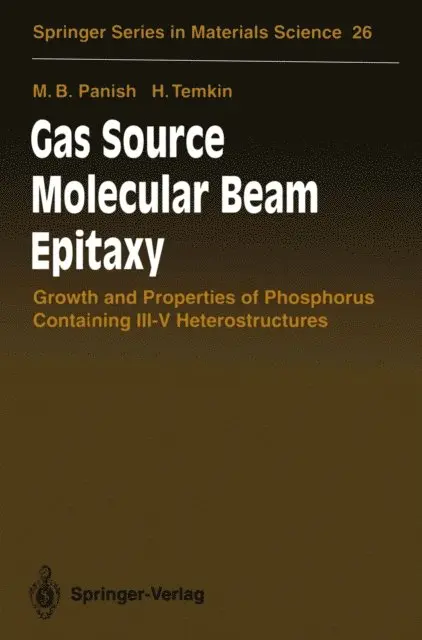
    Gas Source Molecular Beam Epitaxy

    Growth and Properties of Phosphorus Containing III-V Heterostructures

    AvMorton B. Panish,Henryk Temkin

    Häftad, Engelska, 2011

    Del 26 i serien Springer Series in Materials Science

    1 085 kr

    Beställningsvara. Skickas inom 10-15 vardagar. Fri frakt över 249 kr.

    Beskrivning

    Today nobody can do without modern semiconductor technology and their application in micro- and optoelectronics. Here, the technique that is able to grow thinnest and best definded layers is described by the "pope" of the method in whose laboratory it was developed. Whoever is involved in research and development or advanced studies in this fascinating field will welcome the unique volume with great interest.

    Produktinformation

    • Utgivningsdatum:2011-12-30
    • Mått:155 x 235 x 24 mm
    • Vikt:668 g
    • Format:Häftad
    • Språk:Engelska
    • Serie:Springer Series in Materials Science
    • Antal sidor:428
    • Förlag:Springer-Verlag Berlin and Heidelberg GmbH & Co. KG
    • ISBN:9783642781292

    Utforska kategorier

    • Fysik inom Naturvetenskap och teknik
    • Maskinteknik och material inom Naturvetenskap och teknik

    Innehållsförteckning

    • 1. Introduction.- 1.1 Introduction to Molecular Beam Epitaxy.- 1.2 Introduction to Gas Source Molecular Beam Epitaxy.- 1.3 Why Gas Sources?.- 1.4 Heterostructures with GSMBE.- 2. Chemistry.- 2.1 Equilibrium, the Phase Diagram, and Molecular Beam Epitaxy.- 2.2 Liquid-Solid-Vapor Relationships for the Growth of InP and GaAs.- 2.3 III-V Solid Solutions.- 2.4 Group III Metalorganics — Metalorganic MBE.- 2.5 Group V Metalorganics to Replace Arsine and Phosphine.- 3. The Generation of Atomic and Molecular Beams for Elemental and Gas Source Molecular Beam Epitaxy.- 3.1 Background.- 3.2 Molecular Effusion: The Ideal Effusion Cell.- 3.3 Real Effusion Cells.- 3.4 Gas Sources and Their Use in GSMBE.- 3.5 Introduction of the Group III Metalorganics into the MBE System.- 4. Molecular Beam Epitaxy Systems and Procedures.- 4.1 The Conventional Growth Chamber-Configuration for ESMBE, HSMBE and MOMBE.- 4.2 System Pressure — Pumping.- 4.3 Sample Introduction, Transfer and Manipulation.- 4.4 Substrate Temperature Measurement and Control.- 4.5 Gas Handling.- 4.6 Arsine and Phosphine Generators.- 4.7 Safe Handling of Arsine and Phosphine for GSMBE.- 4.8 Procedures for GSMBE.- 4.9 The RHEED Apparatus, Growth Rate and Composition Calibration.- 4.10 Metalorganic MBE Systems — Potential for Scaleup.- 5. Doping During GSMBE.- 5.1 Background.- 5.2 Maximum Free-Carrier Concentrations in Semiconductors.- 5.3 Background Doping and Carbon Incorporation.- 5.4 Doping with Tin.- 5.5 Doping with Be.- 5.6 Zn in InP and GaInAs.- 5.7 Si in GaAs, InP and GaInAs.- 5.8 Semi-insulating InP by Fe Doping During MBE.- 6. Characterization of Heterostructures by High Resolution X-ray Diffraction.- 6.1 X-Ray Diffraction of Epitaxial Layers.- 6.2 Periodic Epitaxial Semiconductor Structures.- 6.3 High-ResolutionX-Ray Diffraction.- 6.4 High-Resolution Rocking Curves of Superlattices.- 6.5 Intrinsic Strain at Heterostructure Interfaces.- 7. Optical Properties of Quantum Wells.- 7.1 Energy Levels in Quantum Wells.- 7.2 Single Quantum Wells.- 7.3 Superlattices.- 7.4 Quantum Wires and Boxes.- 7.5 Electric Field Effects.- 7.6 Strained-Layer Superlattices.- 7.7 Thermal Stability.- 8. Carrier Transport Across Quantum Wells and Superlattices.- 8.1 Experimental Techniques.- 8.2 Motion of Photo-Induced Holes.- 8.3 Sequential Screening.- 8.4 Barrier Height.- 8.5 Heterojunction Band Offsets.- 8.6 Telegraph Noise.- 9. Bipolar Transistors.- 9.1 Background.- 9.2 Figures of Merit.- 9.3 Device Fabrication.- 9.4 DC Characteristics.- 9.5 Temperature Dependence.- 9.6 Carrier Transport.- 9.7 Gain Dependence on the Base Thickness.- 9.8 Microwave Devices.- 9.9 Applications.- 10. Optoelectronic Devices.- 10.1 Broad-Area Lasers.- 10.2 Buried Heterostructure Lasers.- 10.3 Single-Frequency Lasers.- 10.4 Visible Lasers.- 10.5 Photodetectors.- 10.6 Quantum-Well Inter-sub-band Detectors.- 11. In-Situ Processing and Selective Area Epitaxy.- 11.1 Pattern Formation.- 11.2 Ion-Induced Damage.- 11.3 Towards Vacuum Lithography.- 11.4 Buried Heterostructures.- 11.5 Selective-Area Epitaxy.- References.