• Fri frakt över 249 kr
  • •
  • Snabba leveranser
  • •
  • Billiga böcker
Kundservice

Du är på sajten för privatpersoner.

Företag, bibliotek eller offentlig verksamhet?

Du handlar på classic.bokus.com, där alla dina funktioner finns intakta.
Till classic.bokus.com
Bokus logotyp. Gå till startsidan.
  • Erbjudanden
  • Student
  • Topplistor
  • Barn & ungdom
  • Bokus Play
  • E-böcker
  • Ljudböcker
  • Pocketböcker
  • Spel och pussel

5% studentrabatt – använd koden KURSBOK27 →

Sidfot

Mina sidor

    Hjälp

    • Kundservice
    • Vanliga frågor och svar
    • Frakt och leverans
    • Retur vid ångerrätt
    • Reklamera vara
    • Betalning
    • Köpvillkor
    • Allmänna villkor
    • Information om webbplatsens tillgänglighet

    Om Bokus

    • Om oss
    • Pressrum
    • För studenter
    • För företag
    • För bibliotek och offentlig verksamhet
    • För leverantörer
    • Hållbarhet

    Populärt

    • Aktuella erbjudanden
    • Presentkort
    • Studentlitteratur
    • Nya böcker
    • Topplistor
    • Signerade böcker
    • Engelska böcker

    Inspiration

    • Boktips
    • BookTok
    • Barnbokskaraktärer
    • Populära författare
    Logotyp för Bokus
    Följ oss på Facebook (extern länk)Följ oss på Instagram (extern länk)Följ oss på YouTube (extern länk)Följ oss på TikTok (extern länk)
    bokus @ CookiesAnpassa cookiesIntegritetspolicyKöpvillkor
    Till Citymail hemsida (extern länk)Till Budbee hemsida (extern länk)Till Postnord hemsida (extern länk)Till Schenker hemsida (extern länk)Till Early Bird hemsida (extern länk)Till Walleys hemsida (extern länk)
    1. Data och IT
    2. Systemvetenskap och AI

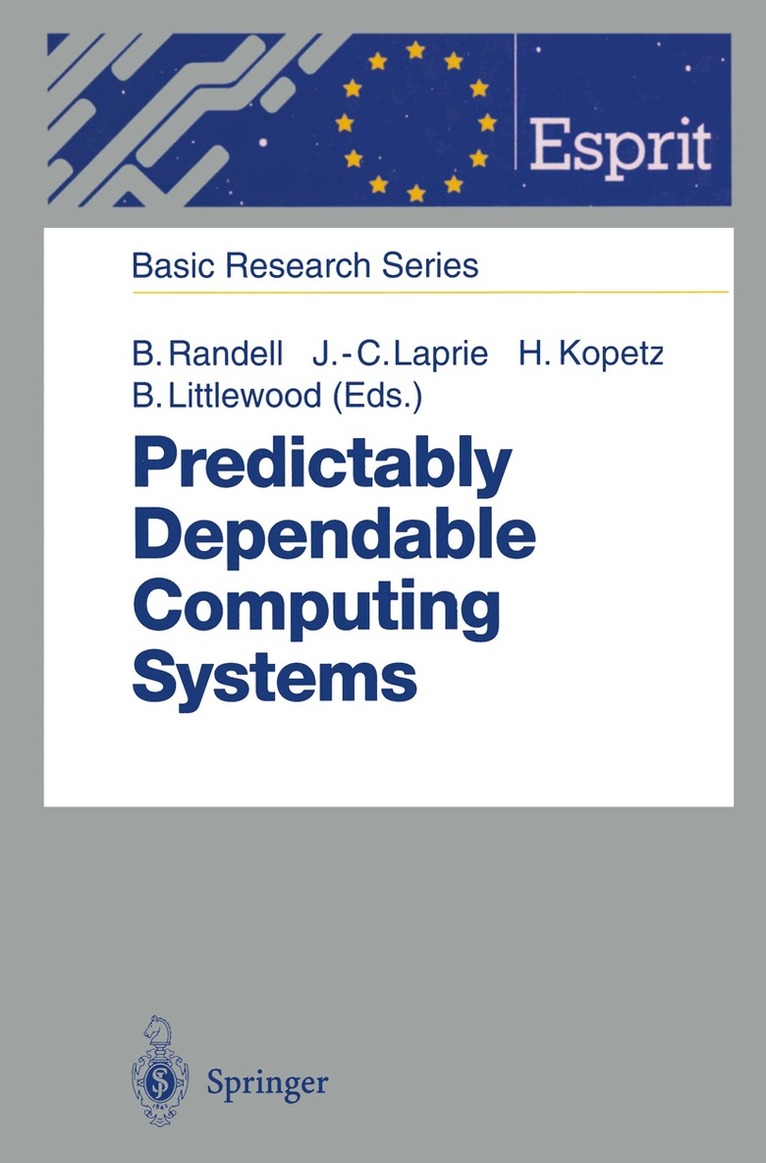
    Predictably Dependable Computing Systems

    AvBrian Randell,Jean-Claude Laprie

    Häftad, Engelska, 2011

    Del i serien ESPRIT Basic Research Series

    1 110 kr

    Beställningsvara. Skickas inom 10-15 vardagar. Fri frakt över 249 kr.

    Beskrivning

    This ESPRIT Basic Research volume provides an overview of two projects intended "to contribute to making the process of designing and constructing dependable computing systems much more predictable and cost-effective". Papers on fault prevention, fault tolerance, fault removal, and fault forecasting are included.

    Produktinformation

    • Utgivningsdatum:2011-12-08
    • Mått:155 x 235 x 33 mm
    • Vikt:914 g
    • Format:Häftad
    • Språk:Engelska
    • Serie:ESPRIT Basic Research Series
    • Antal sidor:588
    • Förlag:Springer-Verlag Berlin and Heidelberg GmbH & Co. KG
    • ISBN:9783642797910

    Utforska kategorier

    • Systemvetenskap och AI inom Data och IT
    • Operativsystem inom Data och IT
    • Programmeringsböcker inom Data och IT

    Innehållsförteckning

    • I. Basic Concepts.- A. Dependability — Its Attributes, Impairments and Means.- References for Chapter 1.- II. Fault Prevention.- A. Analysis of Safety Requirements for Process Control Systems.- B. Real-Time System Scheduling.- C. The Time-Triggered Approach to Real-Time System Design.- D. Software Measurement: A Necessary Scientific Basis.- References for Chapter II.- III. Fault Tolerance.- A. From Recovery Blocks to Concurrent Atomic Actions.- B. Definition and Analysis of Hardware-and-Software Fault-Tolerant Architectures.- C. Failure Mode Assumptions and Assumption Coverage.- D. Rational Design of Multiple-Redundant Systems: Adjudication and Fault Treatment.- E. Dynamic Adjustment of Dependability and Efficiency in Fault-Tolerant Software.- F. Designing Secure and Reliable Applications using FragmentationRedundancy-Scattering: an Object Oriented Approach.- G. Implementing Fault Tolerant Applications Using Reflective Object-Oriented Programming.- H. The PDCS Implementation of MARS Hardware and Software.- References for Chapter III.- IV. Fault Removal.- A. Advantages and Limits of Formal Approaches for Ultra-High Dependability.- B. Software Statistical Testing.- C. An Experimental Evaluation of Formal Testing and Statistical Testing.- D. Testing Distributed Real-Time Systems: An Overview.- References for Chapter IV.- V. Fault Forecasting — Fault Injection.- A. Integration and Comparison of Three Physical Fault Injection Techniques.- B. Fault Injection into VHDL Models: The MEFISTO Tool.- C. Estimators for Fault Tolerance Coverage Evaluation.- References for Chapter V.- VI. Fault Forecasting — Software Reliability.- A. Software Reliability Trend Analyses: From Theoretical to Practical Considerations.- B. The Transformation Approach to the Modeling and Evaluationof Reliability and Availability Growth.- C. New Ways to Get Accurate Reliability Measures.- D. Combination of Predictions Obtained from Different Software Reliability Growth Models.- E. Dependability Modelling and Evaluation of Software Fault-Tolerant Systems.- F. Dependability Analysis of Iterative Fault-Tolerant Software Considering Correlation.- G. Validation of Ultra-High Dependability for Software-based Systems.- References for Chapter VI.- VII. Fault Forecasting — Large State Space Modelling.- A. Computable Dependability Bounds for Large Markov Chains.- B. Fast Numerical Solution for a Class of Markov Models.- References for Chapter VII.- VIII. Fault Forecasting — Security Modelling.- A. Towards Operational Measures of Computer Security: Concepts.- B. Towards Operational Measures of Computer Security: Experimentation and Modelling.- References for Chapter VIII.- Pdcs Publications.