ESPRIT Basic Research Series – serie
Visar alla böcker i serien ESPRIT Basic Research Series. Handla med fri frakt och snabb leverans.
17 produkter
17 produkter
Inbunden, Engelska, 1994
1 105 kr
Skickas inom 10-15 vardagar
Computer vision falls short of human vision in two respects: execution time and intelligent interpretation. This book addresses the question of execution time. It is based on a workshop on specialized processors for real-time image analysis, held as part of the activities of an ESPRIT Basic Research Action, the Working Group on Vision. The aim of the book is to examine the state of the art in vision-oriented computers. Two approaches are distinguished: multiprocessor systems and fine-grain massively parallel computers. The development of fine-grain machines has become more important over the last decade, but one of the main conclusions of the workshop is that this does not imply the replacement of multiprocessor machines. The book is divided into four parts. Part 1 introduces different architectures for vision: associative and pyramid processors as examples of fine-grain machines and a workstation with bus-oriented network topology as an example of a multiprocessor system. Parts 2 and 3 deal with the design and development of dedicated and specialized architectures. Part 4 is mainly devoted to applications, including road segmentation, mobile robot guidance and navigation, reconstruction and identification of 3D objects, and motion estimation.
Inbunden, Engelska, 1994
556 kr
Skickas inom 10-15 vardagar
This volume assesses approaches to the construction ofcomputer vision systems. It shows that there is a spectrumof approaches with different degrees of maturity androbustness. The useful exploitation of computer vision inindustry and elsewhere and the development of the disciplineitself depend on understanding the way these approachesinfluence one another. The chief topic discussed is autonomy. True autonomy may notbe achievable in machines in the near future, and theworkshop concluded that it may be more desirable - and iscertainly more pragmatic - to leave a person in theprocessing loop. The second conclusion of the workshop concerns the manner inwhich a system is designedfor an application. It was agreedthat designers should first specify the requiredfunctionality, then identify the knowledge appropriate tothat task, and finally choose the appropriate techniques andalgorithms. The third conclusion concerns the methodologies employed indeveloping vision systems: craft, engineering, and scienceare mutually relevant and contribute to one another. The contributors place heavy emphasis on providing thereader with concrete examples of operational systems.Thebook is based on a workshop held as part of the activitiesof an ESPRIT Basic Research Action.
Inbunden, Engelska, 1994
1 654 kr
Skickas inom 10-15 vardagar
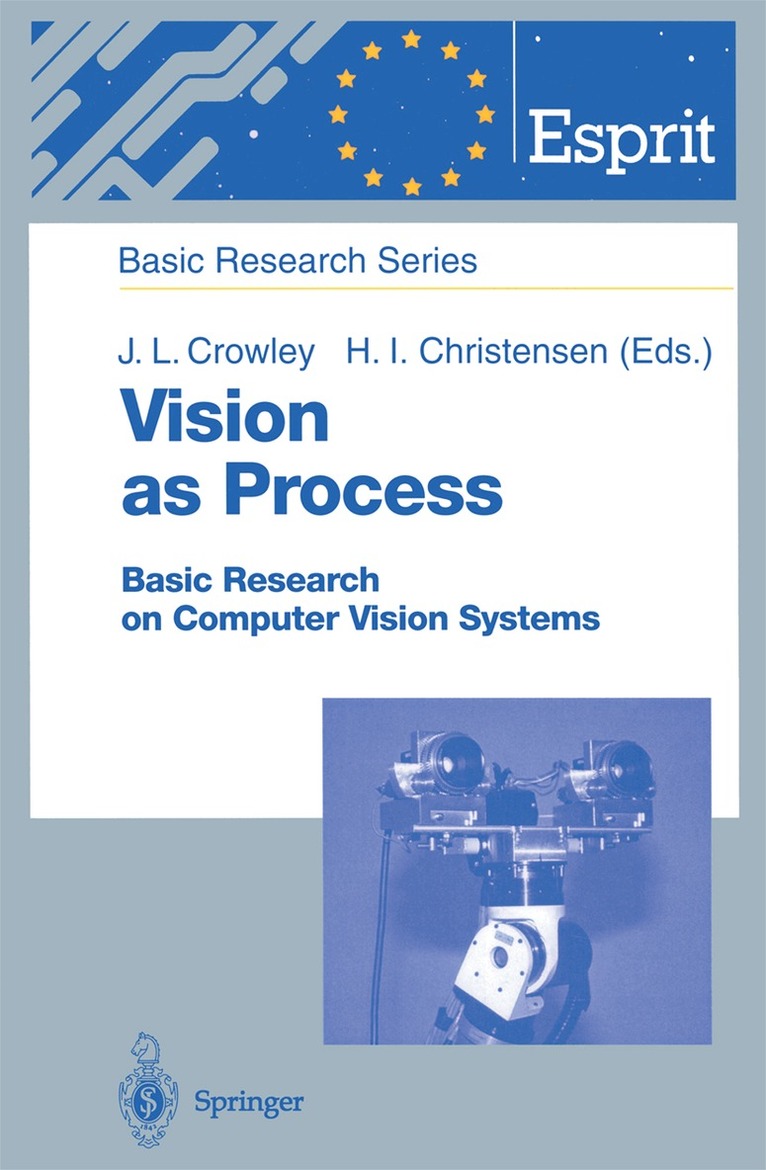
There is growing interest in the use of active control of image formation to simplify and accelerate scene understanding. AI research on machine vision emphasizes the use of declarative knowledge and explicit representation of goals to control the perceptual process. This book describes the first implemented vision system anywhere to integrate robotic camera control, ocular reflexes, reactive fixation, real-time image processing, image tracking, perceptual grouping, active 3D modeling, and object recognition. The book presents the results of the ESPRIT project BG 3038/7108 "Vision as Process" initiated in 1989. The presentation is organized as five parts which reflect the components developed for the resulting experimental test-bed system.
Inbunden, Engelska, 1999
1 105 kr
Skickas inom 10-15 vardagar
Research into Fully Integrated Data Environments (FIDE) has the goal of substantially improving the quality of application systems while reducing the cost of building and maintaining them. Application systems invariably involve the long-term storage of data over months or years. Much unnecessary complexity obstructs the construction of these systems when conventional databases, file systems, operating systems, communication systems, and programming languages are used. This complexity limits the sophistication of the systems that can be built, generates operational and usability problems, and deleteriously impacts both reliability and performance. This book reports on the work of researchers in the Esprit FIDE projects to design and develop a new integrated environment to support the construction and operation of such persistent application systems. It reports on the principles they employed to design it, the prototypes they built to test it, and their experience using it.
Häftad, Engelska, 2010
1 606 kr
Skickas inom 10-15 vardagar
There is growing interest in the use of active control of image formation to simplify and accelerate scene understanding. AI research on machine vision emphasizes the use of declarative knowledge and explicit representation of goals to control the perceptual process. This book describes the first implemented vision system anywhere to integrate robotic camera control, ocular reflexes, reactive fixation, real-time image processing, image tracking, perceptual grouping, active 3D modeling, and object recognition. The book presents the results of the ESPRIT project BG 3038/7108 "Vision as Process" initiated in 1989. The presentation is organized as five parts which reflect the components developed for the resulting experimental test-bed system.
Häftad, Engelska, 2014
556 kr
Skickas inom 10-15 vardagar
This volume is a monograph on parallel optical interconnects. It presents not only the state of-the-art in this domain but also the necessary physical and chemical background. It also provides a discussion of the potential for future devices. Both experts and newcomers to the area will appreciate the authors' proficiency in providing the complete picture of this rapidly growing field. Optical interconnects are already established in telecommunications and should eventually find their way being applied to chip and even gate level connections in integrated systems. The inspiring environment of the Basic Research Working Group on Optical Information Technology WOIT (3199), together with the excellent and complementary skills of its participants, make this contribution highly worthwhile. G. Metakides Table of contents 1 Perspectives for parallel optical interconnects: introduction . . . . . . . . . . . . . . . . . . . . . . . . . l Pierre Chavel and Philippe lAlanne 1. 1 Optical Interconnects and ESPRIT BRA WOIT . . . . . . . . . . . . . . . . . . . . . . . . . . . . . . . . . . . . . . . . . 1 1. 2 What are optical interconnects? . . . . . . . . . . . . . . . . . . . . . . . . . . . . . . . . . . . . . . . . . . . . . . . . . . . . . . . . . . . . . . . . . . . . 2 1. 3 Optical interconnects: how ? . . . . . . . . . . . . . . . . . . . . . . . . . . . . . . . . . . . . . . . . . . . . . . . . . . . . . . . . . . . . . . . . . . . . . . . . . 3 1. 3. 1 Passive devices . . . . . . . . . . . . . . . . . . . . . . . . . . . . . . . . . . . . . . . . . . . . . . . . . . . . . . . . . . . . . . . . 3 1. 3. 2 Active devices . . . . . . . . . . . . . . . . . . . . . . . . . . . . . . . . . . . . . . . . . . . . . . . . . . . . . . . . . . . . . . . . . . 4 1. 3. 3 Schemes forparallel optical interconnects . . . . . . . . . . . . . . . . . . . . . . . . . . . . . . . . . . 5 1. 3. 4 Limits of optical interconnects . . . . . . . . . . . . . . . . . . . . . . . . . . . . . . . . . . . . . . . . . . . . . . . 6 1. 4 Optical interconnects: why ? . . . . . . . . . . . . . . . . . . . . . . . . . . . . . . . . . . . . . . . . . . . . . . . . . . . . . . . . . . . . . . . . . . . . . . . . 6 Acknowledgetnents . . . . . . . . . . . . . . . . . . . . . . . . . . . . . . . . . . . . . . . . . . . . . . . . . . . . . . . . . . . . . . . . . . . . . . . . . . . . . . . . . . . . . . . . . . . . . . . 8 References . . . . . . . . . . . . . . . . . . . . . . . . . . . . . . . . . . . . . . . . . . . . . . . . . . . . . . . . . . . . . . . . . . . . . . . . . . . . . . . . . . . . . . . . . . . . . . . . . . . . . . . . . . . . . . 8 First Section: Components Part 1. 1 Passive interconnect components 2 Free space interconnects . . . . . . . . . . . . . . . . . . . . . . . . . . . . . . . . . . . . . . . . . . . . . . . . . . . . . . . . . . . . . . . . . . . . . . . . . . . . . . . . . . . . . . . . 11 Philippe Lalanne and Pierre ChaveZ 2. 1 Introduction: 3D optical interconnects . . . . . . . . . . . . . . . . . . . . . . . . . . . . . . . . . . . . . . . . . . . . . . . . . . . . . . 11 2. 2 Optical free space channels and their implementations . . . . . . . . . . . . . . . . . . . . . . . . . . . 12 2. 2. 1 Diffraction and degrees of freedom . . . . . . . . . . . . . . . . . . . . . . . . . . . . . . . . . . . . . . . . 12 2. 2. 2 Two Qasic interconnect setups . . . . . . . . . . . . . . . . . . . . . . . . . . . . . . . . . . . . . . . . . . . . .
Häftad, Engelska, 2011
1 105 kr
Skickas inom 10-15 vardagar
Research into Fully Integrated Data Environments (FIDE) has the goal of substantially improving the quality of application systems while reducing the cost of building and maintaining them. Application systems invariably involve the long-term storage of data over months or years. Much unnecessary complexity obstructs the construction of these systems when conventional databases, file systems, operating systems, communication systems, and programming languages are used. This complexity limits the sophistication of the systems that can be built, generates operational and usability problems, and deleteriously impacts both reliability and performance. This book reports on the work of researchers in the Esprit FIDE projects to design and develop a new integrated environment to support the construction and operation of such persistent application systems. It reports on the principles they employed to design it, the prototypes they built to test it, and their experience using it.
Häftad, Engelska, 2011
1 073 kr
Skickas inom 10-15 vardagar
This volume has a dual significance to the ESPRIT Basic Research efforts towards forging strong links between European academic and industrial teams carrying out research, often interdisciplinary, at the forefront of Information Technology. Firstly, it consists of the proceedings of the "Symposium on Computational Logic" - held on the occasion of the 7th ESPRIT Conference Week in November 1990 - whose organisation was inspired by the work of Basic Research Action 3012 (COMPULOG). This is a consortium which has attracted world-wide interest, with requests for collaboration throughout Europe, the US and Japan. The work of COMPULOG acts as a focal point in this symposium which is broadened to cover the work of other eminent researchers in the field, thus providing a review of the state of the art in computational logic, new and important contributions in the field, but also a vision of the future. Secondly, this volume is the first of an ESPRIT Basic Research Series of publications of research results. It is expected that the quality of content and broad distribution of this series will have a major impact in making the advances achieved accessible to the world of academic and industrial research alike. At this time, all ESPRIT Basic Research Actions have completed their first year and it is most encouraging and stimulating to see the flow of results such as the fine examples presented in this symposium.
Häftad, Engelska, 2011
1 105 kr
Skickas inom 10-15 vardagar
This volume in the Basic Research Series consists of the proceedings of the Symposium on Natural Language and Speech held during the ESPRIT Conference of November 1991 - a conference that serves to open up ESPRIT results not only to the ESPRIT community but also to the entire European IT industry and its users. The symposium is organised by the newly launched Network of Excellence on Language and Speech (3701) which brings together the foremost European experts and institutions in these two domains. By bringing together these two communities, which have so far been working in relative isolation from each other, the network aims to augment the focusing of research onto the long-term goal of the "construction of an integrated model of the cognitive chain linking speech to reasoning via natural language". To advance towards this industrially significant goal, the network operates at different levels - a strategy for research, a coordination for the training of needed researchers and a coordination of the use of its resource and communication infrastructure for the most efficient interworking of the members of the community who are spread all over Europe. This symposium is a small but significant building block for the achievement of the goals of the network.
Häftad, Engelska, 2011
1 105 kr
Skickas inom 10-15 vardagar
Geographical Information Systems are becoming increasingly important to geologists, geographers, and urban and environmental planners, amongst others. Although there is an increasing number of such systems available on the market, many questions of a theoretical nature need to be addressed, because of the inherently large amounts of data and the lack of appropriate models and languages. Also, there is a need for flexible and efficient usage of GIS, thus permitting their application in a broad range of new areas, such as navigation systems for transport and the automotive industry. ESPRIT Working Groups provide a structure that enables researchers to meet, interact and share research results, thus providing a platform for ad dressing fertile research areas with significant industrial promise. This par ticular volume is the result of a workshop organised by the "Basic GOODS" Working Group. The challenge has been to define richer and more powerful data definition and manipulation languages, and also to develop new and efficient algorithms. The challenge has been met, as presented in this volume, and the Working Group has succeeded in laying a good foundation for future research and eventual applications. We look forward to seeing the results of the recently launched "AMUSING" project, which will build on this foundation.
Häftad, Engelska, 2011
540 kr
Skickas inom 10-15 vardagar
As is true with most areas of Artificial Intelligence, there is real need for a symbiotic relationship between the biological and artificial - a need for problems to be viewed from many different angles, and particularly so in the study of vision. The INSIGHT consortium is taking steps in this direction. In a traditional sense, the papers in this volume are represented by the areas of neuroscience, psychophysics and traditional computer vision. However, to gain deeper insight into vision processes, it is the interaction of scientific ideas from these areas that is essential. The scope of the topics discussed has a definite interdisciplinary flavour: at one end of the spectrum we have experiments performed and direct measurement of the responses of neurons to visual stimuli; at the other end we have the mathematical and computational aspects of optical flow (the relative motion between observer and object) and approaches of tackling vision through binocular disparities (stereopsis). Traditional edge detection (essential for the initial classification of shape) is also covered as is the study of natural texture patterns that occur on object surfaces. A fundamental aim of the Basic Research part of the ESPRIT programme is the pro duction and maintenance of a pool of research expertise in Europe, from which both fur ther research and industry can draw. As the authors state in their preface, this project has not only succesfully merged the talents of senior researchers from different backgrounds, but also brought many young ones along.
Häftad, Engelska, 2012
556 kr
Skickas inom 10-15 vardagar
Research in optical information technology in Europe hasbeen very active inrecent years. This volume recordsstate-of-the-art research conducted in some 22 laboratorieswho have worked together within EC ESPRIT Basic ResearchAction 3199 up to 1992. The topics cover:(1) Active optical logic and switching devices - embracingnew materials, nonlinear and electrooptic mechanisms as wellas advanced device fabrication. These devices cover therange from all-optical nonlinear interferometer structuresthrough hybrid optical-electronic modulators to integratedemitter-receiver structures.(2) The latest state of optical interconnect technology,embracing diffractive optics (binary and multi-level phasegratings), holographic space-variant elements andmicro-refractive optics.(3) Contributions on optical information processingarchitecture and demonstrator projects. The materials baseranges from silicon to II-VI materials with the realisationof pn-junction devices in ZnSe.The research reported here lays the basis for long-termprogress in devices for information processing.
Häftad, Engelska, 2011
1 105 kr
Skickas inom 10-15 vardagar
The first ESPRIT Basic Research Project on Predictably Dependable Computing Systems (No. 3092, PDCS) commenced in May 1989, and ran until March 1992. The institutions and principal investigators that were involved in PDCS were: City University, London, UK (Bev Littlewood), lEI del CNR, Pisa, Italy (Lorenzo Strigini), Universitiit Karlsruhe, Germany (Tom Beth), LAAS-CNRS, Toulouse, France (Jean-Claude Laprie), University of Newcastle upon Tyne, UK (Brian Randell), LRI-CNRS/Universite Paris-Sud, France (Marie-Claude Gaudel), Technische Universitiit Wien, Austria (Hermann Kopetz), and University of York, UK (John McDermid). The work continued after March 1992, and a three-year successor project (No.6362, PDCS2) officially started in August 1992, with a slightly changed membership: Chalmers University of Technology, Goteborg, Sweden (Erland Jonsson), City University, London, UK (Bev Littlewood), CNR, Pisa, Italy (Lorenzo Strigini), LAAS-CNRS, Toulouse, France (Jean-Claude Laprie), Universite Catholique de Louvain, Belgium (Pierre-Jacques Courtois), University of Newcastle upon Tyne, UK (Brian Randell), LRI-CNRS/Universite Paris-Sud, France (Marie-Claude Gaudel), Technische Universitiit Wien, Austria (Hermann Kopetz), and University of York, UK (John McDermid). The summary objective of both projects has been "to contribute to making the process of designing and constructing dependable computing systems much more predictable and cost-effective". In the case of PDCS2, the concentration has been on the problems of producing dependable distributed real-time systems and especially those where the dependability requirements centre on issues of safety and/or security.
Häftad, Engelska, 2011
540 kr
Skickas inom 10-15 vardagar
The study of condensed matter using optical techniques, where photons act as both probe and signal, has a long history. It is only recently, however, that the extraction of surface and interface information, with submonolayer resolution, has been shown to be possible using optical techniques (where "optical" applies to electromagnetic radiation in and around the visible region of the spectrum). This book describes these "epioptic" techniques, which have now been quite widely applied to semiconductor surfaces and interfaces. Particular emphasis in the book is placed on recent studies of submonolayer growth on well-characterised semiconductor surfaces, many of which have arisen from CEC DGJGII ESPRIT Basic Research Action No. 3177 "EPIOPTIC", and CEU DGIII ESPRIT Basic Research Action No. 6878 "EASI". Techniques using other areas of the spectrum such as the infra-red region (IR spectroscopy, in its various surface configurations), and the x-ray region (surface x-ray diffraction, x-ray standing wave), are omitted. The optical techniques described use simple lamp or small laser sources and are thus, in principle, easily accessible. Epioptic probes can provide new information on solid-gas, solid-liquid and liquid-liquid interfaces. They are particularly suited to growth monitoring. Emerging process technologies for fabricating submicron and nanoscale semiconductor devices and novel multilayer materials, whether based on silicon or compound semiconductors, all require extremely precise control of growth at surfaces. In situ, non-destructive, real-time monitoring and characterisation of surfaces under growth conditions is needed for further progress. Both atomic scale resolution, and non-destructive characterisation of buried structures, are required.
Häftad, Engelska, 2011
556 kr
Skickas inom 10-15 vardagar
It is widely recognized that the complexity of parallel and distributed systems is such that proper tools must be employed during their design stage in order to achieve the quantitative goals for which they are intended. This volume collects recent research results obtained within the Basic Research Action Qmips, which bears on the quantitative analysis of parallel and distributed architectures. Part 1 is devoted to research on the usage of general formalisms stemming from theoretical computer science in quantitative performance modeling of parallel systems. It contains research papers on process algebras, on Petri nets, and on queueing networks. The contributions in Part 2 are concerned with solution techniques. This part is expected to allow the reader to identify among the general formalisms of Part I, those that are amenable to an efficient mathematical treatment in the perspective of quantitative information. The common theme of Part 3 is the application of the analytical results of Part 2 to the performance evaluation and optimization of parallel and distributed systems. Part 1. Stochastic Process Algebras are used by N. Gotz, H. Hermanns, U. Herzog, V. Mertsiotakis and M. Rettelbach as a novel approach for the struc tured design and analysis of both the functional behaviour and performability (i.e performance and dependability) characteristics of parallel and distributed systems. This is achieved by integrating stochastic modeling and analysis into the powerful and well investigated formal description techniques of process algebras.
Häftad, Engelska, 2012
1 073 kr
Skickas inom 10-15 vardagar
With the invention of the scanning tunneling microscope in 1982 by Binnig and Rohrer and the subsequent award of the Nobel Prize, the field of scan ning microscopy was given a strong boost in view of its wide range of ap plications. In particular, expanding the capability to access nature's foundations at the atomic level is now recognized as having the potential for major impact in Infonnation Technology. This third volume of the ESPRIT Basic Research Series provides a well structured overview of the state of the art of scanning microscopy and re cent advances including results of ESPRIT Basic Research Actions 3109 and 3314. April 1992 G. Metakides Preface The IMO Symposium Fall '90, Wetzlar, FRO, October 1/2, 1990, brought together leading scientists and researchers in scanning microscopy from re search institutes and industries, each of whom was invited to contribute a lecture which was followed by a discussion. The resulting contributions are contained in this proceedings. Microscopic techniques are used not only for research work in material and life science but also for routine applications in almost any vital section of our everyday life. The demand for coming to a better understanding of materials and their behaviour under different conditions and environments as well as all aspects of human life initiated an ongoing development for improved microscopic techniques.
Häftad, Engelska, 2014
540 kr
Skickas inom 10-15 vardagar
Information Technology is having an increasing influence on medicine. This can be readily observed by anybody visiting a hospital or consulting a doctor, or even by going to the chemist. A range of new medical instruments, new scanners, new on-line diagnostics as well as more effective distribution methods all increasingly contain IT elements that enable new more effective medical tools and services. But there is also a lot going on "behind the scenes", at the research and development level, that will greatly influence the medical tools and services of tomorrow. In this respect, Esprit, the European Commission's IT research program, has been supporting a range of research and development projects that are contributing to the opening of new avenues in the medical field. At the 1997 European IT Conference, a special exhibit has highlighted Esprit's contributions in the area, including, for example projects that have succeeded in developing: • a prototype visual prosthesis linked to the optic nerve (MIVIP) • implantable blood micro-pumps (IMALP) • new low-power pacemakers and defibrillators (HIPOCRA T) • new high-quality 3D ultrasound images (NICE) • realistic computer models of the human musculo-skeletal system (CHARM) CHARM, the last - but not least - of these, is further elaborated in this book.