• Fri frakt över 249 kr
  • •
  • Snabba leveranser
  • •
  • Billiga böcker
Kundservice

Du är på sajten för privatpersoner.

Företag, bibliotek eller offentlig verksamhet?

Du handlar på classic.bokus.com, där alla dina funktioner finns intakta.
Till classic.bokus.com
Bokus logotyp. Gå till startsidan.
  • Erbjudanden
  • Student
  • Topplistor
  • Barn & ungdom
  • Bokus Play
  • E-böcker
  • Ljudböcker
  • Pocketböcker
  • Spel och pussel

Pocketfynda! Hundratals böcker för 49 kr/st →

Sidfot

Mina sidor

    Hjälp

    • Kundservice
    • Vanliga frågor och svar
    • Frakt och leverans
    • Retur vid ångerrätt
    • Reklamera vara
    • Betalning
    • Köpvillkor
    • Allmänna villkor
    • Information om webbplatsens tillgänglighet

    Om Bokus

    • Om oss
    • Pressrum
    • För studenter
    • För företag
    • För bibliotek och offentlig verksamhet
    • För leverantörer
    • Hållbarhet

    Populärt

    • Aktuella erbjudanden
    • Presentkort
    • Studentlitteratur
    • Nya böcker
    • Topplistor
    • Signerade böcker
    • Engelska böcker

    Inspiration

    • Boktips
    • BookTok
    • Barnbokskaraktärer
    • Populära författare
    Logotyp för Bokus
    Följ oss på Facebook (extern länk)Följ oss på Instagram (extern länk)Följ oss på YouTube (extern länk)Följ oss på TikTok (extern länk)
    bokus @ CookiesAnpassa cookiesIntegritetspolicyKöpvillkor
    Till Citymail hemsida (extern länk)Till Budbee hemsida (extern länk)Till Postnord hemsida (extern länk)Till Schenker hemsida (extern länk)Till Early Bird hemsida (extern länk)Till Walleys hemsida (extern länk)
    1. Samhälle och politik
    2. Samhälle och kultur
    3. Kultur och medier
    4. Referensverk och tvärvetenskap

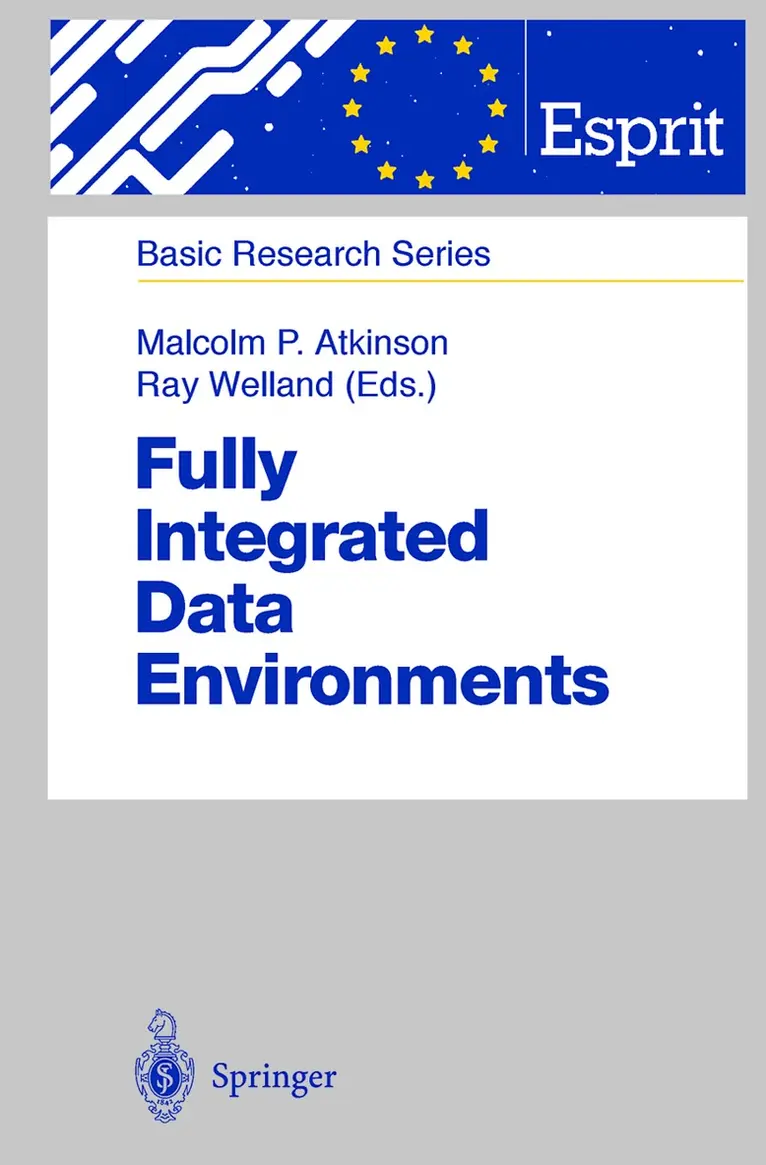
    Fully Integrated Data Environments

    Persistent Programming Languages, Object Stores, and Programming Environments

    AvMalcolm P. Atkinson,Ray Welland

    Häftad, Engelska, 2011

    Del i serien ESPRIT Basic Research Series

    1 110 kr

    Beställningsvara. Skickas inom 10-15 vardagar. Fri frakt över 249 kr.

    Beskrivning

    Research into Fully Integrated Data Environments (FIDE) has the goal of substantially improving the quality of application systems while reducing the cost of building and maintaining them. Application systems invariably involve the long-term storage of data over months or years. Much unnecessary complexity obstructs the construction of these systems when conventional databases, file systems, operating systems, communication systems, and programming languages are used. This complexity limits the sophistication of the systems that can be built, generates operational and usability problems, and deleteriously impacts both reliability and performance. This book reports on the work of researchers in the Esprit FIDE projects to design and develop a new integrated environment to support the construction and operation of such persistent application systems. It reports on the principles they employed to design it, the prototypes they built to test it, and their experience using it.

    Produktinformation

    • Utgivningsdatum:2011-10-06
    • Mått:155 x 235 x undefined mm
    • Vikt:961 g
    • Format:Häftad
    • Språk:Engelska
    • Serie:ESPRIT Basic Research Series
    • Antal sidor:629
    • Förlag:Springer-Verlag Berlin and Heidelberg GmbH & Co. KG
    • ISBN:9783642640551

    Utforska kategorier

    • Referensverk och tvärvetenskap inom Samhälle och politik
    • Programvaruutveckling inom Data och IT
    • Databaser inom Data och IT

    Innehållsförteckning

    • 1 Persistent Languages: Introduction and Overview.- 1.1 Language Design: Introduction and State of the Art.- 1.1.1 Higher-Order Persistent Polymorphic Programming in Tycoon.- 1.1.2 Fibonacci: A Programming Language for Object Databases.- 1.1.3 The Napier88 Persistent Programming Language and Environment.- 1.2 Linguistic Reflection: Introduction and State of the Art.- 1.2.1 Type-Safe Linguistic Reflection: A Generator Technology.- 1.2.2 Type-Safe Linguistic Run-time Reflection: A Practical Perspective.- 1.3 Type Systems: Introduction and State of the Art.- 1.3.1 A Calculus for Overloaded Functions with Subtyping.- 1.3.2 Protection in Persistent Object Systems.- 1.3.3 Subtyping and Assignment in Database Programming Languages.- 1.4 Bulk Types and Iterators: Introduction and State of the Art.- 1.4.1 The Joy of Sets.- 1.4.2 Bulk Types: Built-In or Add-On?.- 1.4.3 Extensible Objects for Database Evolution: Language Features and Implementation Issues.- 1.5 Concurrency and Transactions: Introduction and State of the Art.- 1.5.1 Specifying Flexible Concurrency Control Schemes: an Abstract Operational Approach.- 1.5.2 Persistent Threads.- 2 Persistent Support Systems: Introduction and Overview.- 2.1 Architecture and Abstract Machines: Introduction and State of the Art.- 2.1.1 Persistent Foundations for Scalable Multi-Paradigmal Systems.- 2.1.2 The DBPL Project: Advances in Modular Database Programming.- 2.1.3 The PamCase Machine.- 2.1.4 Tycoon: A Scalable and Interoperable Persistent System Environment.- 2.2 Object Store Design: Introduction and State of the Art.- 2.2.1 An Open System Architecture for a Persistent Object Store.- 2.2.2 Overview of PIOS: a Physically Independent Object Server.- 2.2.3 Efficient Incremental Garbage Collection for Client-Server Object Database Systems.- 2.2.4 Towards a Unified Model of Untyped Object Stores: Experience with the Tycoon Store Protocol.- 2.2.5 Measuring Persistent Object Systems.- 2.3 Implementation Techniques: Introduction and State of the Art.- 2.3.1 Concurrent Shadow Paging in the Flask Architecture.- 2.3.2 Locking in OODBMS Clients Supporting Nested Transactions.- 2.3.3 Query Processing in PIOS.- 2.3.4 Optimization of Nested Queries in Object Bases.- 2.3.5 Integrating Query and Program Optimization Using Persistent CPS Representations.- 2.3.6 An ad hoc Approach to the Implementation of Polymorphism.- 3 Using Persistent Languages: Introduction and Overview.- 3.1 Persistent Programming Environments: Introduction and State of the Art.- 3.1.1 Exploiting Persistent Linkage in Software Engineering Environments.- 3.1.2 Using Persistence Technology to Control Schema Evolution.- 3.1.3 Unifying Interaction with Persistent Data and Program.- 3.1.4 The Persistent Workshop: Programming Environment for Napier88.- 3.1.5 The Glasgow Persistent Libraries.- 3.1.6 Visualising Persistent Stores.- 3.2 Data Modelling: Introduction and State of the Art.- 3.2.1 Application Development using Data Modelling.- 3.2.2 The STYLE Workbench: Systematics of Typed Language Environments.- 3.2.3 Using Extensible Grammars for Data Modelling.- 3.3 Interoperability: Introduction and State of the Art.- 3.3.1 Querying the File.- 3.3.2 Updating the File.- 3.3.3 Lean Languages and Models: Towards an Interoperable Kernel for Persistent Object Systems.- List of Contributors.