• Fri frakt över 249 kr
  • •
  • Snabba leveranser
  • •
  • Billiga böcker
Kundservice

Du är på sajten för privatpersoner.

Företag, bibliotek eller offentlig verksamhet?

Du handlar på classic.bokus.com, där alla dina funktioner finns intakta.
Till classic.bokus.com
Bokus logotyp. Gå till startsidan.
  • Erbjudanden
  • Student
  • Topplistor
  • Barn & ungdom
  • Bokus Play
  • E-böcker
  • Ljudböcker
  • Pocketböcker
  • Spel och pussel

Pocketfynda! Hundratals böcker för 49 kr/st →

Sidfot

Mina sidor

    Hjälp

    • Kundservice
    • Vanliga frågor och svar
    • Frakt och leverans
    • Retur vid ångerrätt
    • Reklamera vara
    • Betalning
    • Köpvillkor
    • Allmänna villkor
    • Information om webbplatsens tillgänglighet

    Om Bokus

    • Om oss
    • Pressrum
    • För studenter
    • För företag
    • För bibliotek och offentlig verksamhet
    • För leverantörer
    • Hållbarhet

    Populärt

    • Aktuella erbjudanden
    • Presentkort
    • Studentlitteratur
    • Nya böcker
    • Topplistor
    • Signerade böcker
    • Engelska böcker

    Inspiration

    • Boktips
    • BookTok
    • Barnbokskaraktärer
    • Populära författare
    Logotyp för Bokus
    Följ oss på Facebook (extern länk)Följ oss på Instagram (extern länk)Följ oss på YouTube (extern länk)Följ oss på TikTok (extern länk)
    bokus @ CookiesAnpassa cookiesIntegritetspolicyKöpvillkor
    Till Citymail hemsida (extern länk)Till Budbee hemsida (extern länk)Till Postnord hemsida (extern länk)Till Schenker hemsida (extern länk)Till Early Bird hemsida (extern länk)Till Walleys hemsida (extern länk)
    1. Data och IT
    2. Systemvetenskap och AI

    Vision as Process

    Basic Research on Computer Vision Systems

    AvJames L. Crowley,Henrik I. Christensen

    Häftad, Engelska, 2010

    Del i serien ESPRIT Basic Research Series

    1 613 kr

    Beställningsvara. Skickas inom 10-15 vardagar. Fri frakt över 249 kr.

    Beskrivning

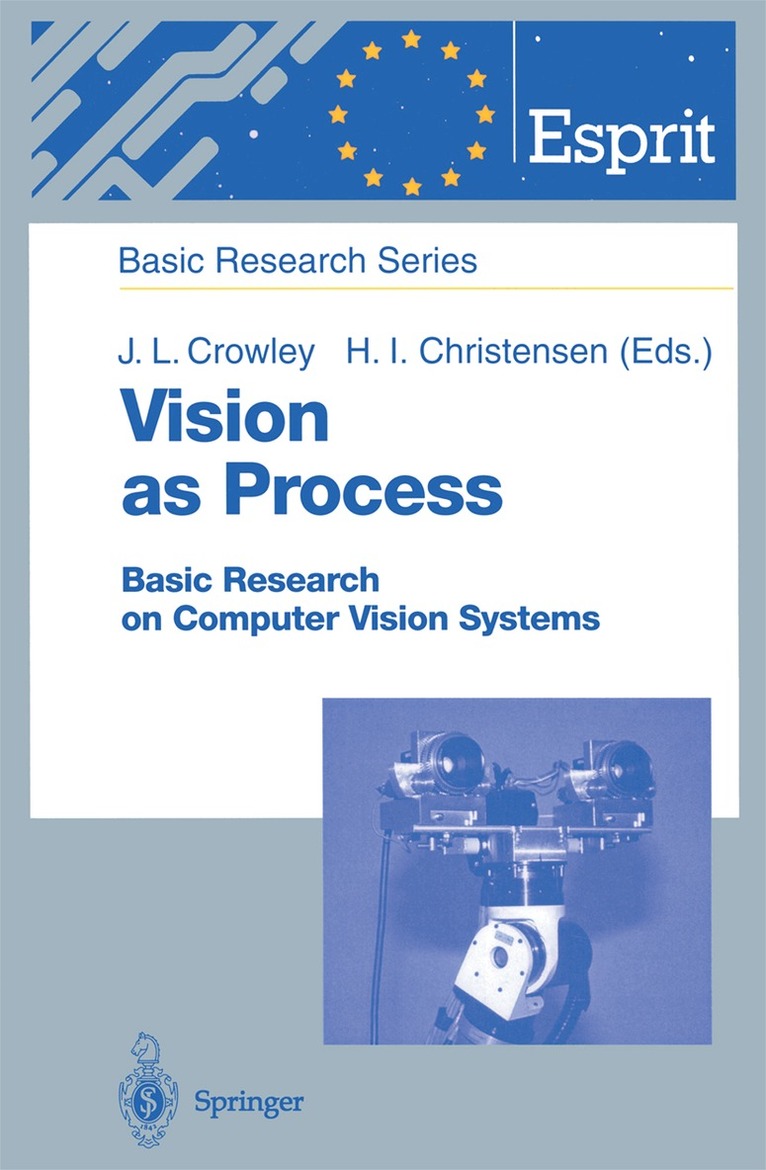
    Human and animal vision systems have been driven by the pressures of evolution to become capable of perceiving and reacting to their environments as close to instantaneously as possible. Casting such a goal of reactive vision into the framework of existing technology necessitates an artificial system capable of operating continuously, selecting and integrating information from an environment within stringent time delays. The YAP (Vision As Process) project embarked upon the study and development of techniques with this aim in mind. Since its conception in 1989, the project has successfully moved into its second phase, YAP II, using the integrated system developed in its predecessor as a basis. During the first phase of the work the "vision as a process paradigm" was realised through the construction of flexible stereo heads and controllable stereo mounts integrated in a skeleton system (SA V A) demonstrating continuous real-time operation. It is the work of this fundamental period in the V AP story that this book aptly documents. Through its achievements, the consortium has contributed to building a strong scientific base for the future development of continuously operating machine vision systems, and has always underlined the importance of not just solving problems of purely theoretical interest but of tackling real-world scenarios. Indeed the project members should now be well poised to contribute (and take advantage of) industrial applications such as navigation and process control, and already the commercialisation of controllable heads is underway.

    Produktinformation

    • Utgivningsdatum:2010-12-01
    • Mått:155 x 235 x 24 mm
    • Vikt:668 g
    • Format:Häftad
    • Språk:Engelska
    • Serie:ESPRIT Basic Research Series
    • Antal sidor:435
    • Förlag:Springer-Verlag Berlin and Heidelberg GmbH & Co. KG
    • ISBN:9783642081972

    Utforska kategorier

    • Systemvetenskap och AI inom Data och IT
    • Teknik: allmänt inom Naturvetenskap och teknik
    • Artificiell intelligens inom Data och IT

    Innehållsförteckning

    • I Integration and Control of Perception.- 1. System Integration and Control.- 2. The SAVA Skeleton System.- 3. KTH Software Integration in the VAP Project.- 4. A Vision Programmers Workbench.- II Image Processing and Description.- 5. Image Processing in the SAVA System.- 6. Building a Pyramid of Low-Pass Images.- 7. One-pass Polygonal Approximation of a Contour Image.- 8. Tracking and Description of Image Structures.- 9. Contextual Junction Finder.- III Advanced Image Processing.- 10. Introduction and Background.- 11. Phase-based Disparity Estimation.- 12. Low Level Focus of Attention Mechanisms.- 13. Tensor Based Spatio-temporal Signal Analysis.- 14. Line Extraction Using Tensors.- IV Active Gaze Control and 3D Scene Description.- 15. The KTH Head-Eye System.- 16. Hierarchical Control of a Binocular Camera Head.- 17. Active 3D Scene Description in Object Reference Frames.- 18. Geometric Description and Maintenance of 3D Objects in an Active Vision System.- V Active Scene Interpretation.- 19. Control of Perception.- 20. Control of Scene Interpretation.- 21. Recognition of Polyhedral Objects Using Triangle-pair Features.- 22. Recognition of 3D Cylinders in 2D Images by Top-Down Model Imposition.- 23. Camera Control for Establishing the Current and Next-Look Direction in an Active Vision Object Recognition System.- VI Lessons Learned.