Denis Weaire - Böcker
Visar alla böcker från författaren Denis Weaire. Handla med fri frakt och snabb leverans.
4 produkter
4 produkter
935 kr
Skickas inom 10-15 vardagar
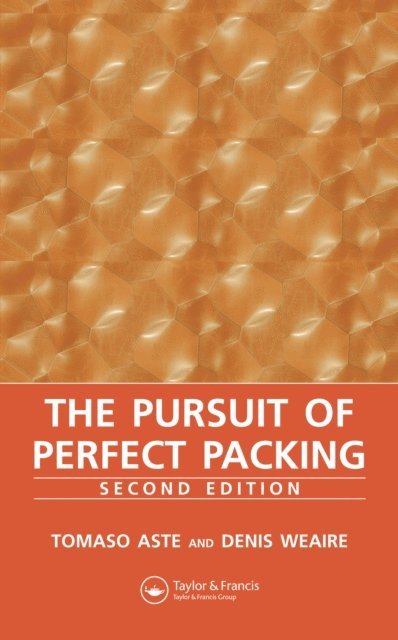
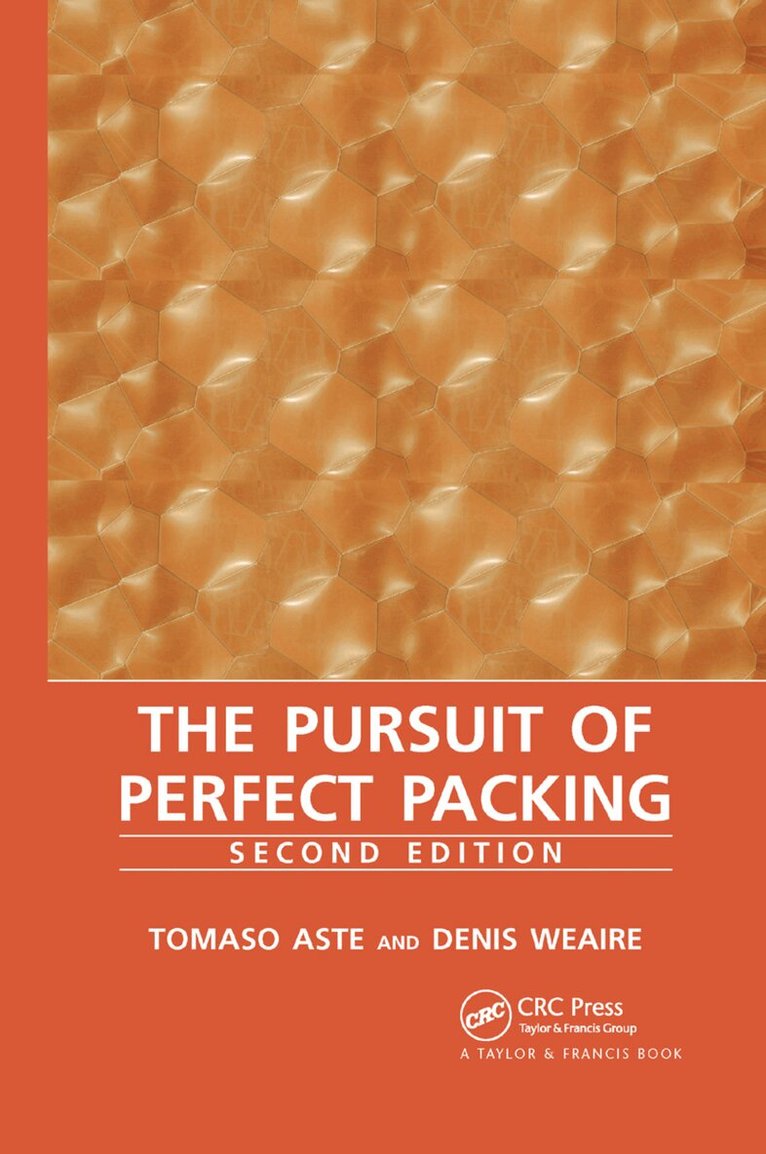
Coauthored by one of the creators of the most efficient space packing solution, the Weaire–Phelan structure, The Pursuit of Perfect Packing, Second Edition explores a problem of importance in physics, mathematics, chemistry, biology, and engineering: the packing of structures. Maintaining its mathematical core, this edition continues and revises some of the stories from its predecessor while adding several new examples and applications.The book focuses on both scientific and everyday problems ranging from atoms to honeycombs. It describes packing models, such as the Kepler conjecture, Voronoï decomposition, and Delaunay decomposition, as well as actual structure models, such as the Kelvin cell and the Weaire–Phelan structure. The authors discuss numerous historical aspects and provide biographical details on influential contributors to the field, including emails from Thomas Hales and Ken Brakke. With examples from physics, crystallography, engineering, and biology, this accessible and whimsical book touches on many aspects of packing objects. It will help you understand components of packing and aid you in the quest for the perfect packing solution.
851 kr
Tillfälligt slut
Coauthored by one of the creators of the most efficient space packing solution, the Weaire–Phelan structure, The Pursuit of Perfect Packing, Second Edition explores a problem of importance in physics, mathematics, chemistry, biology, and engineering: the packing of structures. Maintaining its mathematical core, this edition continues and revises some of the stories from its predecessor while adding several new examples and applications.The book focuses on both scientific and everyday problems ranging from atoms to honeycombs. It describes packing models, such as the Kepler conjecture, Voronoï decomposition, and Delaunay decomposition, as well as actual structure models, such as the Kelvin cell and the Weaire–Phelan structure. The authors discuss numerous historical aspects and provide biographical details on influential contributors to the field, including emails from Thomas Hales and Ken Brakke. With examples from physics, crystallography, engineering, and biology, this accessible and whimsical book touches on many aspects of packing objects. It will help you understand components of packing and aid you in the quest for the perfect packing solution.
3 659 kr
Skickas inom 5-8 vardagar
Packing problems, which are concerned with optimal arrangements of objects in space, are cross-disciplinary in nature and are encountered in mathematics, physics, chemistry, biology, engineering, and architecture. Such problems form a subject of interest in its own right, providing intriguing intellectual challenges, but are also at the heart of many material properties of condensed matter. In view of this, a series of international conferences on packing problems was launched in 2012 to provide a platform for soft-matter researchers to disseminate their findings. To continue the spirit of this conference series, this international community of researchers has also been invited to contribute reviews of their research to this book. Covering topics on models of ordered and disordered packings, mechanical behaviour of packings, and applications in soft matter and biology, this book provides a broad and authoritative overview of current research.
540 kr
Skickas inom 10-15 vardagar
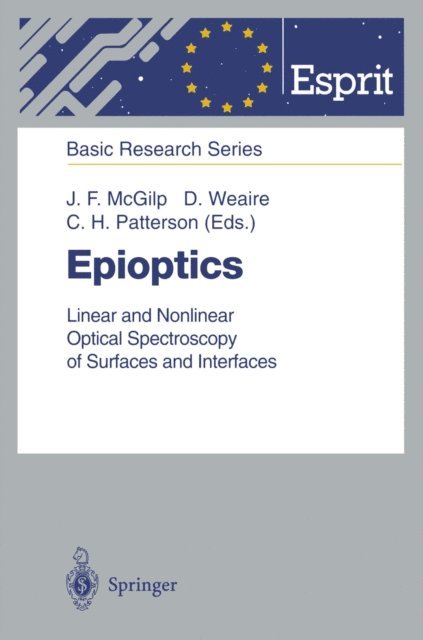
The study of condensed matter using optical techniques, where photons act as both probe and signal, has a long history. It is only recently, however, that the extraction of surface and interface information, with submonolayer resolution, has been shown to be possible using optical techniques (where "optical" applies to electromagnetic radiation in and around the visible region of the spectrum). This book describes these "epioptic" techniques, which have now been quite widely applied to semiconductor surfaces and interfaces. Particular emphasis in the book is placed on recent studies of submonolayer growth on well-characterised semiconductor surfaces, many of which have arisen from CEC DGJGII ESPRIT Basic Research Action No. 3177 "EPIOPTIC", and CEU DGIII ESPRIT Basic Research Action No. 6878 "EASI". Techniques using other areas of the spectrum such as the infra-red region (IR spectroscopy, in its various surface configurations), and the x-ray region (surface x-ray diffraction, x-ray standing wave), are omitted. The optical techniques described use simple lamp or small laser sources and are thus, in principle, easily accessible. Epioptic probes can provide new information on solid-gas, solid-liquid and liquid-liquid interfaces. They are particularly suited to growth monitoring. Emerging process technologies for fabricating submicron and nanoscale semiconductor devices and novel multilayer materials, whether based on silicon or compound semiconductors, all require extremely precise control of growth at surfaces. In situ, non-destructive, real-time monitoring and characterisation of surfaces under growth conditions is needed for further progress. Both atomic scale resolution, and non-destructive characterisation of buried structures, are required.