• Fri frakt över 249 kr
  • •
  • Snabba leveranser
  • •
  • Billiga böcker
Kundservice

Du är på sajten för privatpersoner.

Företag, bibliotek eller offentlig verksamhet?

Du handlar på classic.bokus.com, där alla dina funktioner finns intakta.
Till classic.bokus.com
Bokus logotyp. Gå till startsidan.
  • Erbjudanden
  • Nyheter
  • Student
  • Topplistor
  • Barn & ungdom
  • Bokus Play
  • E-böcker
  • Pocketböcker
  • Spel & pussel

10% rabatt på allt med kod: NYSTART10 →

Sidfot

Mina sidor

    Hjälp

    • Kundservice
    • Vanliga frågor och svar
    • Frakt och leverans
    • Retur vid ångerrätt
    • Reklamera vara
    • Betalning
    • Köpvillkor
    • Allmänna villkor
    • Information om webbplatsens tillgänglighet

    Om Bokus

    • Om oss
    • Pressrum
    • För studenter
    • För företag
    • För bibliotek och offentlig verksamhet
    • För leverantörer
    • Hållbarhet

    Populärt

    • Aktuella erbjudanden
    • Presentkort
    • Studentlitteratur
    • Nya böcker
    • Topplistor
    • Signerade böcker
    • Engelska böcker

    Inspiration

    • Boktips
    • BookTok
    • Populära bokserier
    • Barnbokskaraktärer
    • Populära författare
    Logotyp för Bokus
    Följ oss på Facebook (extern länk)Följ oss på Instagram (extern länk)Följ oss på YouTube (extern länk)Följ oss på TikTok (extern länk)
    bokus @ CookiesAnpassa cookiesIntegritetspolicyKöpvillkor
    Till Citymail hemsida (extern länk)Till Budbee hemsida (extern länk)Till Postnord hemsida (extern länk)Till Schenker hemsida (extern länk)Till Early Bird hemsida (extern länk)Till Walleys hemsida (extern länk)
    1. Ekonomi och Ledarskap
    2. Nationalekonomi

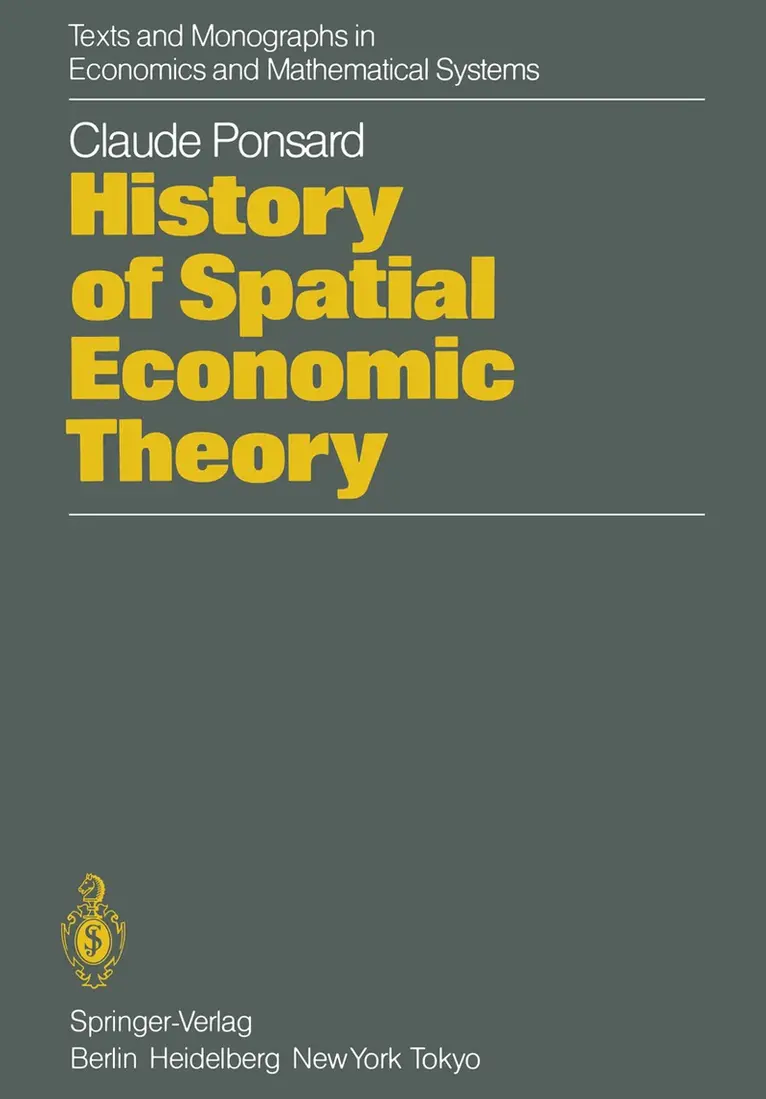
    History of Spatial Economic Theory

    AvC. Ponsard

    Häftad, Engelska, 2011

    Del i serien Texts and Monographs in Economics and Mathematical Systems

    1 119 kr

    Beställningsvara. Skickas inom 10-15 vardagar. Fri frakt över 249 kr.

    Fler format och utgåvor

    E-bok

    1 459 kr

    Beskrivning

    The concept of space has always been a fundamental element in various branches of knowledge. The concept often appears in the evolution of knowledge, either as a basis of theory or as a factor in research. It is associated, more or less directly, with all the history of scientific thought. At the level of simple common sense, the importance of the concept of space is only equaled by its lack of precision. It was part of legend before becoming part of history. To indicate the founding of Rome, Romulus started by drawing the boundaries, locating its landmarks in a discontinuous space after having cut the limits of a continuous space. However, neither geographical explorations nor mathematico-logical speculations have ever completely removed the mystery from the concept of space. For all its simple common sense, its mystique remains intact. The privileged position occupied by the concept of space in the history of science and the vagueness of its meaning in the current use of the term, far from constituting a paradox, are mutually explanatory. Every concept of space is necessarily the result of an abstraction, whether the process by which it is reached is through mathematics, psychology, biology, or any other discipline. At the level of common knowledge, the space-time concept is the base upon which are arranged individual experiences. It is thus easy to understand how the concept of space can be understood only through an orderly arrangement of these experiences and their integration into a logical scheme.

    Produktinformation

    • Utgivningsdatum:2011-12-14
    • Mått:170 x 244 x 15 mm
    • Vikt:448 g
    • Format:Häftad
    • Språk:Engelska
    • Serie:Texts and Monographs in Economics and Mathematical Systems
    • Antal sidor:240
    • Förlag:Springer-Verlag Berlin and Heidelberg GmbH & Co. KG
    • ISBN:9783642821271
    • Översättare:B.H. Stevens, M. Chevaillier, J.P. Pujol, B. H. Stevens, J. P. Pujol

    Utforska kategorier

    • Nationalekonomi inom Ekonomi och Ledarskap
    • Ekonomisk politik inom Ekonomi och Ledarskap

    Innehållsförteckning

    • 1. Before Thunen.- Section 1. Space in 18th Century Economic Thought.- Section 2. The Break Between Spatial Analysis and the English Classical School.- 2. Johann-Heinrich Von Thunen.- Genesis of Thunen’s Theories.- Section 1. The Model of Concentric Rings.- Section 2. Thunen and His Time.- Conclusion.- 3. From Thunen to Weber.- Section 1. The Anglo-Saxon Descriptions.- Section 2. Towards the First German Deductive Theories.- 4. Alfred Weber.- Historical and Theoretical Background of the Weberian Analysis.- Section 1. Parameters and Assumptions.- Section 2. The Three Types of Location Orientation.- Section 3. The System of Locations.- Conclusion.- 5. From Weber to Palander.- Section 1. Andreas Predohl.- Section 2. From Englander to Christaller.- Section 3. From Fetter to Ohlin.- 6. Tord Palander.- The Goals and Methods of Palander’s Theories.- Section 1. Market and Location.- Section 2. Transport Cost, Location of Production, and Market Size.- Section 3. Conditions of Competition and Location.- Conclusion.- 7. From Palander to Losch.- 8. August Losch.- The Background for Losch’s Theories.- Section 1. The Theory of Location.- Section 2. The Theory of Regions.- Section 3. The Theory of Exchange.- Conclusion.- 9. From Losch to the Nineteen Fifties.- Section 1. Partial Spatial Equilibria.- Section 2. General Spatial Equilibrium.- 10. Since the Nineteen Fifties.- The Scientific Environment During the Second Half of the 20th Century.- Section 1. The Paradigms.- Section 2. New Directions.- Conclusion.- Conclusion.- Mathematical Appendix.- I. Von Thunen’s Models.- 1. Concentric Rings.- 2. Theory of the Natural Wage.- II. Weber’s Models.- 1. The Point of Minimum Transport Cost.- 2. Labor Deviation (The Isodapane Technique).- 3. Agglomeration.- III. Palander’s Models.-1. The Delineation of the Market.- 2. Price Policy and Transport Costs.- 3. Isoline Technique.- 4. Law of Refraction.- 5. Conditions of Competition and Location.- IV. Losch’s Models.- 1. Location of Two Agricultural Products.- 2. The Equations of General Spatial Equilibrium.- 3. Economic Regions.- 4. Spatial Differentiation of Prices.- Chronological Bibliography.- Author Index.