• Fri frakt över 249 kr
  • •
  • Snabba leveranser
  • •
  • Billiga böcker
Kundservice

Du är på sajten för privatpersoner.

Företag, bibliotek eller offentlig verksamhet?

Du handlar på classic.bokus.com, där alla dina funktioner finns intakta.
Till classic.bokus.com
Bokus logotyp. Gå till startsidan.
  • Erbjudanden
  • Nyheter
  • Student
  • Topplistor
  • Barn & ungdom
  • Bokus Play
  • E-böcker
  • Pocketböcker
  • Spel & pussel

10% rabatt på allt med kod NYSTART10 →

Sidfot

Mina sidor

    Hjälp

    • Kundservice
    • Vanliga frågor och svar
    • Frakt och leverans
    • Retur vid ångerrätt
    • Reklamera vara
    • Betalning
    • Köpvillkor
    • Allmänna villkor
    • Information om webbplatsens tillgänglighet

    Om Bokus

    • Om oss
    • Pressrum
    • För studenter
    • För företag
    • För bibliotek och offentlig verksamhet
    • För leverantörer
    • Hållbarhet

    Populärt

    • Aktuella erbjudanden
    • Presentkort
    • Studentlitteratur
    • Nya böcker
    • Topplistor
    • Signerade böcker
    • Engelska böcker

    Inspiration

    • Boktips
    • BookTok
    • Populära bokserier
    • Barnbokskaraktärer
    • Populära författare
    Logotyp för Bokus
    Följ oss på Facebook (extern länk)Följ oss på Instagram (extern länk)Följ oss på YouTube (extern länk)Följ oss på TikTok (extern länk)
    bokus @ CookiesAnpassa cookiesIntegritetspolicyKöpvillkor
    Till Citymail hemsida (extern länk)Till Budbee hemsida (extern länk)Till Postnord hemsida (extern länk)Till Schenker hemsida (extern länk)Till Early Bird hemsida (extern länk)Till Walleys hemsida (extern länk)
    1. Naturvetenskap och teknik
    2. Teknik och industri
    3. Maskinteknik och material

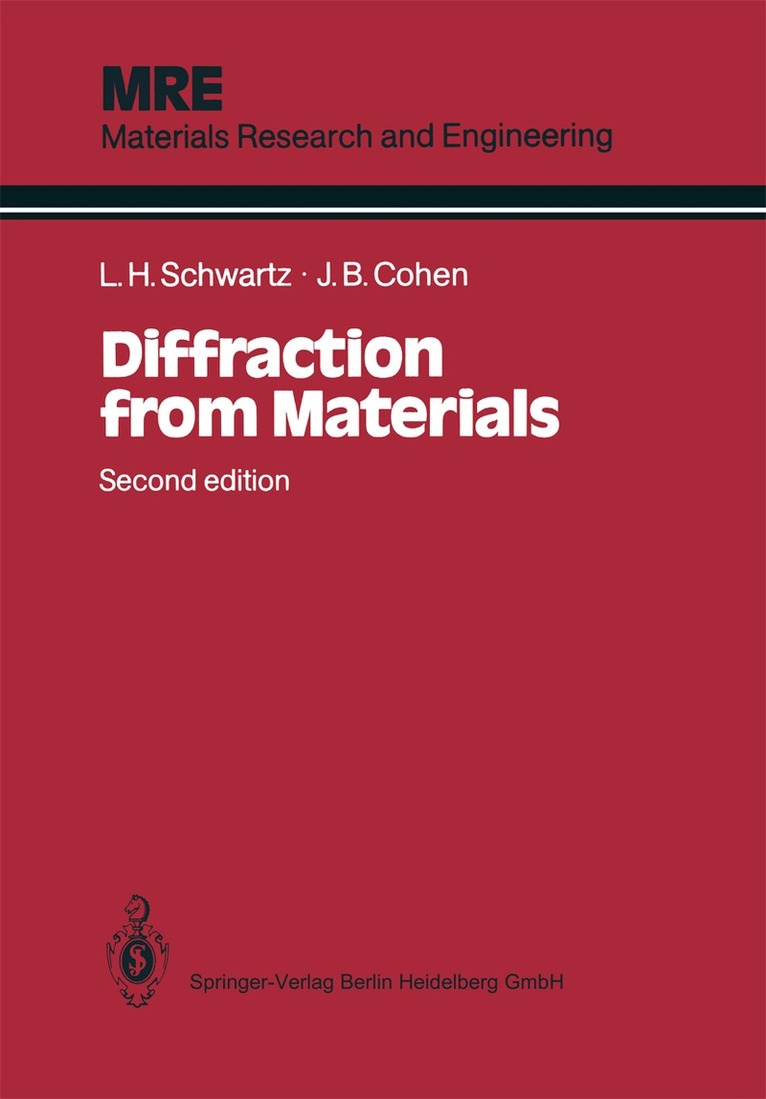
    Diffraction from Materials

    AvLyle H. Schwartz,Jerome B. Cohen

    Häftad, Engelska, 2013

    Del i serien Materials Research and Engineering

    1 086 kr

    Beställningsvara. Skickas inom 10-15 vardagar. Fri frakt över 249 kr.

    Beskrivning

    The atomic arrangements in condensed matter play an ever increasing role in many areas of science and technology - Materials Science and Engineering, Chemistry, Physics, Geology, Biology and Electrical, Civil, Mechanidtl and Chemical Engineering. Exciting discoveries in these fields in this century often stemmed from studies of these arrangements using diffraction: the structure and functions of DNA and other biological molecules, the configuration of polymer chains, the crystalline nature of metals and their imperfections, semiconductors and insulators, and -the links between their structures, their defects and material properties, and the interaction between materials and the environment. The broad, interdisciplinary character of diffraction studies makes them particularly exciting. With new tools such as the high-resolution electron microscope, new detectors, new techniques (such as EXAFS and glancing angle diffraction) and the new sources, the horizons of this field greatly expanded in the 1950's and 60's. Pulsed neutron sources and high intensity storage rings that came on the scene in the late 70's have opened up possibilities for new study to such vast horizons that it is hard to sit here writing this - there's so much to be done! Within the walls bounding each field of science or engineering, diffraction and structure is only one specialty. It is too easy for this topic to be developed in such a narrow way that sight is lost of the basic principles and broad possibilities.

    Produktinformation

    • Utgivningsdatum:2013-07-13
    • Mått:170 x 244 x 33 mm
    • Vikt:1 040 g
    • Format:Häftad
    • Språk:Engelska
    • Serie:Materials Research and Engineering
    • Antal sidor:591
    • Upplaga:2
    • Förlag:Springer-Verlag Berlin and Heidelberg GmbH & Co. KG
    • ISBN:9783642829291

    Utforska kategorier

    • Maskinteknik och material inom Naturvetenskap och teknik

    Innehållsförteckning

    • 1. Geometry of Crystal Structures.- 2. The Nature of Diffraction.- 3. Properties of Radiation Useful for Studying the Structure of Materials.- 4. Recording the Diffraction Pattern.- 5. Crystal Symmetry and the Diffraction Pattern.- 6. Determination of Crystal Structures.- 7. What Else Can We Learn from a Diffraction Experiment Besides the Average Structure?.- 8. The Dynamical Theory of Diffraction.- Appendix A: Location of Useful Information in International Tables for Crystallography.- Appendix B: Crystallographic Classification of the 230 Space Groups.- Appendix C: Determination of the Power of the Direct Beam in X-ray Diffraction.- Method 1: Aluminum Powder.- Method 2: Polystyrene.- Method 3: Multiple Foils.- Method 4: The Ionization Chamber.- References.- Appendix D: Accuracy in Digital Counting.- D.1 Some Additional Information on Counting Electronics.- D.2 Measurement of Dead Time.- Answers to Selected Problems.