• Fri frakt över 249 kr
  • •
  • Snabba leveranser
  • •
  • Billiga böcker
Kundservice

Du är på sajten för privatpersoner.

Företag, bibliotek eller offentlig verksamhet?

Du handlar på classic.bokus.com, där alla dina funktioner finns intakta.
Till classic.bokus.com
Bokus logotyp. Gå till startsidan.
  • Erbjudanden
  • Nyheter
  • Student
  • Topplistor
  • Barn & ungdom
  • Bokus Play
  • E-böcker
  • Pocketböcker
  • Spel & pussel

10% rabatt på allt med kod: NYSTART10 →

Sidfot

Mina sidor

    Hjälp

    • Kundservice
    • Vanliga frågor och svar
    • Frakt och leverans
    • Retur vid ångerrätt
    • Reklamera vara
    • Betalning
    • Köpvillkor
    • Allmänna villkor
    • Information om webbplatsens tillgänglighet

    Om Bokus

    • Om oss
    • Pressrum
    • För studenter
    • För företag
    • För bibliotek och offentlig verksamhet
    • För leverantörer
    • Hållbarhet

    Populärt

    • Aktuella erbjudanden
    • Presentkort
    • Studentlitteratur
    • Nya böcker
    • Topplistor
    • Signerade böcker
    • Engelska böcker

    Inspiration

    • Boktips
    • BookTok
    • Populära bokserier
    • Barnbokskaraktärer
    • Populära författare
    Logotyp för Bokus
    Följ oss på Facebook (extern länk)Följ oss på Instagram (extern länk)Följ oss på YouTube (extern länk)Följ oss på TikTok (extern länk)
    bokus @ CookiesAnpassa cookiesIntegritetspolicyKöpvillkor
    Till Citymail hemsida (extern länk)Till Budbee hemsida (extern länk)Till Postnord hemsida (extern länk)Till Schenker hemsida (extern länk)Till Early Bird hemsida (extern länk)Till Walleys hemsida (extern länk)
    1. Naturvetenskap och teknik
    2. Matematik och naturvetenskap
    3. Matematik
    4. Beräkning och matematisk analys

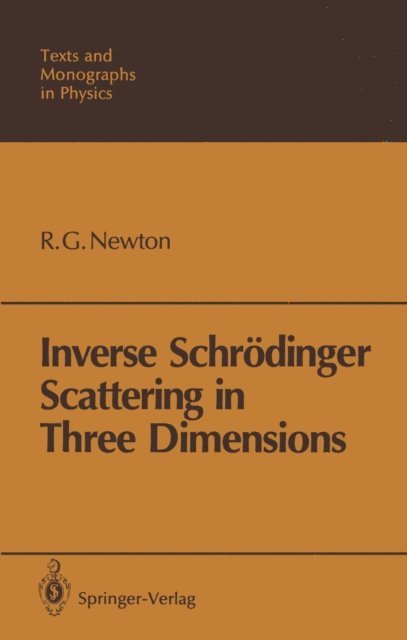
    Inverse Schrodinger Scattering in Three Dimensions

    AvRoger G. Newton

    E-bok
    PDF, Engelska, 2012

    710 kr

    Läs direkt i Bokus Reader – eller ladda ned till din enhet (PDF kräver ofta zoom och scroll på små skärmar).

    Beskrivning

    Most of the laws of physics are expressed in the form of differential equations; that is our legacy from Isaac Newton. The customary separation of the laws of nature from contingent boundary or initial conditions, which has become part of our physical intuition, is both based on and expressed in the properties of solutions of differential equations. Within these equations we make a further distinction: that between what in mechanics are called the equations of motion on the one hand and the specific forces and shapes on the other. The latter enter as given functions into the former. In most observations and experiments the "equations of motion," i. e. , the structure of the differential equations, are taken for granted and it is the form and the details of the forces that are under investigation. The method by which we learn what the shapes of objects and the forces between them are when they are too small, too large, too remote, or too inaccessi­ ble for direct experimentation, is to observe their detectable effects. The question then is how to infer these properties from observational data. For the theoreti­ cal physicist, the calculation of observable consequences from given differential equations with known or assumed forces and shapes or boundary conditions is the standard task of solving a "direct problem. " Comparison of the results with experiments confronts the theoretical predictions with nature.

    Produktinformation

    • Utgivningsdatum:2012-12-06
    • Språk:Engelska
    • Filformat:PDF
    • Kopieringsskydd:LCP
    • ISBN:9783642836718
    • Förlag:Springer Berlin Heidelberg

    Utforska kategorier

    • Beräkning och matematisk analys inom Naturvetenskap och teknik
    • Materietillstånd inom Naturvetenskap och teknik
    • Kvantfysik inom Naturvetenskap och teknik