• Fri frakt över 249 kr
  • •
  • Snabba leveranser
  • •
  • Billiga böcker
Kundservice

Du är på sajten för privatpersoner.

Företag, bibliotek eller offentlig verksamhet?

Du handlar på classic.bokus.com, där alla dina funktioner finns intakta.
Till classic.bokus.com
Bokus logotyp. Gå till startsidan.
  • Erbjudanden
  • Nyheter
  • Student
  • Topplistor
  • Barn & ungdom
  • Bokus Play
  • E-böcker
  • Pocketböcker
  • Spel & pussel

10% rabatt på allt med kod: NYSTART10 →

Sidfot

Mina sidor

    Hjälp

    • Kundservice
    • Vanliga frågor och svar
    • Frakt och leverans
    • Retur vid ångerrätt
    • Reklamera vara
    • Betalning
    • Köpvillkor
    • Allmänna villkor
    • Information om webbplatsens tillgänglighet

    Om Bokus

    • Om oss
    • Pressrum
    • För studenter
    • För företag
    • För bibliotek och offentlig verksamhet
    • För leverantörer
    • Hållbarhet

    Populärt

    • Aktuella erbjudanden
    • Presentkort
    • Studentlitteratur
    • Nya böcker
    • Topplistor
    • Signerade böcker
    • Engelska böcker

    Inspiration

    • Boktips
    • BookTok
    • Populära bokserier
    • Barnbokskaraktärer
    • Populära författare
    Logotyp för Bokus
    Följ oss på Facebook (extern länk)Följ oss på Instagram (extern länk)Följ oss på YouTube (extern länk)Följ oss på TikTok (extern länk)
    bokus @ CookiesAnpassa cookiesIntegritetspolicyKöpvillkor
    Till Citymail hemsida (extern länk)Till Budbee hemsida (extern länk)Till Postnord hemsida (extern länk)Till Schenker hemsida (extern länk)Till Early Bird hemsida (extern länk)Till Walleys hemsida (extern länk)
    1. Ekonomi och Ledarskap
    2. Nationalekonomi

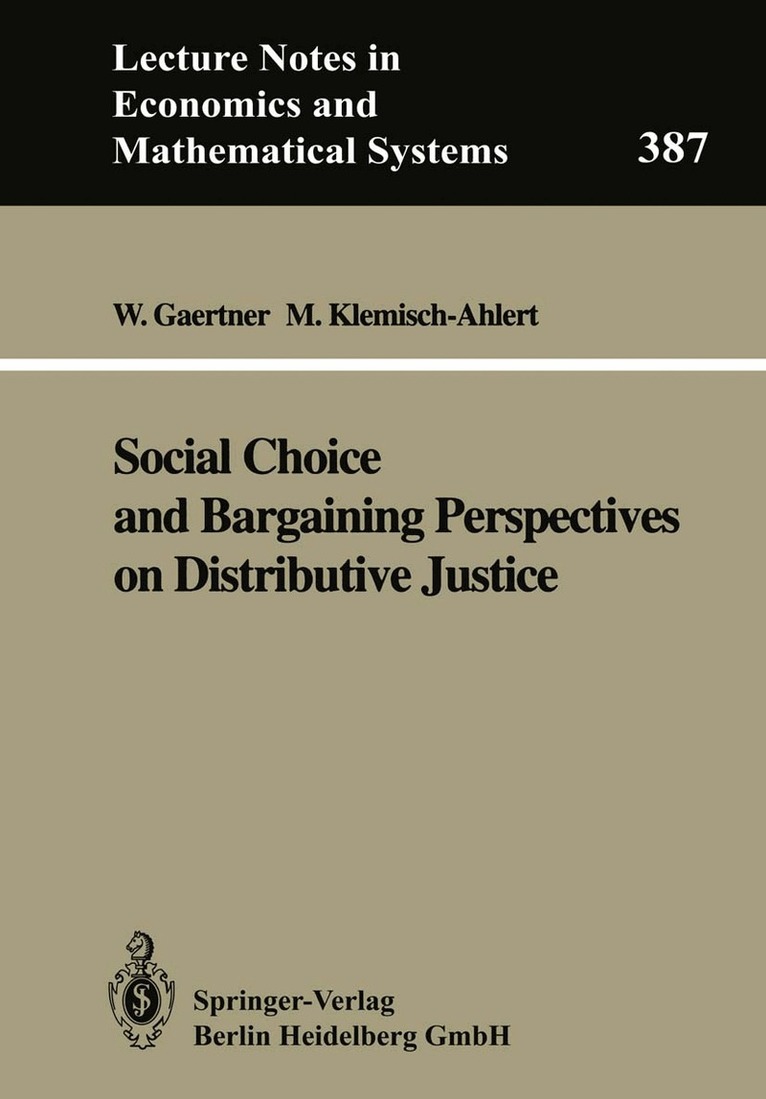
    Social Choice and Bargaining Perspectives on Distributive Justice

    AvMarlies Klemisch-Ahlert,Wulf Gaertner

    E-bok
    PDF, Engelska, 2013

    732 kr

    Läs direkt i Bokus Reader – eller ladda ned till din enhet (PDF kräver ofta zoom och scroll på små skärmar).

    Beskrivning

    It is probably fair to say that there does not exist a unique and generally accepted not ion of justice. Even if one confines oneself to economic justice one can still get many answers to the question of how justice - henceforth we shall use the term "distributive justice" ­ should be defined and characterized. This may be disappointing for the outside observer but one can also view this as achallenge, at least as long as one thinks that distributive justice is an issue economics should be concerned with. Many problems of distributive justice can be described as follows: There is a fixed collection of well-defined objects (usually commodi­ ties) which are quantitatively measurable and perfectly divisible. This collection is to be divided up among a certain number of individuals, the members of society, let ''s say. According to which principles or rules should this distribution be carried out? Should people be rewarded according to their ability or according to their needs? Should the distribution be such that nobody envies the bundle of any other member of society? Should the collection of entities be distributed in a way that yields the greatest benefi.

    Produktinformation

    • Utgivningsdatum:2013-06-29
    • Språk:Engelska
    • Filformat:PDF
    • Kopieringsskydd:LCP
    • ISBN:9783662028117
    • Förlag:Springer Berlin Heidelberg

    Utforska kategorier

    • Nationalekonomi inom Ekonomi och Ledarskap