• Fri frakt över 249 kr
  • •
  • Snabba leveranser
  • •
  • Billiga böcker
Kundservice

Du är på sajten för privatpersoner.

Företag, bibliotek eller offentlig verksamhet?

Du handlar på classic.bokus.com, där alla dina funktioner finns intakta.
Till classic.bokus.com
Bokus logotyp. Gå till startsidan.
  • Erbjudanden
  • Nyheter
  • Student
  • Topplistor
  • Barn & ungdom
  • Bokus Play
  • E-böcker
  • Pocketböcker
  • Spel & pussel

Må bättre, för mindre! Upp till 50% rabatt på hälsoböcker

Sidfot

Mina sidor

    Hjälp

    • Kundservice
    • Vanliga frågor och svar
    • Frakt och leverans
    • Retur vid ångerrätt
    • Reklamera vara
    • Betalning
    • Köpvillkor
    • Allmänna villkor
    • Information om webbplatsens tillgänglighet

    Om Bokus

    • Om oss
    • Pressrum
    • För studenter
    • För företag
    • För bibliotek och offentlig verksamhet
    • För leverantörer
    • Hållbarhet

    Populärt

    • Aktuella erbjudanden
    • Presentkort
    • Studentlitteratur
    • Nya böcker
    • Topplistor
    • Signerade böcker
    • Engelska böcker

    Inspiration

    • Boktips
    • BookTok
    • Populära bokserier
    • Barnbokskaraktärer
    • Populära författare
    Logotyp för Bokus
    Följ oss på Facebook (extern länk)Följ oss på Instagram (extern länk)Följ oss på YouTube (extern länk)Följ oss på TikTok (extern länk)
    bokus @ CookiesAnpassa cookiesIntegritetspolicyKöpvillkor
    Till Citymail hemsida (extern länk)Till Budbee hemsida (extern länk)Till Postnord hemsida (extern länk)Till Schenker hemsida (extern länk)Till Early Bird hemsida (extern länk)Till Walleys hemsida (extern länk)
    1. Naturvetenskap och teknik
    2. Teknik och industri
    3. Övrig teknik och tillämpad vetenskap

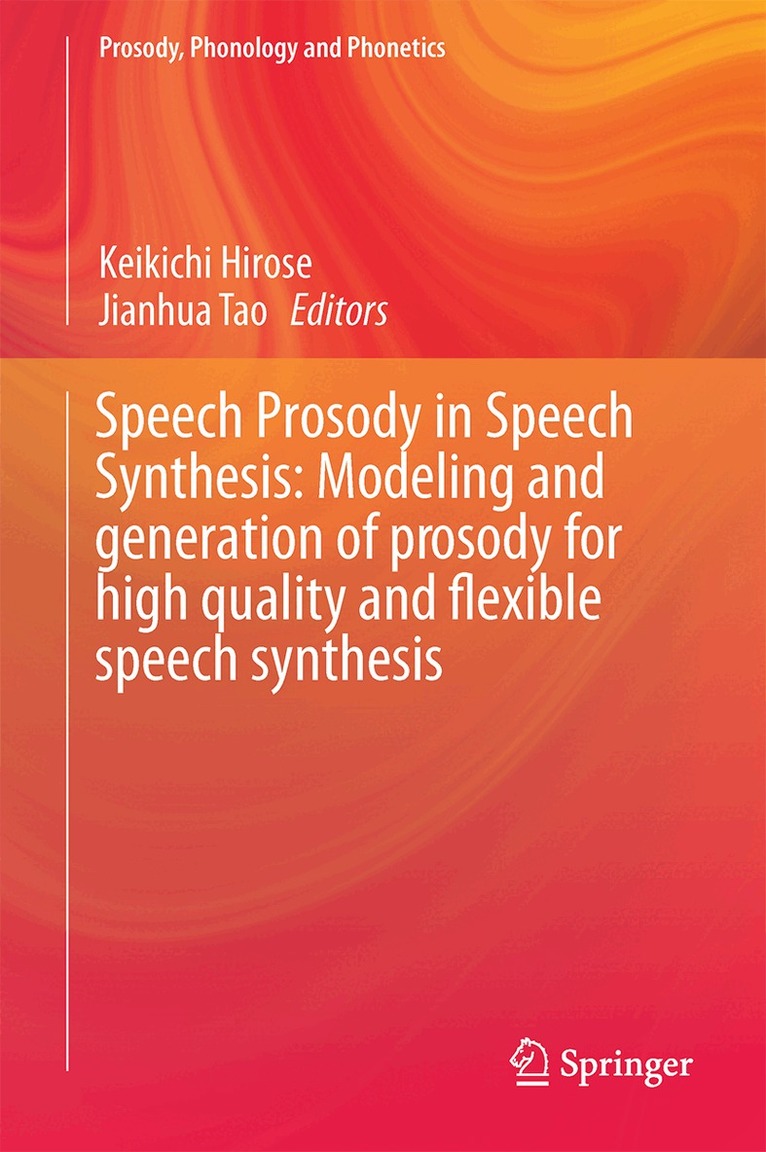
    Speech Prosody in Speech Synthesis: Modeling and generation of prosody for high quality and flexible speech synthesis

    AvKeikichi Hirose,Jianhua Tao

    Inbunden, Engelska, 2015

    Del i serien Prosody, Phonology and Phonetics

    1 194 kr

    Beställningsvara. Skickas inom 10-15 vardagar. Fri frakt över 249 kr.

    Beskrivning

    The volume addresses issues concerning prosody generation in speech synthesis, including prosody modeling, how we can convey para- and non-linguistic information in speech synthesis, and prosody control in speech synthesis (including prosody conversions). A high level of quality has already been achieved in speech synthesis by using selection-based methods with segments of human speech. Although the method enables synthetic speech with various voice qualities and speaking styles, it requires large speech corpora with targeted quality and style.Accordingly, speech conversion techniques are now of growing interest among researchers. HMM/GMM-based methods are widely used, but entail several major problems when viewed from the prosody perspective; prosodic features cover a wider time span than segmental features and their frame-by-frame processing is not always appropriate. The book offers a good overview of state-of-the-art studies on prosody in speech synthesis.

    Produktinformation

    • Utgivningsdatum:2015-03-23
    • Mått:155 x 235 x 18 mm
    • Vikt:506 g
    • Format:Inbunden
    • Språk:Engelska
    • Serie:Prosody, Phonology and Phonetics
    • Antal sidor:213
    • Upplaga:2015
    • Förlag:Springer-Verlag Berlin and Heidelberg GmbH & Co. KG
    • ISBN:9783662452578

    Utforska kategorier

    • Övrig teknik och tillämpad vetenskap inom Naturvetenskap och teknik
    • Referensverk och tvärvetenskap inom Samhälle och politik
    • Språkvetenskap och lingvistik inom Språk och ordböcker

    Mer om författaren

    Professor Keikichi Hirose received the B. E. degree in electrical engineering in 1972, and the M. E. and Ph. D. degrees in electronic engineering respectively in 1974 and 1977 from the University of Tokyo. From 1977, he is a faculty member at the University of Tokyo, and was a Professor of the Department of Electronic Engineering from 1994. Currently he is professor at the Department of Information and Communication Engineering, Graduate School of Information Science and Technology, University of Tokyo. From March 1987 to January 1988, he was Visiting Scientist at the Research Laboratory of Electronics, Massachusetts Institute of Technology, Cambridge, U.S.A. He has been engaged in a wide range of research on spoken language processing, including analysis, synthesis, recognition, dialogue systems, and computer-assisted language learning. From 2000 to 2004, he was Principal Investigator of the national project “Realization of advanced spoken language information processing utilizing prosodic features,” supported by the Japanese Government. He served as Chair of Speech Committee, Institute of Electronics, Information and Communication Engineers (IEICE)/Acoustical Society of Japan (ASJ) from 2003 to 2005. He is Chair of Speech Prosody Special Interest Group (SPro-SIG), ISCA, from October 2010.  He has been on the editorial board of Speech Communication journal since 2004 and on the editorial board of ETRI Journal since 2009. He is a Fellow of Institute of Information and Communication Engineering and a member of a number of academic societies, including IEEE, International Speech Communication Association (Board member), Acoustical Society of America, Acoustical Society of Japan, Information Processing Society of Japan, Japanese Society for Artificial Intelligence, and Research Institute of Signal Processing Japan (Board member).Jianhua Tao received the M.S. degree from Nanjing University in 1996 and the Ph.D. in Computer Science from TsinghuaUniversity in 2001. He is currently the professor at National Laboratory of Pattern Recognition (NLPR) of Chinese Academy of Sciences where he chairs the human computer speech interaction group. He developed quite several earliest versions of Speech systems, multimodal interaction system in China, and published more than 90 papers in IEEE Trans. on ASLP, ICASSP, Interspeech, ICME, ICPR, ICCV, ICIP, etc. He has been the main researcher and contributor of several national scientific projects supported by National Natural Science Foundation of China (NSFC), National High-Tech Program and International Cooperation Projects (863). Currently, He is one of the editorial board members of "International Journal on Computational Linguistics and Chinese Language Processing", “Journal on Multimodal User Interfaces (JMUI)”, “International Journal of Synthetic Emotions (IJSE)”, and the Steering Committee Member for the IEEE Transactions on Affective Computing. He was elected as vice-chair of ISCA Special Interesting Group of Chinese Spoken Language Processing from 2006, the executive committee member of HUMAINE association from 2007, the board member of COCOSDA from 2007, and is also the Council member of Chinese Speech Information Processing Society and the Acoustical Society of China.

    Innehållsförteckning

    • Modeling of Prosody.- ProZed: A speech prosody editor for linguists, using analysis-by-synthesis.- On degree of freedom in prosody modeling.- Extraction, analysis and synthesis of Fujisaki model parameters.- Probabilistic modeling of pitch contours towards prosody synthesis and conversion.- Para- and non-linguistic issues of prosody.- Communicative speech synthesis as pan-linguistic prosody control.- Mandarin stress analysis and prediction for speech synthesis.- Expressivity in interactive speech synthesis; some para-linguistic and non-linguistic issues of speech prosody for conversational dialogue systems.- Temporally variable multi-attribute morphing of arbitrarily many voices for exploratory research of speech prosody.- Control of prosody in speech synthesis.- Statistical models for dealing with discontinuity of fundamental frequency.- Use of generation process model for improved control of fundamental frequency contours in HMM-based speech synthesis.- Tone Nucleus Model for Emotional Mandarin Speech Synthesis.- Emphasis, word prominence, and continuous wavelet transform in the control of HMM based synthesis.- Exploiting alternatives for text-to-speech synthesis: from machine to human.- Prosody control and variation enhancement techniques for HMM-based expressive speech synthesis.