• Fri frakt över 249 kr
  • •
  • Snabba leveranser
  • •
  • Billiga böcker
Kundservice

Du är på sajten för privatpersoner.

Företag, bibliotek eller offentlig verksamhet?

Du handlar på classic.bokus.com, där alla dina funktioner finns intakta.
Till classic.bokus.com
Bokus logotyp. Gå till startsidan.
  • Erbjudanden
  • Student
  • Topplistor
  • Barn & ungdom
  • Bokus Play
  • E-böcker
  • Ljudböcker
  • Pocketböcker
  • Spel och pussel

5% studentrabatt – använd koden KURSBOK27 →

Sidfot

Mina sidor

    Hjälp

    • Kundservice
    • Vanliga frågor och svar
    • Frakt och leverans
    • Retur vid ångerrätt
    • Reklamera vara
    • Betalning
    • Köpvillkor
    • Allmänna villkor
    • Information om webbplatsens tillgänglighet

    Om Bokus

    • Om oss
    • Pressrum
    • För studenter
    • För företag
    • För bibliotek och offentlig verksamhet
    • För leverantörer
    • Hållbarhet

    Populärt

    • Aktuella erbjudanden
    • Presentkort
    • Studentlitteratur
    • Nya böcker
    • Topplistor
    • Signerade böcker
    • Engelska böcker

    Inspiration

    • Boktips
    • BookTok
    • Barnbokskaraktärer
    • Populära författare
    Logotyp för Bokus
    Följ oss på Facebook (extern länk)Följ oss på Instagram (extern länk)Följ oss på YouTube (extern länk)Följ oss på TikTok (extern länk)
    bokus @ CookiesAnpassa cookiesIntegritetspolicyKöpvillkor
    Till Citymail hemsida (extern länk)Till Budbee hemsida (extern länk)Till Postnord hemsida (extern länk)Till Schenker hemsida (extern länk)Till Early Bird hemsida (extern länk)Till Walleys hemsida (extern länk)
    1. Data och IT
    2. Systemvetenskap och AI

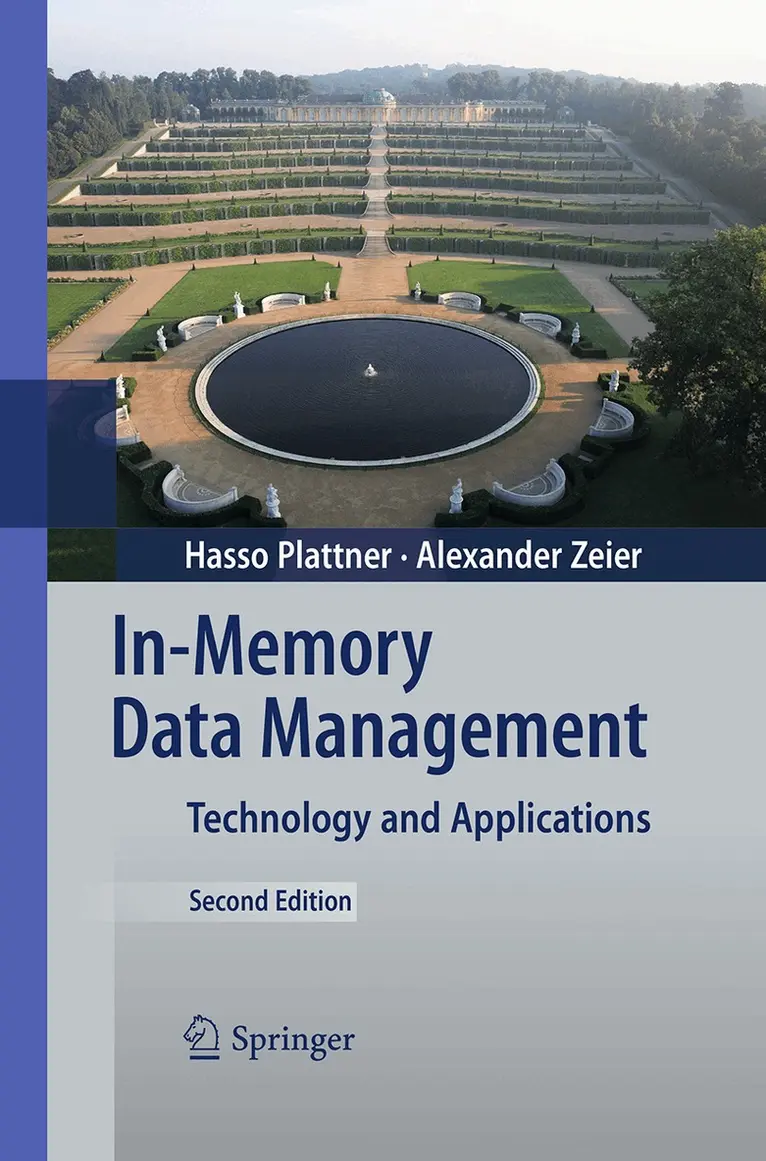
    In-Memory Data Management

    Technology and Applications

    AvHasso Plattner,Alexander Zeier

    Häftad, Engelska, 2016

    890 kr

    Beställningsvara. Skickas inom 10-15 vardagar. Fri frakt över 249 kr.

    Fler format och utgåvor

    Inbunden

    1 110 kr

    Beskrivning

    In the last fifty years the world has been completely transformed through the use of IT. We have now reached a new inflection point. This book presents, for the first time, how in-memory data management is changing the way businesses are run. Today, enterprise data is split into separate databases for performance reasons. Multi-core CPUs, large main memories, cloud computing and powerful mobile devices are serving as the foundation for the transition of enterprises away from this restrictive model. This book provides the technical foundation for processing combined transactional and analytical operations in the same database. In the year since we published the first edition of this book, the performance gains enabled by the use of in-memory technology in enterprise applications has truly marked an inflection point in the market. The new content in this second edition focuses on the development of these in-memory enterprise applications, showing how they leverage the capabilities ofin-memory technology.  The book is intended for university students, IT-professionals and IT-managers, but also for senior management who wish to create new business processes.

    Produktinformation

    • Utgivningsdatum:2016-08-23
    • Mått:155 x 235 x 17 mm
    • Vikt:464 g
    • Format:Häftad
    • Språk:Engelska
    • Antal sidor:267
    • Upplaga:2
    • Förlag:Springer-Verlag Berlin and Heidelberg GmbH & Co. KG
    • ISBN:9783662520499

    Utforska kategorier

    • Systemvetenskap och AI inom Data och IT
    • Hårdvara inom Data och IT
    • Affärsförhandlingar inom Ekonomi och Ledarskap

    Mer om författaren

    Prof. Dr. h.c. Hasso Plattner is a co-founder of SAP AG, where he served as the CEO until 2003 and has since been chairman of the supervisory board. SAP AG is today the leading provider of enterprise software solutions. In his role as chief software advisor, he concentrates on defining the mid- and long- term  technology strategy and direction of SAP. Hasso Plattner received his diploma in communications engineering  from the University of Karlsruhe. In recent years, he has been focusing on teaching and research in the field of business computing  and software engineering at large. In 1998, he founded the Hasso-Plattner-Institute (HPI) in Potsdam, Germany. At the HPI, approximately 480 students are currently pursuing their Bachelors' and Masters' degrees in IT Systems Engineering with the help of roughly 50 professors and lecturers. The HPI currently has about 100 PhD candidates. Hasso Plattner leads one of the research groups at HPI which focuses mainly on In-Memory Data Managementfor Enterprise Applications and Human-Centered Software Design and Engineering.Dr. Alexander Zeier graduated from the University of Wuerzburg in business management and successfully completed his studies in information technology at the TU Chemnitz. He worked for a few years as a strategic IT consultant, before gaining his Ph.D. in Supply Chain Management (SCM) at the University of Erlangen-Nuremberg.  He has 20 years experience with IT/SAP Systems and started working for SAP in 2002 as product manager with overall responsibility for the SCM Software, SAP's first large In-Memory Application. Since 2006 he has been Deputy Chair Enterprise Platform and Integration Concepts of Prof. Hasso Plattner at the Hasso Plattner Institute in Potsdam, focusing on real-time In-Memory Enterprise Systems. During that time he has also been Executive Director for the European Section of the MIT Forum for Supply Chain Innovation. Since March 2012 Dr. Zeier has been working at the Massachusetts Institute of Technology (MIT) as Visiting Professor, lecturing and conducting research in the area of In-Memory Technology & Applications, and Supply Chain Innovation. He is the author of more than 150 journal articles and papers and has also published six books on IT and SAP.

    Innehållsförteckning

    • 1. Introduction. Lloyd Strickland, Julia Weckend.- Section 1: Science. 2. Philosophy and science in Leibniz. Maria Rosa Antognazza.- 3. Between learned science and technical knowledge: Leibniz, Leeuwenhoek and the school for microscopists. Alessandro Becchi.- 4. Leibniz, organic matter and astrobiology. Richard T. W. Arthur.- Section 2: Metaphysics. 5. Plenitude and mirrors of God in Leibniz. Nicholas Jolley.- 6. As matter to form so passive to active? The irreducible metaphysics of Leibniz’s Dynamics. Tzuchien Tho.- 7. Conceptual analysis and ontology in the Leibniz – De Volder correspondence. Stefano di Bella.- Section 3: Epistemology. 8. Leibniz’s empirical, not empiricist methodology. Dale Jacquette.- 9. Leibniz on certainty. Julia Weckend.- 10. Leibniz and probability in the moral domain. Chris Meyns.- Section 4: Religion and Theology. 11. How Leibniz would have responded to the Lisbon earthquake. Lloyd Strickland.- 12. Leibniz on the efficacy and economy of divine grace. Agustín Echavarría.- 13. Eternal punishment, universal salvation and pragmatic theology in Leibniz. Paul Lodge.- Biographical conclusion. 14. In the “hinterland” of globalization? Leibniz and the European expansion. Michael Kempe.- Index.