• Fri frakt över 249 kr
  • •
  • Snabba leveranser
  • •
  • Billiga böcker
Kundservice

Du är på sajten för privatpersoner.

Företag, bibliotek eller offentlig verksamhet?

Du handlar på classic.bokus.com, där alla dina funktioner finns intakta.
Till classic.bokus.com
Bokus logotyp. Gå till startsidan.
  • Erbjudanden
  • Nyheter
  • Student
  • Topplistor
  • Barn & ungdom
  • Bokus Play
  • E-böcker
  • Pocketböcker
  • Spel & pussel

10% rabatt på allt med kod: NYSTART10 →

Sidfot

Mina sidor

    Hjälp

    • Kundservice
    • Vanliga frågor och svar
    • Frakt och leverans
    • Retur vid ångerrätt
    • Reklamera vara
    • Betalning
    • Köpvillkor
    • Allmänna villkor
    • Information om webbplatsens tillgänglighet

    Om Bokus

    • Om oss
    • Pressrum
    • För studenter
    • För företag
    • För bibliotek och offentlig verksamhet
    • För leverantörer
    • Hållbarhet

    Populärt

    • Aktuella erbjudanden
    • Presentkort
    • Studentlitteratur
    • Nya böcker
    • Topplistor
    • Signerade böcker
    • Engelska böcker

    Inspiration

    • Boktips
    • BookTok
    • Populära bokserier
    • Barnbokskaraktärer
    • Populära författare
    Logotyp för Bokus
    Följ oss på Facebook (extern länk)Följ oss på Instagram (extern länk)Följ oss på YouTube (extern länk)Följ oss på TikTok (extern länk)
    bokus @ CookiesAnpassa cookiesIntegritetspolicyKöpvillkor
    Till Citymail hemsida (extern länk)Till Budbee hemsida (extern länk)Till Postnord hemsida (extern länk)Till Schenker hemsida (extern länk)Till Early Bird hemsida (extern länk)Till Walleys hemsida (extern länk)
    1. Ekonomi och Ledarskap
    2. Ledarskapsböcker

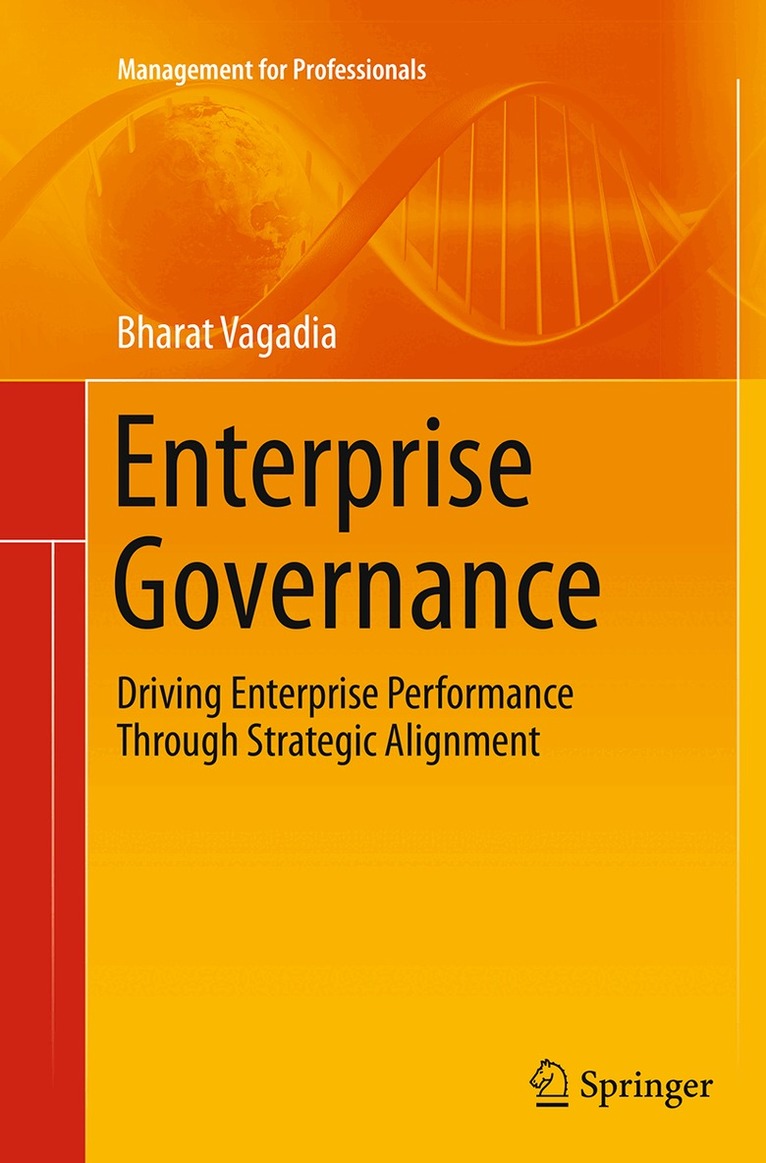
    Enterprise Governance

    Driving Enterprise Performance Through Strategic Alignment

    AvBharat Vagadia

    Häftad, Engelska, 2016

    Del i serien Management for Professionals

    563 kr

    Beställningsvara. Skickas inom 10-15 vardagar. Fri frakt över 249 kr.

    Fler format och utgåvor

    Inbunden

    563 kr

    E-bok

    734 kr

    Beskrivning

    This book is written for business leaders and those that govern organisations. All high performing organisations excel in achieving 7 organisational outcomes: Accountability, Awareness, Adaptability, Agility, Alignment, Action and Achievement. The enterprise governance framework must deliver on these 7 As through penetrating and integrating three organisational governance layers to drive high performance. These include: corporate governance, strategic governance and operational governance. The book unifies traditional corporate governance, leadership, and strategic management processes, whilst seeking to understand what actually happens on the ground to keep the organisation working and delivering ongoing value to its stakeholders. It synthesises these separate streams into a unified enterprise governance framework, posing some challenging questions whilst providing clear insight into how you implement enterprise governance: something that helps deliver on the 7 As and ultimately high performance.

    Produktinformation

    • Utgivningsdatum:2016-08-27
    • Mått:155 x 235 x 18 mm
    • Vikt:482 g
    • Format:Häftad
    • Språk:Engelska
    • Serie:Management for Professionals
    • Antal sidor:288
    • Förlag:Springer-Verlag Berlin and Heidelberg GmbH & Co. KG
    • ISBN:9783662522370

    Utforska kategorier

    • Ledarskapsböcker inom Ekonomi och Ledarskap
    • Organisationsteori inom Ekonomi och Ledarskap
    • Affärsstrategi inom Ekonomi och Ledarskap

    Mer om författaren

    Dr Vagadia is a director of a sourcing and governance research and advisory firm (www.Op2i.com), is a Board Director of the UK National Outsourcing Association, director of an enterprise governance software platform (www.GovernanceDirector.com), an advisor to the International Telecommunications Union (ITU) on policy and regulatory affairs, and teaches on MBA programs at UK business schools. Dr Vagadia has a PhD researching the interplay of legal contracts and trust in outsourcing relationships. He has been awarded an LLM in Commercial Law, an MBA from Imperial Business School, a 1st Class (Hons) in Engineering from King’s College London, and a CIM Diploma in Marketing.

    Recensioner i media

    "The significant and stimulating topic of corporate governance (CG) has become richer with this timely, conceptual, candid and provocative book that aids with an applied and intellectual discussion on delivering sustained performance improvement for organisations. The failure of CG in the recent financial crisis has exasperated the need for a book with such an agenda, especially as recent outputs in this area have assumed that CG on its own, significantly impacts the operation of organisations. The unique stand of this book is its concept to portray CG, not as a stand-alone governance entity, but as part of a broader area of governance that also includes both strategic and operational governance, and it demonstrates how these complement each other. The book claims that the synergetic triangulation of these three layers of governance has deeper and greater meaningful impact on organisational behaviour and performance. Evidence is provided through organisations that were perceived to have only a robust 'corporate' governance strategy and were cynically viewed in the way they advanced during the financial crisis. The author has derived rich data through interviews with business leaders from a diverse range of organisations to explain their understanding of good governance. The book thus amalgamates these three separate areas into an integrated enterprise governance framework, posing some challenging questions while providing clear insight into how organisations should implement enterprise governance and in the process help drive organisational performance and become successful organisations. Overall, this book suggests that all high performing organisations would eventually excel in achieving seven organisational outcomes (7A's): Accountability, Awareness, Adaptability, Agility, Alignment, Action and Achievement, if the above integrated nterprise governance framework is followed. The book starts with identifying differences between governance and management, which it claims are often misinterpreted. It is claimed that these differences, albeit subtle, have led to ignoring areas of 'strategic' and 'operational' governance processes. The book discusses the varying complexities and intricacies involved within the environments in which organisations operate in. This lead to organisations getting blurred when it came to the boundaries between governance, leadership and management and this is compounded when it comes to identifying the responsibility of and for each of these. The author calls this the concept of 'enterprise governance'. The book then discusses different governance layers, involving operational governance, then strategic governance, corporate governance, and ultimately joint governance. Thus, this book develops upon a concept that 'governance' is something that is not just an activity that resides within boardrooms, not something that is done because there are compliance obligations, is not about policies and authority levels, but is an enterprise-wide philosophy, and a 'cultural thing'. The book thus unifies traditional corporate governance, leadership, and strategic management process and thus is an integration of processes, structure and systems, with clear demarcation of accountability and responsibility between the various layers within an organisation. The book prescribes what it calls a mantra of participative 'self-governance', wherein it claims that it is not the leaders and governors that govern the behaviours and performance of the organisation but the organisation needs to take a stakeholder perspective. Here, it defines self-governance as stakeholders being proactively involved in, contributing to and participating in the governance of their organisation. Alongside, the book also prescribes self-discipline by organisational members/stakeholders. The uniqueness of the book is that it again draws on academic and theoretical research, but remains practitioner focused, thus maintaining both rigour and relevance. In conclusion, this book will be a great asset for various stakeholders, including business leaders, NGOs, not-for-profit entities or any other form of organisations that wishes to prosper over the longer term. It is also useful if one has an interest in any form of governance; strategic management process; organisational structures; leadership; performance management; risk management, compliance assurance; organisational alignment, oversight and insight mechanisms. It is an easy read and includes a take-away at the end of key chapters." Dr Vijay Pereira, Senior Lecturer (Associate Professor) and Leader in Knowledge Services (Organisational Studies and HRM), Portsmouth Business School, University of Portsmouth, UK "A year before the global financial crisis of 2008 I was with a group of developing leaders at a major UK bank. An executive leader had been invited to come and share his wisdom. I asked him over dinner why the bank was continuing to lend to customers it knew would not be able to repay. 'All our competitors are doing so and in any case this is cyclical' he said. As the financial debacle unfolded and then the crisis of leadership extended to all the key institutions I had previously looked up to, I reflected frequently on the comments from that leader who bore the euphemistic title Head of Risk. In this book Dr Vagadia draws from a range of sources, theories, real organisations, leaders and not least of all his own commercial and academic experience, to present a compelling case for the concept of 'enterprise governance'. Whilst this alone may not be sufficient to fix the crisis of leadership facing society today, it does cause the reader to step back and challenge how narrowly governance has been defined in organisations. Appropriately in my view it also challenges the traditional business schools to consider what short shrift they give to such an important concept. The author has an ability to draw on wide-ranging concepts and relate them to corporate reality. There are few such books which can draw parallels between corporate governance, particle physics and Indian history! However it is clear that Dr Vagadia is more than a thinker and has worked closely with major corporations - this means he is able to propose his conceptualisation of enterprise governance with a credible degree of granularity. I believe the theme of ethical leadership is more relevant now than ever and as such this book has a place within that body of literature. It presents both challenges to the reader and some practical guidance. Moreover good use is made of interviews the author has conducted with top level leaders from the business world and public service sector. Having now read Dr Vagadia's book I wish it had been written a few years ago as it might have had an impact on that Head of Risk which might just have had an impact on organisational behaviour." Dr Richard Hale, Professor in Management Development, International Management Centres Association

    Innehållsförteckning

    • A New Approach and Model for Organisational Governance.- Delivering High Performance Organisations Through Enterprise-Wide Governance and Strategic Leadership.- Operational Governance.- Strategic Governance.- Corporate Governance.- Joint Governance.- Systematising Enteprise Governance.- Annex: A Summary of the Corporate Governance Requirements of Different Countries.- Further Reading.