• Fri frakt över 249 kr
  • •
  • Snabba leveranser
  • •
  • Billiga böcker
Kundservice

Du är på sajten för privatpersoner.

Företag, bibliotek eller offentlig verksamhet?

Du handlar på classic.bokus.com, där alla dina funktioner finns intakta.
Till classic.bokus.com
Bokus logotyp. Gå till startsidan.
  • Erbjudanden
  • Nyheter
  • Student
  • Topplistor
  • Barn & ungdom
  • Bokus Play
  • E-böcker
  • Pocketböcker
  • Spel & pussel

10% rabatt på allt med kod NYSTART10 →

Sidfot

Mina sidor

    Hjälp

    • Kundservice
    • Vanliga frågor och svar
    • Frakt och leverans
    • Retur vid ångerrätt
    • Reklamera vara
    • Betalning
    • Köpvillkor
    • Allmänna villkor
    • Information om webbplatsens tillgänglighet

    Om Bokus

    • Om oss
    • Pressrum
    • För studenter
    • För företag
    • För bibliotek och offentlig verksamhet
    • För leverantörer
    • Hållbarhet

    Populärt

    • Aktuella erbjudanden
    • Presentkort
    • Studentlitteratur
    • Nya böcker
    • Topplistor
    • Signerade böcker
    • Engelska böcker

    Inspiration

    • Boktips
    • BookTok
    • Populära bokserier
    • Barnbokskaraktärer
    • Populära författare
    Logotyp för Bokus
    Följ oss på Facebook (extern länk)Följ oss på Instagram (extern länk)Följ oss på YouTube (extern länk)Följ oss på TikTok (extern länk)
    bokus @ CookiesAnpassa cookiesIntegritetspolicyKöpvillkor
    Till Citymail hemsida (extern länk)Till Budbee hemsida (extern länk)Till Postnord hemsida (extern länk)Till Schenker hemsida (extern länk)Till Early Bird hemsida (extern länk)Till Walleys hemsida (extern länk)
    1. Naturvetenskap och teknik
    2. Teknik och industri
    3. Byggnadsteknik

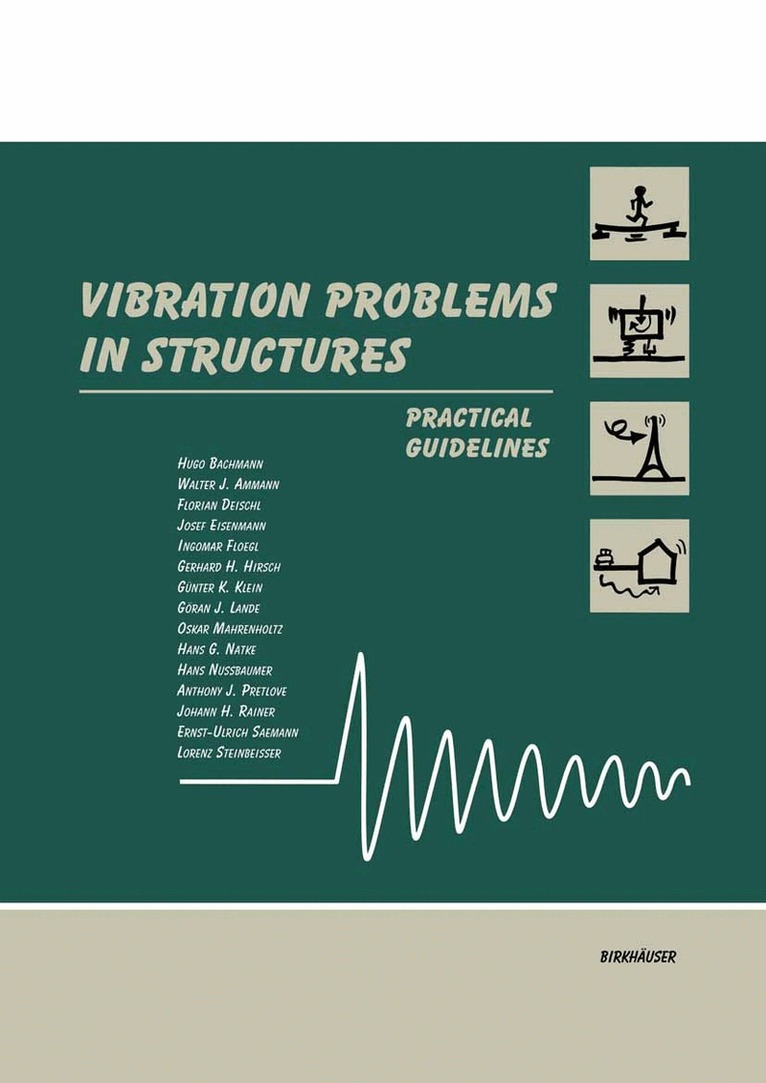
    Vibration Problems in Structures

    Practical Guidelines

    AvHugo Bachmann,Walter J. Ammann

    Inbunden, Engelska, 1994

    869 kr

    Beställningsvara. Skickas inom 10-15 vardagar. Fri frakt över 249 kr.

    Fler format och utgåvor

    Häftad

    869 kr

    Beskrivning

    Authors: Hugo Bachmann, Walter J. Ammann, Florian Deischl, Josef Eisenmann, Ingomar Floegl, Gerhard H. Hirsch, Gunter K. Klein, Goran J. Lande, Oskar Mahrenholtz, Hans G. Natke, Hans Nussbaumer, Anthony J. Pretlove, Johann H. Rainer, Ernst-Ulrich Saemann, Lorenz Steinbeisser. Large structures such as factories, gymnasia, concert halls, bridges, towers, masts and chimneys can be detrimentally affected by vibrations. These vibrations can cause either serviceability problems, severely hampering the user's comfort, or safety problems. The aim of this book is to provide structural and civil engineers working in construction and environmental engineering with practical guidelines for counteracting vibration problems. Dynamic actions are considered from the following sources of vibration: - human body motions, - rotating, oscillating and impacting machines, - wind flow, - road traffic, railway traffic and construction work. The main section of the book presents tools that aid in decision-making and in deriving simple solutions to cases of frequently occurring "normal" vibration problems. Complexer problems and more advanced solutions are also considered.In all cases these guidelines should enable the engineer to decide on appropriate solutions expeditiously. The appendices of the book contain fundamentals essential to the main chapters.

    Produktinformation

    • Utgivningsdatum:1994-12-20
    • Mått:152 x 229 x 19 mm
    • Vikt:554 g
    • Format:Inbunden
    • Språk:Engelska
    • Antal sidor:237
    • Förlag:Birkhauser Verlag AG
    • ISBN:9783764351489

    Utforska kategorier

    • Byggnadsteknik inom Naturvetenskap och teknik
    • Maskinteknik och material inom Naturvetenskap och teknik

    Innehållsförteckning

    • 1 Vibrations induced by people.- 1.1 Pedestrian bridges.- 1.2 Floors with walking people.- 1.3 Floors for sport or dance activities.- 1.4 Floors with fixed seating and spectator galleries.- 1.5 High-diving platforms.- References to Chapter 1.- 2 Machinery-induced vibrations.- 2.1 Machine foundations and supports.- 2.2 Bell towers.- 2.3 Structure-borne sound.- 2.4 Ground-transmitted vibrations.- References to Chapter 2.- 3 Wind-induced vibrations.- 3.1 Buildings.- 3.2 Towers.- 3.3 Chimneys and Masts.- 3.4 Guyed Masts.- 3.5 Pylons.- 3.6 Suspension and Cable-Stayed Bridges.- 3.7 Cantilevered Roofs.- References to Chapter 3.- 4 Vibrations induced by traffic and construction activity.- 4.1 Roads.- 4.2 Railways.- 4.3 Bridges.- 4.4 Construction Work.- References to Chapter 4.- A Basic vibration theory and its application to beams and plates.- A.1 Free vibration.- A.2 Forced vibration.- A.3 Harmonic excitation.- A.4 Periodic excitation.- A.4.1 Fourier analysis of the forcing function.- A.4.2 How the Fourier decomposition works.- A.4.3 The Fourier Transform.- A.5 Tuning of a structure.- A.6 Impedance.- A.7 Vibration Isolation (Transmissibility).- A.8 Continuous systems and their equivalent SDOF systems.- B Decibel Scales.- B.1 Sound pressure level.- B.2 Weighting of the sound pressure level.- C Damping.- C.1 Introduction.- C.2 Damping Quantities (Definitions, Interpretations).- C.3 Measurement of damping properties of structures.- C.3.1 Decay curve method.- C.3.2 Bandwidth method.- C.3.3 Conclusions.- C.4 Damping mechanisms in reinforced concrete.- C.5 Overall damping of a structure.- C.5.1 Damping of the bare structure.- C.5.2 Damping by non-structural elements.- C.5.3 Damping by energy radiation to the soil.- C.5.4 Overall damping.- D Tuned vibration absorbers.- D.1 Definition.- D.2 Modelling and differential equations of motion.- D.3 Optimum tuning and optimum damping of the absorber.- D.4 Practical hints.- E Wave Propagation.- E.1 Introduction.- E.2 Wave types and propagation velocities.- E.3 Attenuation laws.- F Behaviour of concrete and steel under dynamic actions.- F.1 Introduction.- F.2 Behaviour of concrete.- F.2.1 Modulus of elasticity.- F.2.2 Compressive strength.- F.2.3 Ultimate strain in compression.- F.2.4 Tensile strength.- F.2.5 Ultimate strain in tension.- F.2.6 Bond between reinforcing steel and concrete.- F.3 Behaviour of reinforcing steel.- F.3.1 Modulus of Elasticity.- F.3.2 Strength in Tension.- F.3.3 Strain in tension.- G Dynamic forces from rhythmical human body motions.- G.1 Rhythmical human body motions.- G.2 Representative types of activity.- G.3 Normalised dynamic forces.- H Dynamic effects from wind.- H.1 Basic theory.- H.l.1 Wind speed and pressure.- H.l.2 Statistical characteristics.- a) Gust spectrum.- b) Aerodynamic admittance function.- c) Spectral density of the wind force.- H.1.3 Dynamic effects.- H.2 Vibrations in along-wind direction induced by gusts.- H.2.1 Spectral methods.- a) Mechanical amplification function.- b) Spectral density of the system response.- H.2.2 Static equivalent force method based on stochastic loading.- H.2.3 Static equivalent force method based on deterministic loading.- H.2.4 Remedial measures.- H.3 Vibrations in along-wind direction induced by buffeting.- H.4 Vibrations in across-wind direction induced by vortex-shedding.- H.4.1 Single structures.- H.4.2 Several structures one behind another.- H.4.3 Conical structures.- H.4.4 Vibrations of shells.- H.5 Vibrations in across-wind direction: Galloping.- H.6 Vibrations in across-wind direction: flutter.- H.7 Damping of high and slenderRC structures subjected to wind.- I Human response to vibrations.- I.1 Introduction.- I.2 Codes of practice.- I.2.1 ISO 2631.- I.2.2 DIN 4150/2.- J Building response to vibrations.- J.1 General.- J.2 Examples of recommended limit values.- References to the Appendices.- List of Codes and Standards.