• Fri frakt över 249 kr
  • •
  • Snabba leveranser
  • •
  • Billiga böcker
Kundservice

Du är på sajten för privatpersoner.

Företag, bibliotek eller offentlig verksamhet?

Du handlar på classic.bokus.com, där alla dina funktioner finns intakta.
Till classic.bokus.com
Bokus logotyp. Gå till startsidan.
  • Erbjudanden
  • Nyheter
  • Student
  • Topplistor
  • Barn & ungdom
  • Bokus Play
  • E-böcker
  • Pocketböcker
  • Spel & pussel

10% rabatt på allt med kod: NYSTART10 →

Sidfot

Mina sidor

    Hjälp

    • Kundservice
    • Vanliga frågor och svar
    • Frakt och leverans
    • Retur vid ångerrätt
    • Reklamera vara
    • Betalning
    • Köpvillkor
    • Allmänna villkor
    • Information om webbplatsens tillgänglighet

    Om Bokus

    • Om oss
    • Pressrum
    • För studenter
    • För företag
    • För bibliotek och offentlig verksamhet
    • För leverantörer
    • Hållbarhet

    Populärt

    • Aktuella erbjudanden
    • Presentkort
    • Studentlitteratur
    • Nya böcker
    • Topplistor
    • Signerade böcker
    • Engelska böcker

    Inspiration

    • Boktips
    • BookTok
    • Populära bokserier
    • Barnbokskaraktärer
    • Populära författare
    Logotyp för Bokus
    Följ oss på Facebook (extern länk)Följ oss på Instagram (extern länk)Följ oss på YouTube (extern länk)Följ oss på TikTok (extern länk)
    bokus @ CookiesAnpassa cookiesIntegritetspolicyKöpvillkor
    Till Citymail hemsida (extern länk)Till Budbee hemsida (extern länk)Till Postnord hemsida (extern länk)Till Schenker hemsida (extern länk)Till Early Bird hemsida (extern länk)Till Walleys hemsida (extern länk)
    1. Naturvetenskap och teknik
    2. Matematik och naturvetenskap
    3. Matematik

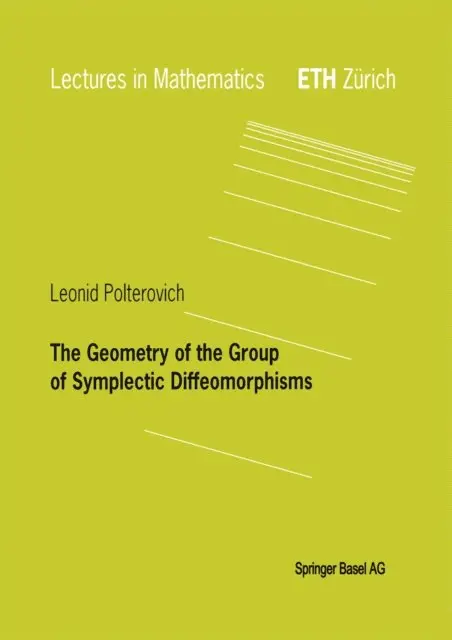
    Geometry of the Group of Symplectic Diffeomorphism

    AvLeonid Polterovich

    Häftad, Engelska, 2001

    Del i serien Lectures in Mathematics. ETH Zürich

    816 kr

    Beställningsvara. Skickas inom 10-15 vardagar. Fri frakt över 249 kr.

    Fler format och utgåvor

    E-bok

    1 026 kr

    Beskrivning

    The group of Hamiltonian diffeomorphisms Ham(M, 0) of a symplectic mani­ fold (M, 0) plays a fundamental role both in geometry and classical mechanics. For a geometer, at least under some assumptions on the manifold M, this is just the connected component of the identity in the group of all symplectic diffeomorphisms. From the viewpoint of mechanics, Ham(M,O) is the group of all admissible motions. What is the minimal amount of energy required in order to generate a given Hamiltonian diffeomorphism I? An attempt to formalize and answer this natural question has led H. Hofer [HI] (1990) to a remarkable discovery. It turns out that the solution of this variational problem can be interpreted as a geometric quantity, namely as the distance between I and the identity transformation. Moreover this distance is associated to a canonical biinvariant metric on Ham(M, 0). Since Hofer's work this new ge­ ometry has been intensively studied in the framework of modern symplectic topology. In the present book I will describe some of these developments. Hofer's geometry enables us to study various notions and problems which come from the familiar finite dimensional geometry in the context of the group of Hamiltonian diffeomorphisms. They turn out to be very different from the usual circle of problems considered in symplectic topology and thus extend significantly our vision of the symplectic world.

    Produktinformation

    • Utgivningsdatum:2001-03-01
    • Mått:170 x 244 x 8 mm
    • Vikt:254 g
    • Format:Häftad
    • Språk:Engelska
    • Serie:Lectures in Mathematics. ETH Zürich
    • Antal sidor:136
    • Förlag:Birkhauser Verlag AG
    • ISBN:9783764364328

    Utforska kategorier

    • Matematik inom Naturvetenskap och teknik
    • Klassisk mekanik inom Naturvetenskap och teknik

    Innehållsförteckning

    • Preface.- 1 Introducing the Group.- 1.1 The origins of Hamiltonian diffeomorphisms.- 1.2 Flows and paths of diffeomorphisms.- 1.3 Classical mechanics.- 1.4 The group of Hamiltonian diffeomorphisms.- 1.5 Algebraic properties of Ham(M, Q).- 2 Introducing the Geometry.- 2.1 A variational problem.- 2.2 Biinvariant geometries on Ham(M, Q).- 2.3 The choice of the norm: Lp vs. Loa.- 2.4 The concept of displacement energy.- 3 Lagrangian Submanifolds.- 3.1 Definitions and examples.- 3.2 The Liouville class.- 3.3 Estimating the displacement energy.- 4 The $$\bar \partial$$-Equation.- 4.1 Introducing the $$\bar \partial$$-operator.- 4.2 The boundary value problem.- 4.3 An application to the Liouville class.- 4.4 An example.- 5 Linearization.- 5.1 The space of periodic Hamiltonians.- 5.2 Regularization.- 5.3 Paths in a given homotopy class.- 6 Lagrangian Intersections.- 6.1 Exact Lagrangian isotopies.- 6.2 Lagrangian intersections.- 6.3 An application to Hamiltonian loops.- 7 Diameter.- 7.1 The starting estimate.- 7.2 The fundamental group.- 7.3 The length spectrum.- 7.4 Refining the estimate.- 8 Growth and Dynamics.- 8.1 Invariant tori of classical mechanics.- 8.2 Growth of one-parameter subgroups.- 8.3 Curve shortening in Hofer’s geometry.- 8.4 What happens when the asymptotic growth vanishes?.- 9 Length Spectrum.- 9.1 The positive and negative parts of Hofer’s norm.- 9.2 Symplectic fibrations over S2.- 9.3 Symplectic connections.- 9.4 An application to length spectrum.- 10 Deformations of Symplectic Forms.- 10.1 The deformation problem.- 10.2 The $$\bar \partial$$-equation revisited.- 10.3 An application to coupling.- 10.4 Pseudo-holomorphic curves.- 10.5 Persistence of exceptional spheres.- 11 Ergodic Theory.- 11.1 Hamiltonian loops as dynamical objects.- 11.2 Theasymptotic length spectrum.- 11.3 Geometry via algebra.- 12 Geodesics.- 12.1 What are geodesics?.- 12.2 Description of geodesics.- 12.3 Stability and conjugate points.- 12.4 The second variation formula.- 12.5 Analysis of the second variation formula.- 12.6 Length minimizing geodesics.- 13 Floer Homology.- 13.1 Near the entrance.- 13.2 Morse homology in finite dimensions.- 13.3 Floer homology.- 13.4 An application to geodesics.- 13.5 Towards the exit.- 14 Non-Hamiltonian Diffeomorphisms.- 14.1 The flux homomorphism.- 14.2 The flux conjecture.- 14.3 Links to “hard” symplectic topology.- 14.4 Isometries in Hofer’s geometry.- List of Symbols.