Leonid Polterovich – författare
Visar alla böcker från författaren Leonid Polterovich. Handla med fri frakt och snabb leverans.
5 produkter
5 produkter
Häftad, Engelska, 2009
1 565 kr
Skickas inom 11-20 vardagar
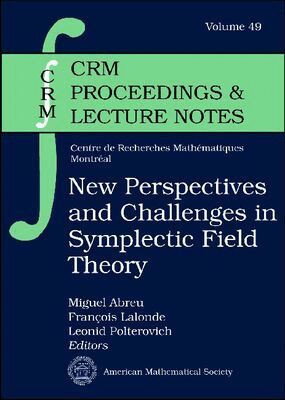
This volume, in honor of Yakov Eliashberg, gives a panorama of some of the most fascinating recent developments in symplectic, contact and gauge theories. It contains research papers aimed at experts, as well as a series of skillfully written surveys accessible for a broad geometrically oriented readership from the graduate level onwards. This collection will serve as an enduring source of information and ideas for those who want to enter this exciting area as well as for experts.
Inbunden, Engelska, 2014
1 529 kr
Skickas inom 5-8 vardagar
This is a book on symplectic topology, a rapidly developing field of mathematics which originated as a geometric tool for problems of classical mechanics. Since the 1980s, powerful methods such as Gromov's pseudo-holomorphic curves and Morse-Floer theory on loop spaces gave rise to the discovery of unexpected symplectic phenomena. The present book focuses on function spaces associated with a symplectic manifold. A number of recent advances show that these spaces exhibit intriguing properties and structures, giving rise to an alternative intuition and new tools in symplectic topology. The book provides an essentially self-contained introduction into these developments along with applications to symplectic topology, algebra and geometry of symplectomorphism groups, Hamiltonian dynamics and quantum mechanics. It will appeal to researchers and students from the graduate level onwards.
Häftad, Engelska, 2020
652 kr
Skickas inom 5-8 vardagar
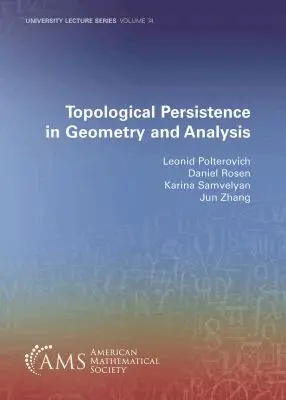
The theory of persistence modules originated in topological data analysis and became an active area of research in algebraic topology. This book provides a concise and self-contained introduction to persistence modules and focuses on their interactions with pure mathematics, bringing the reader to the cutting edge of current research. In particular, the authors present applications of persistence to symplectic topology, including the geometry of symplectomorphism groups and embedding problems. Furthermore, they discuss topological function theory, which provides new insight into oscillation of functions. The book is accessible to readers with a basic background in algebraic and differential topology.
E-bok
PDF, Engelska, 20121 029 kr
Läs direkt efter köp
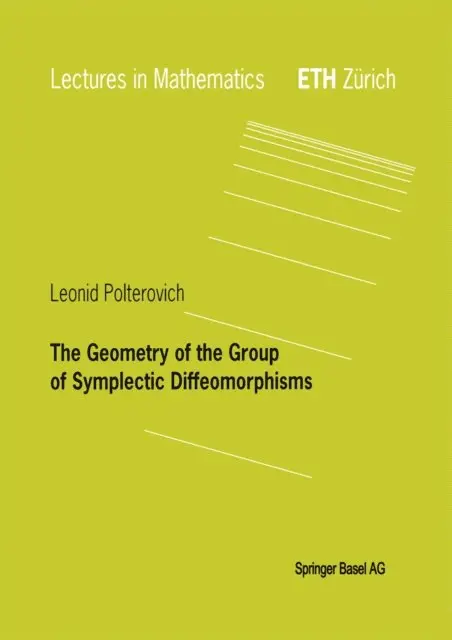
The group of Hamiltonian diffeomorphisms Ham(M, 0) of a symplectic mani fold (M, 0) plays a fundamental role both in geometry and classical mechanics. For a geometer, at least under some assumptions on the manifold M, this is just the connected component of the identity in the group of all symplectic diffeomorphisms. From the viewpoint of mechanics, Ham(M,O) is the group of all admissible motions. What is the minimal amount of energy required in order to generate a given Hamiltonian diffeomorphism I? An attempt to formalize and answer this natural question has led H. Hofer [HI] (1990) to a remarkable discovery. It turns out that the solution of this variational problem can be interpreted as a geometric quantity, namely as the distance between I and the identity transformation. Moreover this distance is associated to a canonical biinvariant metric on Ham(M, 0). Since Hofer''s work this new ge ometry has been intensively studied in the framework of modern symplectic topology. In the present book I will describe some of these developments. Hofer''s geometry enables us to study various notions and problems which come from the familiar finite dimensional geometry in the context of the group of Hamiltonian diffeomorphisms. They turn out to be very different from the usual circle of problems considered in symplectic topology and thus extend significantly our vision of the symplectic world.
Häftad, Engelska, 2001
815 kr
Skickas inom 10-15 vardagar
The group of Hamiltonian diffeomorphisms Ham(M, 0) of a symplectic mani fold (M, 0) plays a fundamental role both in geometry and classical mechanics. For a geometer, at least under some assumptions on the manifold M, this is just the connected component of the identity in the group of all symplectic diffeomorphisms. From the viewpoint of mechanics, Ham(M,O) is the group of all admissible motions. What is the minimal amount of energy required in order to generate a given Hamiltonian diffeomorphism I? An attempt to formalize and answer this natural question has led H. Hofer [HI] (1990) to a remarkable discovery. It turns out that the solution of this variational problem can be interpreted as a geometric quantity, namely as the distance between I and the identity transformation. Moreover this distance is associated to a canonical biinvariant metric on Ham(M, 0). Since Hofer's work this new ge ometry has been intensively studied in the framework of modern symplectic topology. In the present book I will describe some of these developments. Hofer's geometry enables us to study various notions and problems which come from the familiar finite dimensional geometry in the context of the group of Hamiltonian diffeomorphisms. They turn out to be very different from the usual circle of problems considered in symplectic topology and thus extend significantly our vision of the symplectic world.