• Fri frakt över 249 kr
  • •
  • Snabba leveranser
  • •
  • Billiga böcker
Kundservice

Du är på sajten för privatpersoner.

Företag, bibliotek eller offentlig verksamhet?

Du handlar på classic.bokus.com, där alla dina funktioner finns intakta.
Till classic.bokus.com
Bokus logotyp. Gå till startsidan.
  • Erbjudanden
  • Student
  • Topplistor
  • Barn & ungdom
  • Bokus Play
  • E-böcker
  • Ljudböcker
  • Pocketböcker
  • Spel och pussel

5% studentrabatt – använd koden KURSBOK27 →

Sidfot

Mina sidor

    Hjälp

    • Kundservice
    • Vanliga frågor och svar
    • Frakt och leverans
    • Retur vid ångerrätt
    • Reklamera vara
    • Betalning
    • Köpvillkor
    • Allmänna villkor
    • Information om webbplatsens tillgänglighet

    Om Bokus

    • Om oss
    • Pressrum
    • För studenter
    • För företag
    • För bibliotek och offentlig verksamhet
    • För leverantörer
    • Hållbarhet

    Populärt

    • Aktuella erbjudanden
    • Presentkort
    • Studentlitteratur
    • Nya böcker
    • Topplistor
    • Signerade böcker
    • Engelska böcker

    Inspiration

    • Boktips
    • BookTok
    • Barnbokskaraktärer
    • Populära författare
    Logotyp för Bokus
    Följ oss på Facebook (extern länk)Följ oss på Instagram (extern länk)Följ oss på YouTube (extern länk)Följ oss på TikTok (extern länk)
    bokus @ CookiesAnpassa cookiesIntegritetspolicyKöpvillkor
    Till Citymail hemsida (extern länk)Till Budbee hemsida (extern länk)Till Postnord hemsida (extern länk)Till Schenker hemsida (extern länk)Till Early Bird hemsida (extern länk)Till Walleys hemsida (extern länk)
    1. Ekonomi och Ledarskap
    2. Företagsekonomi
    3. Organisation och ägarskap

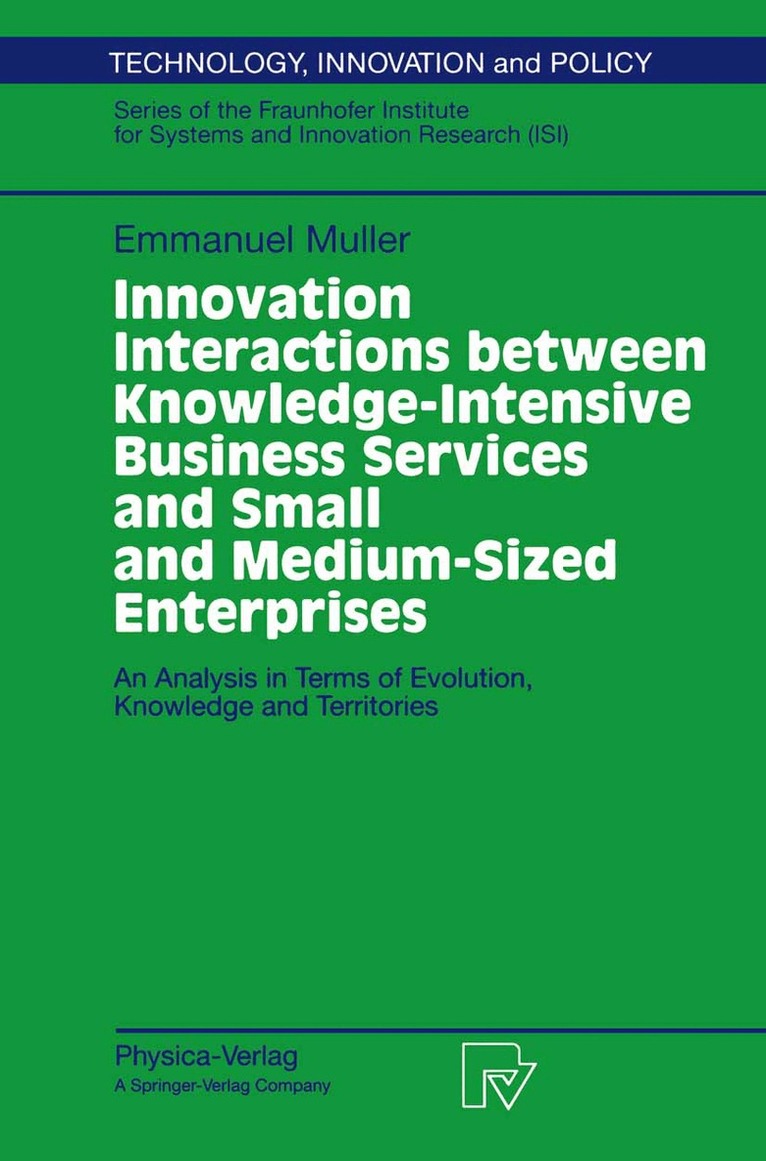
    Innovation Interactions Between Knowledge-Intensive Business Services And Small And Medium-Sized Enterprises

    An Analysis in Terms of Evolution, Knowledge and Territories

    AvEmmanuel Muller

    Häftad, Engelska, 2001

    Del 11 i serien Technology, Innovation and Policy (ISI)

    559 kr

    Beställningsvara. Skickas inom 10-15 vardagar. Fri frakt över 249 kr.

    Fler format och utgåvor

    E-bok

    734 kr

    Beskrivning

    The current decade has stressed the reinforcement of three major trends affecting developed economies since at least half a century. The frrst trend concerns the im- portance of innovations for fIrms, regions and nations. Even if innovation, however defmed, is not a recent phenomenon, the crucial role innovativeness plays in a world of increased competition reveals its importance as a major economic phe- nomenon. A second prominent trend corresponds to the "tertiarisation of the econ- omy", i. e. the considerable and continuous expansion of the share of services in contemporary economies. 1 The third trend consists in the substantial changes af- fecting the economical meaning of "space". Signs of these substantial changes can be found in the increased unity of "space" (the globalisation phenomenon), in the appearance of new territories (as suggested by the emergence of a "virtual conti- nent"2) as well as in the reconsideration of existing ones (for instance, induced by new flexible production systems).As such, these three trends express a triple break- down: a breakdown in the time scale of the economy (due to the increasing velocity of economic activities), a breakdown in the nature of the economy (since "intangi- ble production" is expanding) and a breakdown in the space(s) of the economy (be- cause of shifting dimensions). Certain categories of activities or actors may high- light and even symbolise this triple rupture in diverse ways.

    Produktinformation

    • Utgivningsdatum:2001-01-26
    • Mått:155 x 235 x 13 mm
    • Vikt:341 g
    • Format:Häftad
    • Språk:Engelska
    • Serie:Technology, Innovation and Policy (ISI)
    • Antal sidor:198
    • Förlag:Springer-Verlag Berlin and Heidelberg GmbH & Co. KG
    • ISBN:9783790813623

    Utforska kategorier

    • Organisation och ägarskap inom Ekonomi och Ledarskap

    Innehållsförteckning

    • General introduction.- 1: Innovation as the expression of firms’ evolution capacity.- 1.1 Innovation as an evolutionary process.- 1.2 Innovation as a knowledge-based process.- 1.3 Nature and forms of innovation: towards a continuum approach.- Conclusion.- 2: Interactions between KIES and SMES and impact on innovation capacities.- 2.1 Interactions: between market and hierarchy?.- 2.2 The impact of interactions with KIES on SMEs.- 2.3 KIBS innovation capacity and the influence of interactions with SMEs.- Conclusion.- 3: Territorial determinants and evolution capacities of SMEs and KIBS.- 3.1 Proximity and innovation.- 3.2 Territory and innovation.- 3.3 The impact of territorial determinants on SMEs and KIRS interactions and evolution.- Conclusion.- 4: Operationalisation of the analysis.- 4.1 From the hypotheses to the key variables.- 4.2 Structure of the data.- 4.3 The statistical exploitation procedure.- Conclusion.- 5: Statistical exploitation of the SME sample.- 5.1 Segmentation procedures.- 5.2 Multiple correspondence analysis.- 5.3 Path modelling.- Conclusion.- 6: Statistical exploitation of the KIBS sample.- 6.1 Segmentation procedures.- 6.2 Multiple correspondence analysis.- 6.3 Path modelling.- Conclusion.- 7: Main findings and policy implications.- 7.1 Interpretation of the key fmdings.- 7.2 Towards an integrated typology of innovation interactions.- 7.3 Implications for policies.- Conclusion.- General conclusion.- References.- Appendix A: Basic frequencies of the selected variables.- Appendix B: Selected bivariate tests.- Appendix C: PROBIT analysis.