• Fri frakt över 249 kr
  • •
  • Snabba leveranser
  • •
  • Billiga böcker
Kundservice

Du är på sajten för privatpersoner.

Företag, bibliotek eller offentlig verksamhet?

Du handlar på classic.bokus.com, där alla dina funktioner finns intakta.
Till classic.bokus.com
Bokus logotyp. Gå till startsidan.
  • Erbjudanden
  • Nyheter
  • Student
  • Topplistor
  • Barn & ungdom
  • Bokus Play
  • E-böcker
  • Pocketböcker
  • Spel & pussel

10% rabatt på allt med kod NYSTART10 →

Sidfot

Mina sidor

    Hjälp

    • Kundservice
    • Vanliga frågor och svar
    • Frakt och leverans
    • Retur vid ångerrätt
    • Reklamera vara
    • Betalning
    • Köpvillkor
    • Allmänna villkor
    • Information om webbplatsens tillgänglighet

    Om Bokus

    • Om oss
    • Pressrum
    • För studenter
    • För företag
    • För bibliotek och offentlig verksamhet
    • För leverantörer
    • Hållbarhet

    Populärt

    • Aktuella erbjudanden
    • Presentkort
    • Studentlitteratur
    • Nya böcker
    • Topplistor
    • Signerade böcker
    • Engelska böcker

    Inspiration

    • Boktips
    • BookTok
    • Populära bokserier
    • Barnbokskaraktärer
    • Populära författare
    Logotyp för Bokus
    Följ oss på Facebook (extern länk)Följ oss på Instagram (extern länk)Följ oss på YouTube (extern länk)Följ oss på TikTok (extern länk)
    bokus @ CookiesAnpassa cookiesIntegritetspolicyKöpvillkor
    Till Citymail hemsida (extern länk)Till Budbee hemsida (extern länk)Till Postnord hemsida (extern länk)Till Schenker hemsida (extern länk)Till Early Bird hemsida (extern länk)Till Walleys hemsida (extern länk)
    1. Naturvetenskap och teknik
    2. Geovetenskap
    3. Miljövetenskap och miljöpolitik

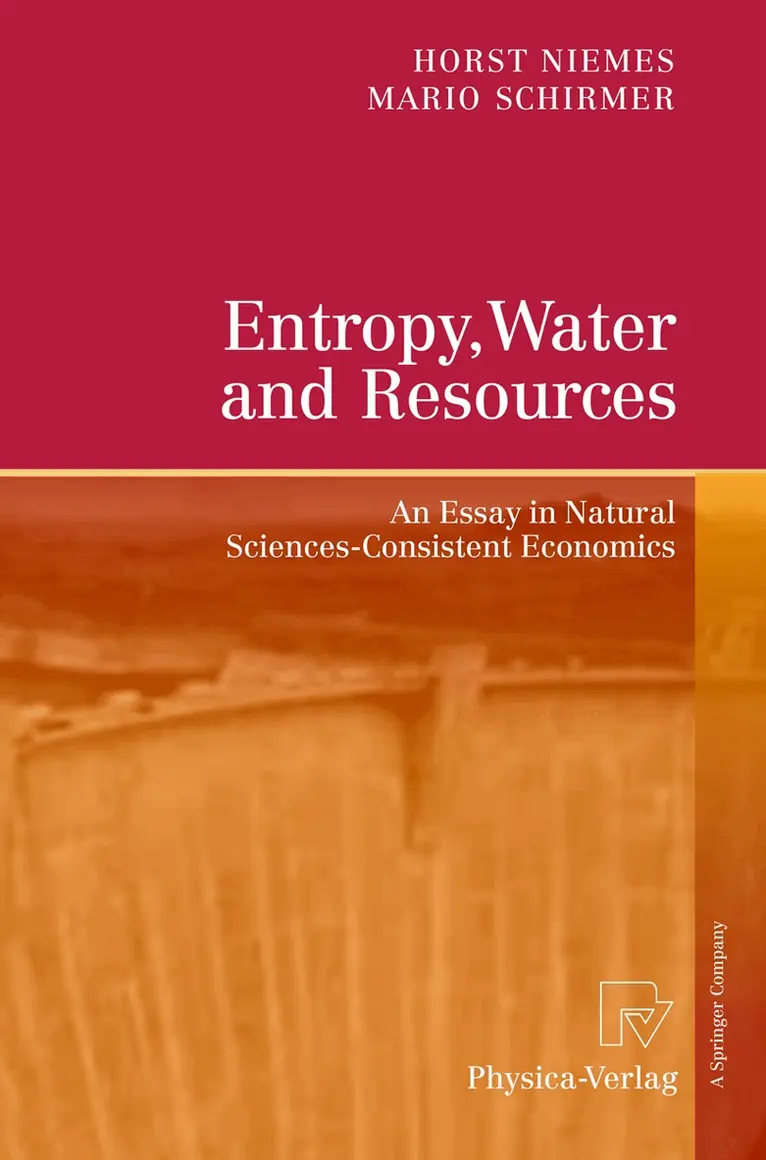
    Entropy, Water and Resources

    An Essay in Natural Sciences-Consistent Economics

    AvHorst Niemes,Mario Schirmer

    Inbunden, Engelska, 2010

    1 086 kr

    Beställningsvara. Skickas inom 10-15 vardagar. Fri frakt över 249 kr.

    Fler format och utgåvor

    Häftad

    1 086 kr

    Beskrivning

    This book lies at the intersection of natural sciences, economics, and water en- neering and is in line with the long tradition of environmental economics at the University of Heidelberg. In the 1970s, the Neo-Austrian Capital Theory was developed using the fundamental laws of thermodynamics as a common language between the natural and social sciences. Niemes (1981) integrated the dynamic and irreversibility characteristics of the natural environment into the Neo-Austrian c- ital theory. Faber et al. (1983, 1987, 1995) then extended this interdisciplinary approach further to create a comprehensive, dynamic, environmental resource model. Over the last 3 decades, the theoretical foundations of environmental economics have been modi ed and there have been an impressive variety of applications. This book aims to reduce the gaps between economic theory, natural sciences, and engineering practice. One of the reasons these gaps exist is because economic assumptions are used to construct dynamic environmental and resource models, which are not consistent with the fundamental laws of the natural sciences. Another reason for the gap might be the distance between academic theory and real world situations. Based on an extended thermodynamic approach, the authors explain which economic assumptions are acceptable for constructing a dynamic model that is consistent with the natural sciences. In particular, the special role of water in the production and reproduction activities will be considered as an integral component.

    Produktinformation

    • Utgivningsdatum:2010-06-19
    • Mått:155 x 235 x undefined mm
    • Format:Inbunden
    • Språk:Engelska
    • Antal sidor:219
    • Förlag:Springer-Verlag Berlin and Heidelberg GmbH & Co. KG
    • ISBN:9783790824155

    Utforska kategorier

    • Miljövetenskap och miljöpolitik inom Naturvetenskap och teknik
    • Miljöekonomi inom Ekonomi och Ledarskap

    Innehållsförteckning

    • The Water Use Model.- Conceptual Foundations: Thermodynamics and Capital Theory.- General Design of Dynamic Models for Water Uses.- Specifications for Constructing the Water Use Model.- Constraints of the Water Use Model.- Optimality Conditions of the Water Use Model.- The Water Infrastructure Model.- Case Studies Guiding the Integration of Water Infrastructure.- Specifications for Constructing the Water Infrastructure Model.- Constraints of the Water Infrastructure Model.- Optimality Conditions of the Water Infrastructure Model.