• Fri frakt över 249 kr
  • •
  • Snabba leveranser
  • •
  • Billiga böcker
Kundservice

Du är på sajten för privatpersoner.

Företag, bibliotek eller offentlig verksamhet?

Du handlar på classic.bokus.com, där alla dina funktioner finns intakta.
Till classic.bokus.com
Bokus logotyp. Gå till startsidan.
  • Erbjudanden
  • Student
  • Topplistor
  • Barn & ungdom
  • Bokus Play
  • E-böcker
  • Ljudböcker
  • Pocketböcker
  • Spel & pussel

Upp till 25% på utvalda nyheter →

Sidfot

Mina sidor

    Hjälp

    • Kundservice
    • Vanliga frågor och svar
    • Frakt och leverans
    • Retur vid ångerrätt
    • Reklamera vara
    • Betalning
    • Köpvillkor
    • Allmänna villkor
    • Information om webbplatsens tillgänglighet

    Om Bokus

    • Om oss
    • Pressrum
    • För studenter
    • För företag
    • För bibliotek och offentlig verksamhet
    • För leverantörer
    • Hållbarhet

    Populärt

    • Aktuella erbjudanden
    • Presentkort
    • Studentlitteratur
    • Nya böcker
    • Topplistor
    • Signerade böcker
    • Engelska böcker

    Inspiration

    • Boktips
    • BookTok
    • Populära bokserier
    • Barnbokskaraktärer
    • Populära författare
    Logotyp för Bokus
    Följ oss på Facebook (extern länk)Följ oss på Instagram (extern länk)Följ oss på YouTube (extern länk)Följ oss på TikTok (extern länk)
    bokus @ CookiesAnpassa cookiesIntegritetspolicyKöpvillkor
    Till Citymail hemsida (extern länk)Till Budbee hemsida (extern länk)Till Postnord hemsida (extern länk)Till Schenker hemsida (extern länk)Till Early Bird hemsida (extern länk)Till Walleys hemsida (extern länk)
    1. Naturvetenskap och teknik
    2. Teknik och industri
    3. Elektronik och kommunikationer

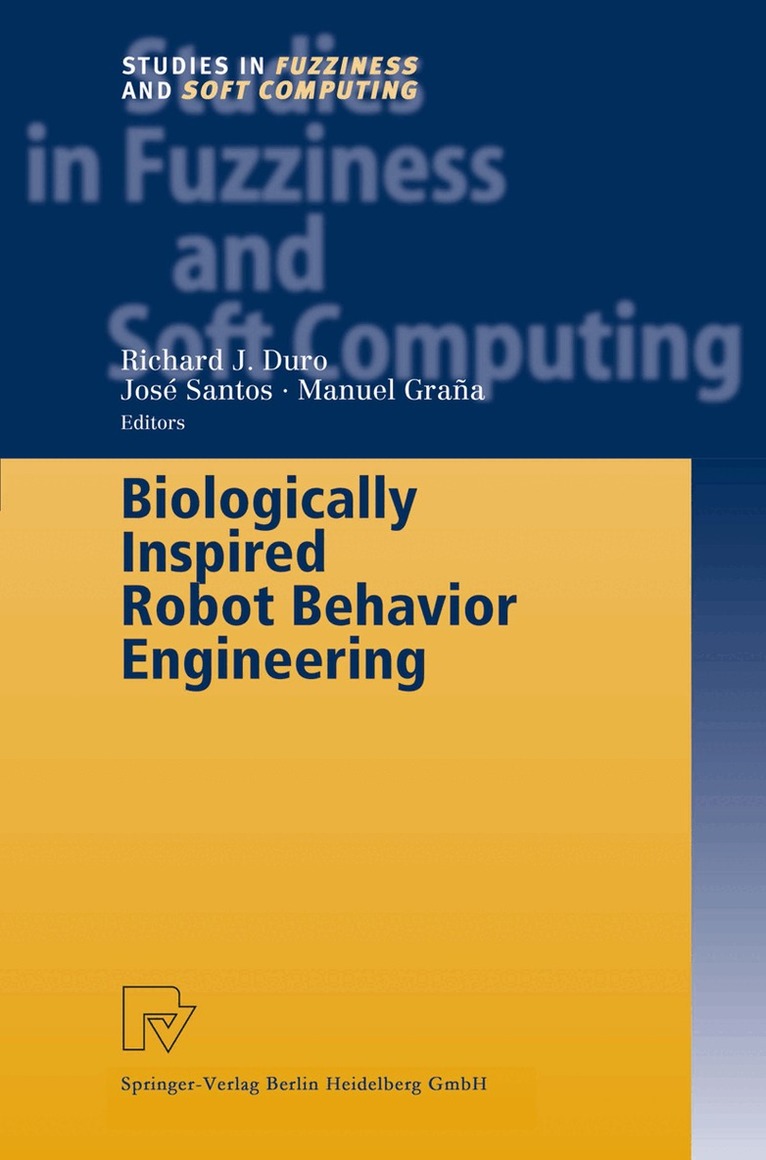
    Biologically Inspired Robot Behavior Engineering

    AvRichard J. Duro,Jose Santos

    Häftad, Engelska, 2010

    Del 109 i serien Studies in Fuzziness and Soft Computing

    1 626 kr

    Beställningsvara. Skickas inom 10-15 vardagar. Fri frakt över 249 kr.

    Beskrivning

    The book presents an overview of current research on biologically inspired autonomous robotics from the perspective of some of the most relevant researchers in this area. The book crosses several boundaries in the field of robotics and the closely related field of artificial life. The key aim throughout the book is to obtain autonomy at different levels. From the basic motor behavior in some exotic robot architectures right through to the planning of complex behaviors or the evolution of robot control structures, the book explores different degrees and definitions of autonomous behavior. These behaviors are supported by a wide variety of modeling techniques: structural grammars, neural networks, and fuzzy logic and evolution underlies many of the development processes. Thus this text can be used by scientists and students interested in these areas and provides a general view of the field for a more general audience.

    Produktinformation

    • Utgivningsdatum:2010-10-21
    • Mått:155 x 235 x 25 mm
    • Vikt:692 g
    • Format:Häftad
    • Språk:Engelska
    • Serie:Studies in Fuzziness and Soft Computing
    • Antal sidor:439
    • Förlag:Springer-Verlag Berlin and Heidelberg GmbH & Co. KG
    • ISBN:9783790825176

    Utforska kategorier

    • Elektronik och kommunikationer inom Naturvetenskap och teknik
    • Systemvetenskap och AI inom Data och IT
    • Artificiell intelligens inom Data och IT

    Innehållsförteckning

    • 1. Evolutionary approaches to neural control of rolling, walking, swimming and flying animats or robots.- 2. Behavior coordination and its modification on monkey-type mobile robot.- 3. Visuomotor control in flies and behavior-based agents.- 4. Using evolutionary methods to parameterize neural models: a study of the lamprey central pattern generator.- 5. Biologically inspired neural network approaches to real-time collision-free robot motion planning.- 6. Self-adapting neural networks for mobile robots.- 7. Evolving robots able to integrate sensory-motor information over time.- 8. A non-computationally-intensive neurocontroller for autonomous mobile robot navigation.- 9. Some approaches for reusing behaviour based robot cognitive architectures obtained through evolution.- 10. Modular neural architectures for robotics.- 11. Designing neural control architectures for an autonomous robot using vision to solve complex learning tasks.- 12. Robust estimation of the optical flow based on VQ-BF.- 13. Steps towards one-shot vision-based self-localization.- 14. Computing the optimal trajectory of arm movement: the TOPS (Task Optimization in the Presence of Signal-dependent noise) model.- 15. A general learning approach to visually guided 3D-positioning and pose control of robot arms.