• Fri frakt över 249 kr
  • •
  • Snabba leveranser
  • •
  • Billiga böcker
Kundservice

Du är på sajten för privatpersoner.

Företag, bibliotek eller offentlig verksamhet?

Du handlar på classic.bokus.com, där alla dina funktioner finns intakta.
Till classic.bokus.com
Bokus logotyp. Gå till startsidan.
  • Erbjudanden
  • Student
  • Topplistor
  • Barn & ungdom
  • Bokus Play
  • Bokus Play
  • E-böcker
  • Ljudböcker
  • Pocketböcker
  • Spel & pussel

10% rabatt på allt med kod NYSTART10 →

Sidfot

Mina sidor

    Hjälp

    • Kundservice
    • Vanliga frågor och svar
    • Frakt och leverans
    • Retur vid ångerrätt
    • Reklamera vara
    • Betalning
    • Köpvillkor
    • Allmänna villkor
    • Information om webbplatsens tillgänglighet

    Om Bokus

    • Om oss
    • Pressrum
    • För studenter
    • För företag
    • För bibliotek och offentlig verksamhet
    • För leverantörer
    • Hållbarhet

    Populärt

    • Aktuella erbjudanden
    • Presentkort
    • Studentlitteratur
    • Nya böcker
    • Topplistor
    • Signerade böcker
    • Engelska böcker

    Inspiration

    • Boktips
    • BookTok
    • Populära bokserier
    • Barnbokskaraktärer
    • Populära författare
    Logotyp för Bokus
    Följ oss på Facebook (extern länk)Följ oss på Instagram (extern länk)Följ oss på YouTube (extern länk)Följ oss på TikTok (extern länk)
    bokus @ CookiesAnpassa cookiesIntegritetspolicyKöpvillkor
    Till Citymail hemsida (extern länk)Till Budbee hemsida (extern länk)Till Postnord hemsida (extern länk)Till Schenker hemsida (extern länk)Till Early Bird hemsida (extern länk)Till Walleys hemsida (extern länk)
    1. Data och IT
    2. Grafik och bildbehandling
    3. CAD-program

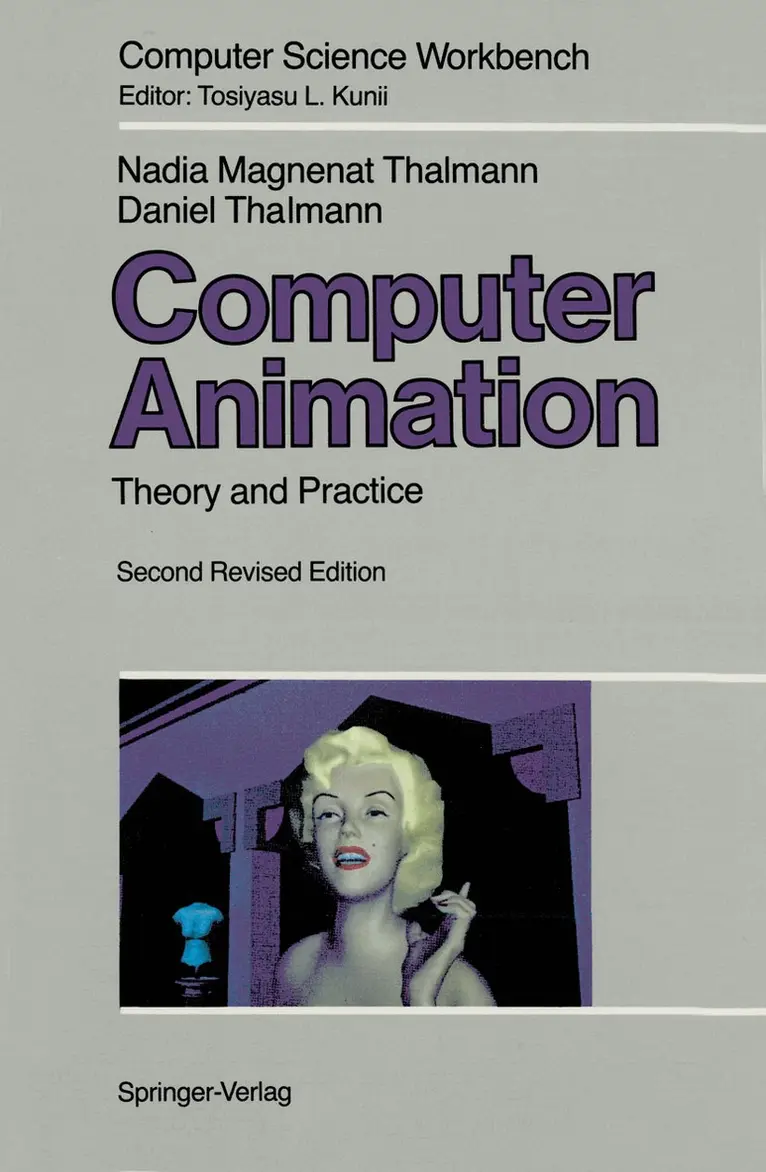
    Computer Animation

    Theory and Practice

    AvNadia Magnenat-Thalmann,Daniel Thalmann

    Häftad, Engelska, 2012

    Del i serien Computer Science Workbench

    562 kr

    Beställningsvara. Skickas inom 10-15 vardagar. Fri frakt över 249 kr.

    Beskrivning

    Computer Science Workbench is a monograph series which will provide you with an in-depth working knowledge of current developments in computer technology. Every volume in this series will deal with a topic of importance in computer science and elaborate on how you yourself can build systems related to the main theme. You will be able to develop a variety of systems, including computer software tools, computer gra­ phics, computer animation, database management systems, and compu­ ter-aided design and manufacturing systems. Computer Science Work­ bench represents an important new contribution in the field of practical computer technology. TOSIYASU L. KUNII Preface to the Second Edition Computer graphics is growing very rapidly; only computer animation grows faster. The first edition of the book Computer Animation: Theory and Practice was released in 1985. Four years later, computer animation has exploded. Conferences on computer animation have appeared and the topic is recognized in well-known journals as a leading theme. Computer-generated film festivals now exist in each country and several thousands of films are produced each year. From a commercial point of view, the computer animation market has grown considerably. TV logos are computer-made and more and more simulations use the technique of computer animation. What is the most fascinating is certainly the development of computer animation from a research point-of-view.

    Produktinformation

    • Utgivningsdatum:2012-01-03
    • Mått:170 x 244 x 15 mm
    • Vikt:462 g
    • Format:Häftad
    • Språk:Engelska
    • Serie:Computer Science Workbench
    • Antal sidor:245
    • Upplaga:2
    • Förlag:Springer Verlag, Japan
    • ISBN:9784431681076

    Utforska kategorier

    • CAD-program inom Data och IT
    • Systemvetenskap och AI inom Data och IT
    • Programmeringsböcker inom Data och IT

    Innehållsförteckning

    • 1. Introduction.- 2. Conventional Animation.- 2.1 Basic Principles of Conventional Animation.- 2.2 How Are Cartoon Animated Films Made?.- 2.3 Multiplane and Shooting Phase.- 2.4 Some Techniques and Special Camera Effects.- 2.5 Bar, Route, Model, and Exposure Sheets.- 2.6 Postproduction.- 2.7 Historical Background.- 2.8 Applications of Animation.- 3. Computer Animation.- 3.1 The Role of the Computer in Animation.- 3.2 How to Classify Computer Animation Systems?.- 3.3 Real-time vs Frame-by-frame.- 3.4 Frame Buffer Animation and Real-time Playback.- 3.5 Systems vs Languages.- 4. The Development of Computer Animation in Various Organizations.- 4.1 The Early Systems: BEFLIX and EXPLOR.- 4.2 Picture-driven Animation: GENESYS.- 4.3 Analog Systems: SCANIMATE and CAESAR.- 4.4 ANIMATOR, ARTÄ, and MOP.- 4.5 Computer Animation at the National Research Council of Canada.- 4.6 Computer Animation at Ohio State University.- 4.7 From GRASS to ZGRASS.- 4.8 New York Institute of Technology, Lucasfilm, and Pixar.- 4.9 MAGI/Synthavision, Robert Abel, Triple I, and Digital Effects.- 4.10 And the Others?.- 5. Keyframe and Painting Systems.- 5.1 Computer-assisted Animation.- 5.2 The Input of Drawings.- 5.3 In-between Calculations.- 5.4 The Laws of Animation.- 5.5 Skeleton Techniques.- 5.6 The Path of Motion and P-curves.- 5.7 In-betweening Using Moving Point Constraints.- 5.8 Coloring Techniques.- 5.9 Paint Systems.- 5.10 Color Simulation and Dithering.- 5.11 Gradation Techniques.- 6. Object Modeling in 3D Animation.- 6.1 What Is 3D Animation?.- 6.2 Object Representation.- 6.3 Surface Modeling.- 6.4 Object Creation.- 7. Motion Control in 3D Animation.- 7.1 A Classification of 3D Computer Animation Methods.- 7.2 A Unified View.- 7.3 A Comparison of Methods.- 7.4 Three-dimensional ShapeInterpolation.- 7.5 A Case Study: The Multiple Track Animator System.- 7.6 Parametric Keyframe Animation.- 7.7 The Use of Splines in Keyframe Animation.- 7.8 Principles of Algorithmic Animation.- 7.9 Motion Specification will Synchronization.- 8. Hidden Surfaces, Reflectance, and Shading.- 8.1 Hidden Surfaces.- 8.2 Light Reflection Models.- 8.3 Surface Shading.- 8.4 Rendering of Parametric and Patch Surfaces.- 8.5 Complex Light Sources.- 9. Transparency, Texture, Shadows, and Anti-aliasing.- 9.1 Ray-tracing Algorithms.- 9.2 Ray-tracing Problems.- 9.3 Optimization Techniques for Ray-tracing.- 9.4 Transparency.- 9.5 Texture.- 9.6 Fractals.- 9.7 Fuzzy Objects Modeling and Particle Systems.- 9.8 Shadows.- 9.9 Spatial Anti-aliasing.- 9.10 Motion Blur and Temporal Anti-aliasing.- 10. Human Modeling and Animation.- 10.1 Stick, Surface, and Volume Models.- 10.2 The NUDES System.- 10.3 The Badler Bubbleman.- 10.4 Labanotation.- 10.5 Parametric Keyframe Animation of Articulated Bodies.- 10.6 Body Deformations and JLD Operators.- 10.7 Hand Animation.- 10.8 Facial Animation.- 10.9 A Three-level Approach Based on Abstract Muscles.- 11. Object-oriented and Actor Languages and Systems.- 11.1 Classes, Modules, and Processes.- 11.2 Kay’s Work and SMALLTALK.- 11.3 Hewitt’s Actor Theory.- 11.4 LOGO and the DIRECTOR Actor-based Animation Language.- 11.5 AS AS: The Actor/Scriptor Animation System.- 11.6 CINEMIRA: A Language Based on Actor and Camera Data Types.- 11.7 MÏRANIM: An Extensible Director-oriented 3D Animation System.- 12. Automatic Motion Control.- 12.1 Mechanics, Robotics, and A.I. in Computer Animation.- 12.2 First Step: Positional Constraints and Inverse Kinematics.- 12.3 Second Step: Motion Control Using Dynamics.- 12.4 Third Step: Impact of the Environment.- 12.5Fourth Step: Task Planning.- 12.6 Fifth Step: Behavioral Animation.- 13. Case Studies of Computer-generated Films.- 13.1 The Film Dream Flight.- 13.2 The Film Rendez-vous à Montréal.- 13.3 The Film Eglantine.- 13.4 The Film Galaxy Sweetheart.- References.- Appendix: Computer-generated Films.