• Fri frakt över 249 kr
  • •
  • Snabba leveranser
  • •
  • Billiga böcker
Kundservice

Du är på sajten för privatpersoner.

Företag, bibliotek eller offentlig verksamhet?

Du handlar på classic.bokus.com, där alla dina funktioner finns intakta.
Till classic.bokus.com
Bokus logotyp. Gå till startsidan.
  • Erbjudanden
  • Nyheter
  • Student
  • Topplistor
  • Barn & ungdom
  • Bokus Play
  • E-böcker
  • Pocketböcker
  • Spel & pussel

10% rabatt på allt med kod NYSTART10 →

Sidfot

Mina sidor

    Hjälp

    • Kundservice
    • Vanliga frågor och svar
    • Frakt och leverans
    • Retur vid ångerrätt
    • Reklamera vara
    • Betalning
    • Köpvillkor
    • Allmänna villkor
    • Information om webbplatsens tillgänglighet

    Om Bokus

    • Om oss
    • Pressrum
    • För studenter
    • För företag
    • För bibliotek och offentlig verksamhet
    • För leverantörer
    • Hållbarhet

    Populärt

    • Aktuella erbjudanden
    • Presentkort
    • Studentlitteratur
    • Nya böcker
    • Topplistor
    • Signerade böcker
    • Engelska böcker

    Inspiration

    • Boktips
    • BookTok
    • Populära bokserier
    • Barnbokskaraktärer
    • Populära författare
    Logotyp för Bokus
    Följ oss på Facebook (extern länk)Följ oss på Instagram (extern länk)Följ oss på YouTube (extern länk)Följ oss på TikTok (extern länk)
    bokus @ CookiesAnpassa cookiesIntegritetspolicyKöpvillkor
    Till Citymail hemsida (extern länk)Till Budbee hemsida (extern länk)Till Postnord hemsida (extern länk)Till Schenker hemsida (extern länk)Till Early Bird hemsida (extern länk)Till Walleys hemsida (extern länk)
    1. Filosofi och religion
    2. Filosofi
    3. Filosofiska discipliner

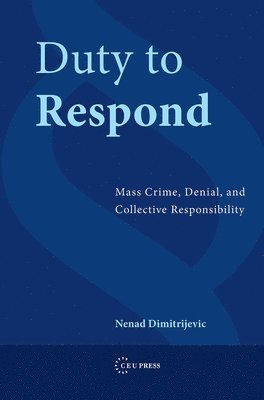
    Duty to Respond

    Mass Crime, Denial, and Collective Responsibility

    AvNenad Dimitrijevic

    Inbunden, Engelska, 2011

    1 566 kr

    Beställningsvara. Skickas inom 10-15 vardagar. Fri frakt över 249 kr.

    Beskrivning

    The subject of the book is responsibility for collective crime. Collective crime is an act committed by a significant number of the members of a group, in the name of all members of that group, with the support of the majority of group members, and against individuals targeted on the basis of their belonging to a different group.The central claim is that all members of the group in whose name collective crime is committed share responsibility for it. This book's special interest is with analytical and normative defense of arguments that purport to explain reasons for, and the character of, responsibility of decent people. Those who did not intend, support, or committed wrong, are still accountable in a non-vicarious manner. The basis of their responsibility is the crime-specific relationship between group identity and personal identity.

    Produktinformation

    • Utgivningsdatum:2011-01-10
    • Mått:159 x 234 x 20 mm
    • Vikt:476 g
    • Format:Inbunden
    • Språk:Engelska
    • Antal sidor:226
    • Förlag:Central European University Press
    • ISBN:9786155053078

    Utforska kategorier

    • Filosofiska discipliner inom Filosofi och religion

    Mer om författaren

    Nenad Dimitrijevic teaches political theory at Central European University, Budapest, Hungary. He taught at Law School, University of Novi Sad, Yugoslavia before joining the faculty at CEU. He has published on a variety of topics in the fields of constitutional theory, moral responsibility, and transitional justice.

    Innehållsförteckning

    • Acknowledgments Introduction Chapter 1 Criminal Regime, its Subjects, and Collective Crime Introduction 1. The Challenge of the Disturbing Past 2. Regime and its subjects: regime crime and collective crime 2.1. Regime crimes 2.2. Collective crimes The preparation of collective crime Criminal action Approving outcomes of crime Chapter Two Politics of Silence and Denial 1. Introduction 2. Transitional justice or just the transition? Politics of silence 2.1. General argument: vulnerability of democracy 2.2. Specific arguments a) Political reconciliation in the name of protecting the genuine common identity b) Injustice c) Unmasterable burden 3. ‘We did nothing wrong’: politics of denial 4. A summary Chapter Three Culture, Knowledge, and Collective Crime: Reading Relativism 1. Introduction: Crime-specific culture 2. Moral relativism as a philosophical argument 3. Blaming Culture for Moral Confusion? 3.1. Collective crime as a normative practice 3.2. Inability thesis 3.2.1. Supporting inability thesis: psychology of obedience to authority 3.2.2. Supporting inability thesis: on the political production of culture 4. The inability thesis as the authenticity thesis: on ‘broken thermometers’, ‘genuine beliefs’, and mass crimes 4.1. Richard Arneson on moral inequality and responsibility 4.2. Michael Zimmerman and the debate on ‘excusing the inexcusable’ 5. Gilbert Harman on the non-moral character of extreme intentions Chapter 4 Moral Responsibility for Collective Crime Introduction 1. Conceptualizing Moral Responsibility 1.1. A preliminary definition 1.2. Responsibility as a relationship 2. What are social groups and how they matter 2.1. The challenge of methodological individualism 2.2. Group structure 2.3. Solidarity through time 2.4. Collective action: relational and positional 3. Collective moral responsibility 3.1. The question 3.2. Responsible agency and the autonomy objection. Can the idea of extended participation provide an answer? 3.3. Two causal reasons for collective moral responsibility a) Intention b) Participation 3.4. An identity-based reason for collective moral responsibility 4. Collective moral responsibility beyond causality and blame 4.1. Group-specific identities created by crime a) Victims b) On the side of criminals: agents, by-standers, decent persons 4.2. Ideological justification of collective crime and how it affects morally decent persons 4.3. Solidarity, taint, and responses a) Solidarity revisited b) Moral taint c) Two forms of collective responsibility List of References