• Fri frakt över 249 kr
  • •
  • Snabba leveranser
  • •
  • Billiga böcker
Kundservice

Du är på sajten för privatpersoner.

Företag, bibliotek eller offentlig verksamhet?

Du handlar på classic.bokus.com, där alla dina funktioner finns intakta.
Till classic.bokus.com
Bokus logotyp. Gå till startsidan.
  • Erbjudanden
  • Nyheter
  • Student
  • Topplistor
  • Barn & ungdom
  • Bokus Play
  • E-böcker
  • Pocketböcker
  • Spel & pussel

10% rabatt på allt med kod: NYSTART10 →

Sidfot

Mina sidor

    Hjälp

    • Kundservice
    • Vanliga frågor och svar
    • Frakt och leverans
    • Retur vid ångerrätt
    • Reklamera vara
    • Betalning
    • Köpvillkor
    • Allmänna villkor
    • Information om webbplatsens tillgänglighet

    Om Bokus

    • Om oss
    • Pressrum
    • För studenter
    • För företag
    • För bibliotek och offentlig verksamhet
    • För leverantörer
    • Hållbarhet

    Populärt

    • Aktuella erbjudanden
    • Presentkort
    • Studentlitteratur
    • Nya böcker
    • Topplistor
    • Signerade böcker
    • Engelska böcker

    Inspiration

    • Boktips
    • BookTok
    • Populära bokserier
    • Barnbokskaraktärer
    • Populära författare
    Logotyp för Bokus
    Följ oss på Facebook (extern länk)Följ oss på Instagram (extern länk)Följ oss på YouTube (extern länk)Följ oss på TikTok (extern länk)
    bokus @ CookiesAnpassa cookiesIntegritetspolicyKöpvillkor
    Till Citymail hemsida (extern länk)Till Budbee hemsida (extern länk)Till Postnord hemsida (extern länk)Till Schenker hemsida (extern länk)Till Early Bird hemsida (extern länk)Till Walleys hemsida (extern länk)
    1. Ekonomi och Ledarskap
    2. Nationalekonomi
    3. Internationell ekonomi

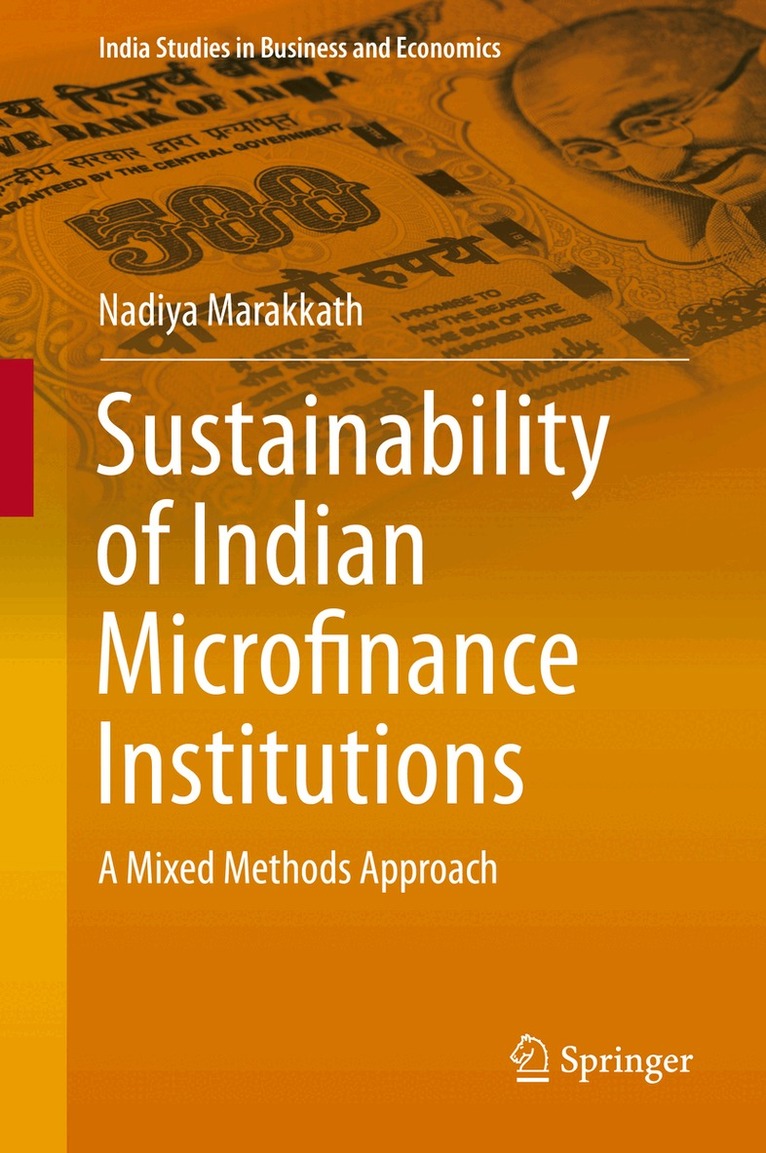
    Sustainability of Indian Microfinance Institutions

    A Mixed Methods Approach

    AvNadiya Marakkath

    Häftad, Engelska, 2016

    Del i serien India Studies in Business and Economics

    563 kr

    Beställningsvara. Skickas inom 10-15 vardagar. Fri frakt över 249 kr.

    Fler format och utgåvor

    Inbunden

    563 kr

    E-bok

    732 kr

    Beskrivning

    Although 'doing good' is our innate nature, we often get lost in the complexities and view goodness as a distant dream. Making this dream of goodness a reality is often thwarted by thoughts surrounding sustainability. Thus, all good initiatives require a focus on sustainability and this has become one of greatest and most formidable challenges faced by any social enterprise. The book documents the understanding of the sustainability of one of the most celebrated forms of social enterprise of our times — Microfinance Institutions (MFIs) gained through a mixed-methods research investigation. It attempts to answer pertinent questions such as: What are the determinant and discriminating factors for the sustainability of MFIs in India? How are these factors being managed by the operationally efficient Indian MFIs that remained sustainable at reasonable interest rates before the onset of the crisis and ceilings imposition in Indian microfinance markets? What does the Indian microfinance crisis teach us about sustainability management and mismanagement? In a nutshell, the answers show that sustainability is a strategic issue that needs managerial attention and not a matter to be left to serendipity. At a time when the industry is recovering from the adverse effects of a crisis and when there are still contentions as to whether the rate fixed by the regulator is enough for the sustenance of the MFIs, the findings mentioned in the book revive the lost hope for the Indian microfinance industry. By deciphering the strategies used by efficient and sustainable MFIs and discussing the lessons that the crisis has imparted to the Indian microfinance markets, this book will enable Indian MFIs to march towards efficient and sustainable operations without losing focus on their clients.

    Produktinformation

    • Utgivningsdatum:2016-08-23
    • Mått:155 x 235 x 11 mm
    • Vikt:289 g
    • Format:Häftad
    • Språk:Engelska
    • Serie:India Studies in Business and Economics
    • Antal sidor:166
    • Förlag:Springer, India, Private Ltd
    • ISBN:9788132234999

    Utforska kategorier

    • Internationell ekonomi inom Ekonomi och Ledarskap
    • Finansiering inom Ekonomi och Ledarskap
    • Makroekonomi inom Ekonomi och Ledarskap

    Mer om författaren

    Nadiya Marakkath is an Assistant Professor at the Centre for Social Entrepreneurship, School of Management and Labour Studies, Tata Institute of Social Sciences (TISS), Mumbai. She teaches academic courses in finance, microfinance and research methods to M. A. social entrepreneurship students at TISS. She enjoys nurturing the dreams of young social entrepreneurs and therefore involves herself in incubation and funding initiatives for social entrepreneurship students at TISS. She received her PhD in financial management, with specialization in microfinance and has doctoral research experience in finance at the National Institute of Technology, Calicut and the Indian Institute of Technology Madras, Chennai, India. Finance systems and their regulatory aspects, microfinance sustainability management, legitimacy and sustainability challenges in social entrepreneurship, entry and exit issues of social entrepreneurs, performance management for social ventures and design of hybrid ventures are her areas of research interest.

    Innehållsförteckning

    • 1: Introduction.- 2: Literature Review.- 3: Research Objectives and Design.- 4: Quantitative Phase: Identification of Factors Affecting and Discriminating Sustainability.- 5: Intermediate Participant Selection Phase: Assessment of Efficiency and Sustainability.- 6: Qualitative Phase: Management of Factors Affecting and Discriminating Sustainability.- 7: Dangers in Mismanaging the Factors Affecting and Discriminating Sustainability: An Exploration into Indian Microfinance Crisis.- 8: Summary of Findings, Implications and Conclusion.- Appendices.- A1: Operational Definition and Distinction between Operational Self-Sustainability Ratio, Financial Self-Sustainability Ratio and Subsidy Dependence Index.- A2: Charnes, Cooper & Rhodes Model and Banker, Charnes & Cooper Model Formulation.- A3: Interview Guide.- A4: Summary of the Qualitative Data Collected During the Interviews.- A5: Group Formation Process in Fourteen Days.