• Fri frakt över 249 kr
  • •
  • Snabba leveranser
  • •
  • Billiga böcker
Kundservice

Du är på sajten för privatpersoner.

Företag, bibliotek eller offentlig verksamhet?

Du handlar på classic.bokus.com, där alla dina funktioner finns intakta.
Till classic.bokus.com
Bokus logotyp. Gå till startsidan.
  • Erbjudanden
  • Nyheter
  • Student
  • Topplistor
  • Barn & ungdom
  • Bokus Play
  • E-böcker
  • Pocketböcker
  • Spel & pussel

10% rabatt på allt med kod: NYSTART10 →

Sidfot

Mina sidor

    Hjälp

    • Kundservice
    • Vanliga frågor och svar
    • Frakt och leverans
    • Retur vid ångerrätt
    • Reklamera vara
    • Betalning
    • Köpvillkor
    • Allmänna villkor
    • Information om webbplatsens tillgänglighet

    Om Bokus

    • Om oss
    • Pressrum
    • För studenter
    • För företag
    • För bibliotek och offentlig verksamhet
    • För leverantörer
    • Hållbarhet

    Populärt

    • Aktuella erbjudanden
    • Presentkort
    • Studentlitteratur
    • Nya böcker
    • Topplistor
    • Signerade böcker
    • Engelska böcker

    Inspiration

    • Boktips
    • BookTok
    • Populära bokserier
    • Barnbokskaraktärer
    • Populära författare
    Logotyp för Bokus
    Följ oss på Facebook (extern länk)Följ oss på Instagram (extern länk)Följ oss på YouTube (extern länk)Följ oss på TikTok (extern länk)
    bokus @ CookiesAnpassa cookiesIntegritetspolicyKöpvillkor
    Till Citymail hemsida (extern länk)Till Budbee hemsida (extern länk)Till Postnord hemsida (extern länk)Till Schenker hemsida (extern länk)Till Early Bird hemsida (extern länk)Till Walleys hemsida (extern länk)
    1. Juridik
    2. Internationell rätt
    3. Folkrätt

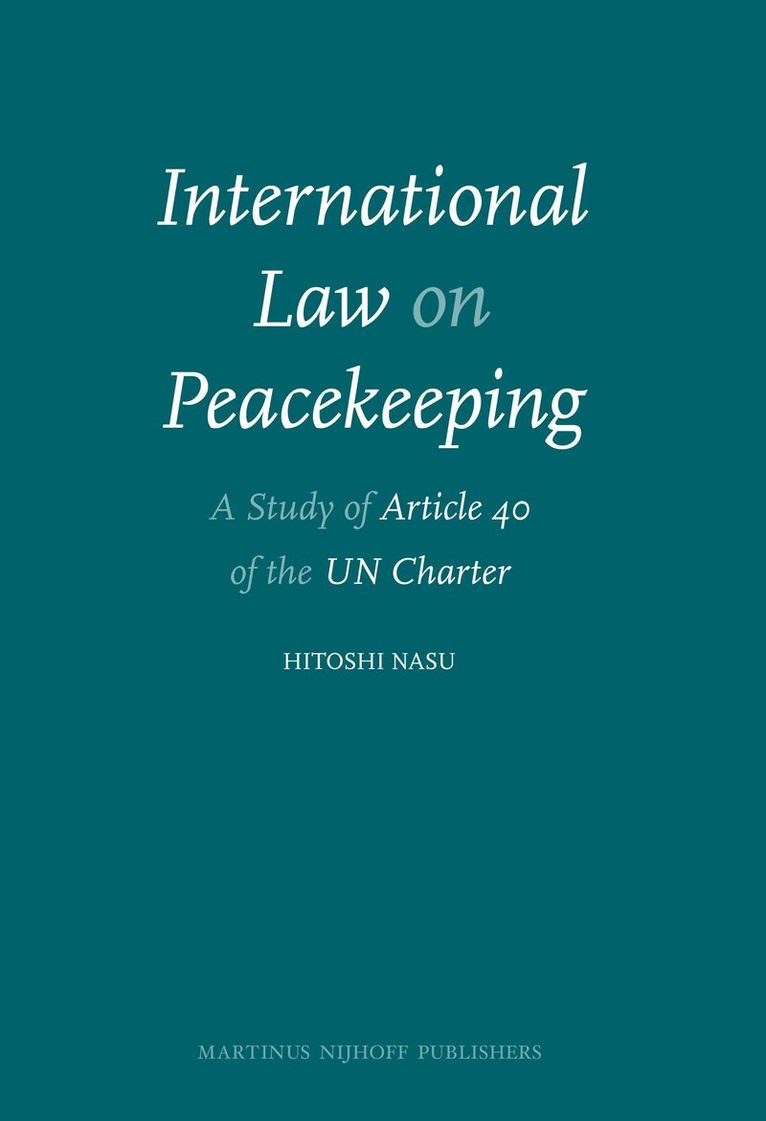
    International Law on Peacekeeping

    A Study of Article 40 of the UN Charter

    AvHitoshi Nasu

    Inbunden, Engelska, 2009

    Del i serien Brill

    2 975 kr

    Beställningsvara. Skickas inom 5-8 vardagar. Fri frakt över 249 kr.

    Beskrivning

    It is generally considered that the UN Security Council has been galvanised since the end of the Cold War. However, the existence and development of armed conflicts remain the reality in the international scene. Is the upsurge in instances of invoking Chapter VII of the UN Charter truly a sign of the invigoration of the Security Council’s authority or mere evidence of its failure to prevent the aggravation of armed conflicts? To what extent is the Security Council authorised to exercise the peacekeeping power in order to take a more flexible approach to conflict management from an earlier stage of conflict? This book explores the potential of the UN peacekeeping power, placing Article 40 of the UN Charter at the centre of the legal regime governing peacekeeping measures. It traces the origins of peacekeeping measures primarily in the experience of the League of Nations and identifies Article 40 of the Charter as the primary legal basis for, and the legal restraints upon, the exercise of the peacekeeping power. It examines the regulatory framework within which the United Nations, particularly the Security Council, is authorised and may even be required to direct peacekeeping measures to prevent the aggravation of armed conflicts. It suggests that the legal accountability of the Security Council in directing peacekeeping measures will be enhanced by utilising procedural mechanisms for self-regulation

    Produktinformation

    • Utgivningsdatum:2009-01-26
    • Mått:160 x 240 x 22 mm
    • Vikt:785 g
    • Format:Inbunden
    • Språk:Engelska
    • Serie:Brill
    • Antal sidor:324
    • Förlag:Brill
    • ISBN:9789004172265

    Utforska kategorier

    • Folkrätt inom Juridik

    Mer om författaren

    Hitoshi Nasu is a lecturer in law at the ANU College of Law, The Australian National University. He received his Ph.D. in International Law from the Faculty of Law, The University of Sydney.

    Innehållsförteckning

    • ACKNOWLEDGEMENTSABBREVIATIONS TABLE OF CASES TABLE OF TREATIES AND OTHER DOCUMENTS International TreatiesOther International DocumentsLIST OF UN RESOLUTIONSSecurity Council ResolutionsGeneral Assembly ResolutionsINTRODUCTION I PEACEKEEPING IN PERSPECTIVE 1. Conflict Prevention and Peacekeeping 2. Concept of Confl ict Prevention 3. Doctrinal Paradigm of Peacekeeping 4. Legal Basis of Peacekeeping within the UN Charter II ORIGINS OF PEACEKEEPING 1. Embryonic Rise of Peacekeeping 2. Emergence of Peacekeeping under Article 11 of the Covenant of the League of Nations 3. Emergence of Forceful Peacekeeping Measures 4. Transformation from Article 11 of the Covenant into Article 40 of the Charter III PEACEKEEPING AS PROVISIONAL MEASURE 1. Types of Provisional Measures 2. Call for Cease-fire 3. Peace Observation 4. Peacekeeping Forces 5. Provisional Territorial Administration 6. Preventive Arms Embargo 7. Peacekeeping and Article 39 of the UN Charter IV Legal Force and Eff ects of Peacekeeping Measures 1. Ambiguity of ‘Calls’ for Provisional Measures 2. Th e Determination of Legal Force 3. Giving Eff ects to the Legal Force 4. Legal Eff ects 5. Peacekeeping and Article 25 of the UN Charter V IMPARTIALITY OF PEACEKEEPING MEASURES 1. Th e Principle of Non-Intervention 2. Internal Armed Confl icts and the Scope of Domestic Jurisdiction of States 3. Defi nition of Intervention and Neutrality/Impartiality 4. Peacekeeping and Article 2(7) of the UN Charter VI ENFORCEMENT OF PEACEKEEPING MEASURES 1. Enforceability of Peacekeeping Measures 2. Conceptual Level Analysis: Peace Enforcement 3. Strategic Level Analysis: The Right of Self-Defence 4. Tactical Level Analysis: Rules of Engagement 5. Legal Constraints on the Use of Force in Peacekeeping 6. Peacekeeping and Article 42 of the UN Charter VII REGULATORY FRAMEWORK FOR PEACEKEEPING1. Regulation of the Peacekeeping Power 2. Jurisdictional Bases of Peacekeeping 3. Legality of Peacekeeping 4. Legitimacy of Peacekeeping 5. Peacekeeping towards the Responsibility to React and to Prevent 6. Regulatory Criteria for Peacekeeping VIII REGULATORY CONTROL OF PEACEKEEPING 1. Political Control 2. Judicial Control 3. Self-Regulation 4. Towards Better Control of Peacekeeping CONCLUSIONBIBLIOGRAPHY INDEX