• Fri frakt över 249 kr
  • •
  • Snabba leveranser
  • •
  • Billiga böcker
Kundservice

Du är på sajten för privatpersoner.

Företag, bibliotek eller offentlig verksamhet?

Du handlar på classic.bokus.com, där alla dina funktioner finns intakta.
Till classic.bokus.com
Bokus logotyp. Gå till startsidan.
  • Erbjudanden
  • Nyheter
  • Student
  • Topplistor
  • Barn & ungdom
  • Bokus Play
  • E-böcker
  • Pocketböcker
  • Spel & pussel

10% rabatt på allt med kod NYSTART10 →

Sidfot

Mina sidor

    Hjälp

    • Kundservice
    • Vanliga frågor och svar
    • Frakt och leverans
    • Retur vid ångerrätt
    • Reklamera vara
    • Betalning
    • Köpvillkor
    • Allmänna villkor
    • Information om webbplatsens tillgänglighet

    Om Bokus

    • Om oss
    • Pressrum
    • För studenter
    • För företag
    • För bibliotek och offentlig verksamhet
    • För leverantörer
    • Hållbarhet

    Populärt

    • Aktuella erbjudanden
    • Presentkort
    • Studentlitteratur
    • Nya böcker
    • Topplistor
    • Signerade böcker
    • Engelska böcker

    Inspiration

    • Boktips
    • BookTok
    • Populära bokserier
    • Barnbokskaraktärer
    • Populära författare
    Logotyp för Bokus
    Följ oss på Facebook (extern länk)Följ oss på Instagram (extern länk)Följ oss på YouTube (extern länk)Följ oss på TikTok (extern länk)
    bokus @ CookiesAnpassa cookiesIntegritetspolicyKöpvillkor
    Till Citymail hemsida (extern länk)Till Budbee hemsida (extern länk)Till Postnord hemsida (extern länk)Till Schenker hemsida (extern länk)Till Early Bird hemsida (extern länk)Till Walleys hemsida (extern länk)
    1. Samhälle och politik
    2. Politik och statsskick

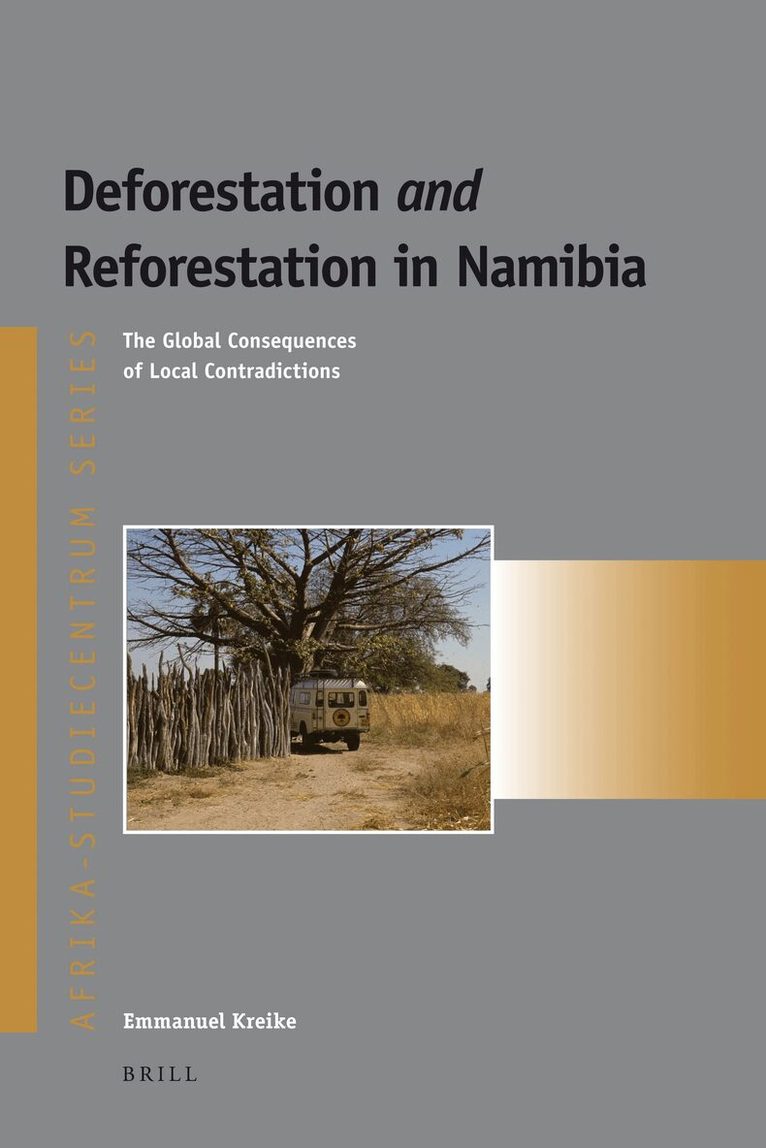
    Deforestation and Reforestation in Namibia

    The Global Consequences of Local Contradictions

    AvEmmanuel Kreike

    Häftad, Engelska, 2009

    Del 17 i serien Afrika-Studiecentrum Series

    845 kr

    Beställningsvara. Skickas inom 5-8 vardagar. Fri frakt över 249 kr.

    Fler format och utgåvor

    Häftad

    421 kr

    Beskrivning

    Descriptions of the late 1800s landscape in the Ovambo floodplain in north-central Namibia closely match the area’s late 1900s appearance, suggesting that little change occurred between the pre-colonial baseline and the postcolonial outcome. Yet, paradoxically, colonial conquest, population pressure, biological invasions, new technology, and economic globalization caused both dramatic deforestation and reforestation in less than a century. The paradox stems from the fact that the prevailing global environmental models obscure and homogenize the process of environmental change: different and contradictory interpretations are dismissed as alternative readings or misreadings of the same process. Deforestation and Reforestation, however, argues that the paradox highlights the need to reframe environmental change as plural processes occurring along multiple trajectories that may be dissynchronized and asymmetrical.

    Produktinformation

    • Utgivningsdatum:2009-10-26
    • Mått:160 x 240 x 17 mm
    • Vikt:443 g
    • Format:Häftad
    • Språk:Engelska
    • Serie:Afrika-Studiecentrum Series
    • Antal sidor:226
    • Förlag:Brill
    • ISBN:9789004179912

    Utforska kategorier

    • Politik och statsskick inom Samhälle och politik
    • Historia inom Historia och arkeologi

    Mer om författaren

    Emmanuel Kreike, PhD (2006) in Forestry, Wageningen University, the Netherlands, and PhD (1996) in History, Yale University, is Associate Professor of History at Princeton University. He authored Re-Creating Eden: Land Use, Environment, and Society in Southern Angola and Northern Namibia (Heinemann, 2004).

    Innehållsförteckning

    • ContentsAcknowledgments ixAbbreviations xiiiMaps xvPhotos xvii1. Approaches to environmental change Models of environmental change The modernization paradigm The declinist paradigm The inclinist paradigm Paradoxes of environmental change 2. Tree castles and population bombsTree castles and insecurity on the eve of colonial conquest Portuguese violence and population fight into Ovamboland Internal migration in South Africa’s OvambolandTree castles and deforestation in the 1920s to 1940s Colonial concerns about overpopulation and deforestation in the 1950sPopulation growth in Ovamboland Woody vegetation resources by the close of the twentieth century3. Conquest of Nature: Imperial political ecologiesThe political ecology of insecurity Indirect environmental ruleThe colonial conquest of Nature: Direct environmental rule 4. Fierce species: Biological imperialism Invading microbes and virgin soil epizootics Invading microbes and virgin soil epidemics A plague of donkeys: Fierce invading equines Fierce indigenous creatures on the rampage 5. Guns, hoes and steel:Techno-environmental determinism Guns Steel tools Steel plows Guns and steel in north-central Namibia 6.Naturalizing cattle culture: Colonialism as a deglobalizing and decommodifying forceThe cattle complex and environmental degradation Ovambo cattle as global commodities Cattle, culture and nature Overstocking and biological time bombs Colonial barriers: Conservation and fences Grazing pressure and desertification Livestock and deforestation Commodification, deglobalization and deforestation 7. The Palenque paradox: Beyond Nature-to-Culture Bush cities and the bush ‘Bushmen’ and the bush 8. The Ovambo paradox and environmental pluralismDeforestation in Ovamboland Reforestation in OvambolandEnvironmental pluralism: Multiprocessual asynchronous environmental change Bibliography Index