
Hofkritik im Licht humanistischer Lebens- und Bildungsideale
ENEA SILVIO PICCOLOMINI, De miseriis curialium (1444), Über das Elend der Hofleute und VLRICHI DE HUTTEN, Equitis Germani Aula Dialogus (1518), Aula, eines deutschen Ritters Dialog über den Hof
AvKlaus Schreiner,Ernst Wenzel
Inbunden, Tyska, 2011
Del 44 i serien Mittellateinische Studien und Texte
2 433 kr
Beställningsvara. Skickas inom 5-8 vardagar. Fri frakt över 249 kr.
Beskrivning
Royal and princely courts in the late Middle Ages and Early Modern period did not only fill the roles of centers of government. The striving for a synthesis between power and the mind made courts into sites of art and literature, of instruction and education. Sons of nobles learned at court not only the use of weapons, but also reading, writing and arithmetic. Jousting gave young knights the opportunity to test their weapons skills and horsemanship. Moreover festivities were a part of court life, and feasts were celebrated extravagantly. Those nobles who lived as knights as well as the academically educated bourgeois used royal and princely courts as opportunities for assuring their professional careers and for social advancement. The reality of the social and ruling fabric of the court included in the late Middle Ages and Early Modern period some rough criticism from those eloquent contemporaries who branded the court as a morally corrupt place of vices. Church reformers brought the courtly lifestyle and the Christian ethic into irreconcilable contrast. How Enea Silvio Piccolimini, the humanist occupying the seat of St. Peter in Rome, and Ulrich von Hutten, the knightly poet, perceived, criticized and justified courtly life, is the subject of this book.
Produktinformation
Utforska kategorier
Mer om författaren
Innehållsförteckning
Hoppa över listan







Mer från samma författare
Bilder, Texte, Rituale: Wirklichkeitsbezug Und Wirklichkeitskonstruktion Politisch-Rechtlicher Kommunikationsmedien in Stadt- Und Adelsgesellschaften
Klaus Schreiner, Gabriela Signori
Häftad
604 kr
Del 20
Del 78
Hoppa över listan

Mer från samma serie
Del 38
Del 39
Klosterreform und mittelalterliche Buchkultur im deutschen Südwesten
Felix Heinzer
Inbunden, 2008
3 273 kr
Del 40
Del 42
Del 43
Odyssea Homeri a Francisco Griffolino Aretino in Latinum translata
Bernd Schneider, Christina Meckelnborg
Inbunden, 2011
3 251 kr
Del 47
Del 45
Physica Sacra: Wunder, Naturwissenschaft und historischer Schriftsinn zwischen Mittelalter und Früher Neuzeit
Bernd Roling
Inbunden, 2013
3 560 kr
Del 48
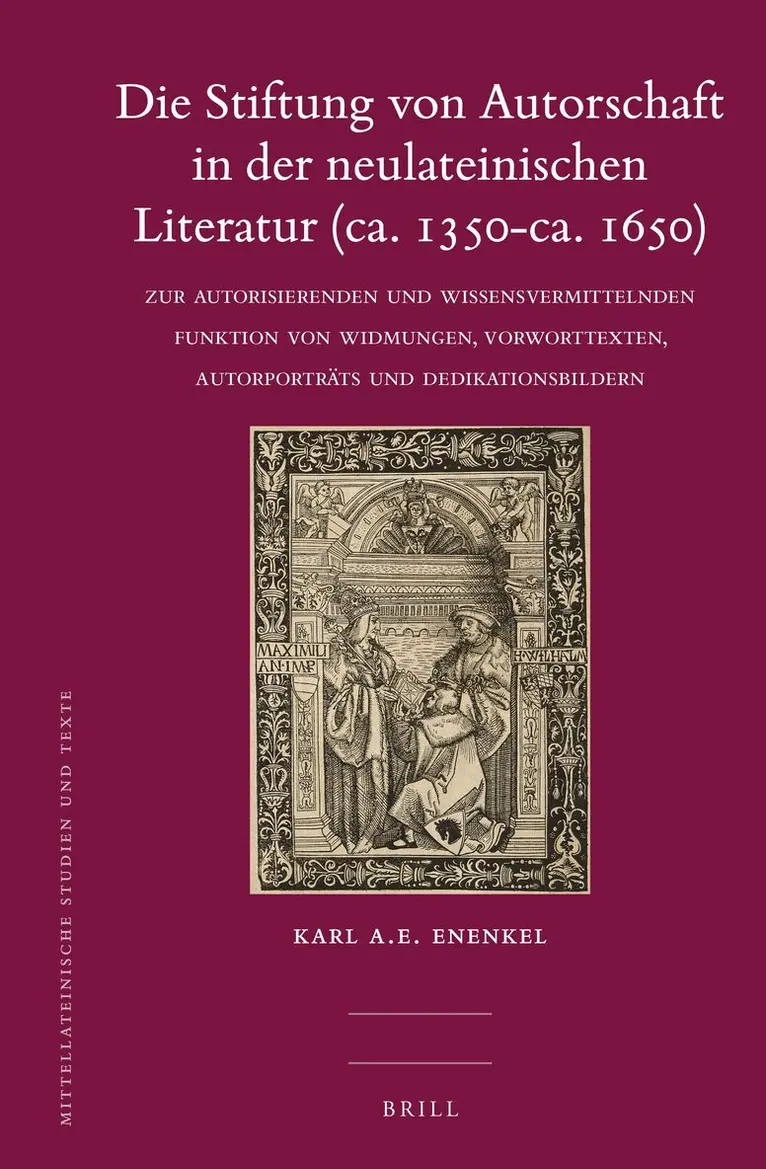
Die Stiftung von Autorschaft in der neulateinischen Literatur (ca. 1350-ca. 1650)
Karl A. E. Enenkel
Inbunden, 2014
4 360 kr
Del 52
Die Polygraphia des Johannes Trithemius nach der handschriftlichen Fassung (Band 1)
Maximilian Gamer
Inbunden, 2022
2 125 kr