• Fri frakt över 249 kr
  • •
  • Snabba leveranser
  • •
  • Billiga böcker
Kundservice

Du är på sajten för privatpersoner.

Företag, bibliotek eller offentlig verksamhet?

Du handlar på classic.bokus.com, där alla dina funktioner finns intakta.
Till classic.bokus.com
Bokus logotyp. Gå till startsidan.
  • Erbjudanden
  • Nyheter
  • Student
  • Topplistor
  • Barn & ungdom
  • Bokus Play
  • E-böcker
  • Pocketböcker
  • Spel & pussel

10% rabatt på allt med kod: NYSTART10 →

Sidfot

Mina sidor

    Hjälp

    • Kundservice
    • Vanliga frågor och svar
    • Frakt och leverans
    • Retur vid ångerrätt
    • Reklamera vara
    • Betalning
    • Köpvillkor
    • Allmänna villkor
    • Information om webbplatsens tillgänglighet

    Om Bokus

    • Om oss
    • Pressrum
    • För studenter
    • För företag
    • För bibliotek och offentlig verksamhet
    • För leverantörer
    • Hållbarhet

    Populärt

    • Aktuella erbjudanden
    • Presentkort
    • Studentlitteratur
    • Nya böcker
    • Topplistor
    • Signerade böcker
    • Engelska böcker

    Inspiration

    • Boktips
    • BookTok
    • Populära bokserier
    • Barnbokskaraktärer
    • Populära författare
    Logotyp för Bokus
    Följ oss på Facebook (extern länk)Följ oss på Instagram (extern länk)Följ oss på YouTube (extern länk)Följ oss på TikTok (extern länk)
    bokus @ CookiesAnpassa cookiesIntegritetspolicyKöpvillkor
    Till Citymail hemsida (extern länk)Till Budbee hemsida (extern länk)Till Postnord hemsida (extern länk)Till Schenker hemsida (extern länk)Till Early Bird hemsida (extern länk)Till Walleys hemsida (extern länk)
    1. Filosofi och religion
    2. Filosofi
    3. Filosofiska discipliner

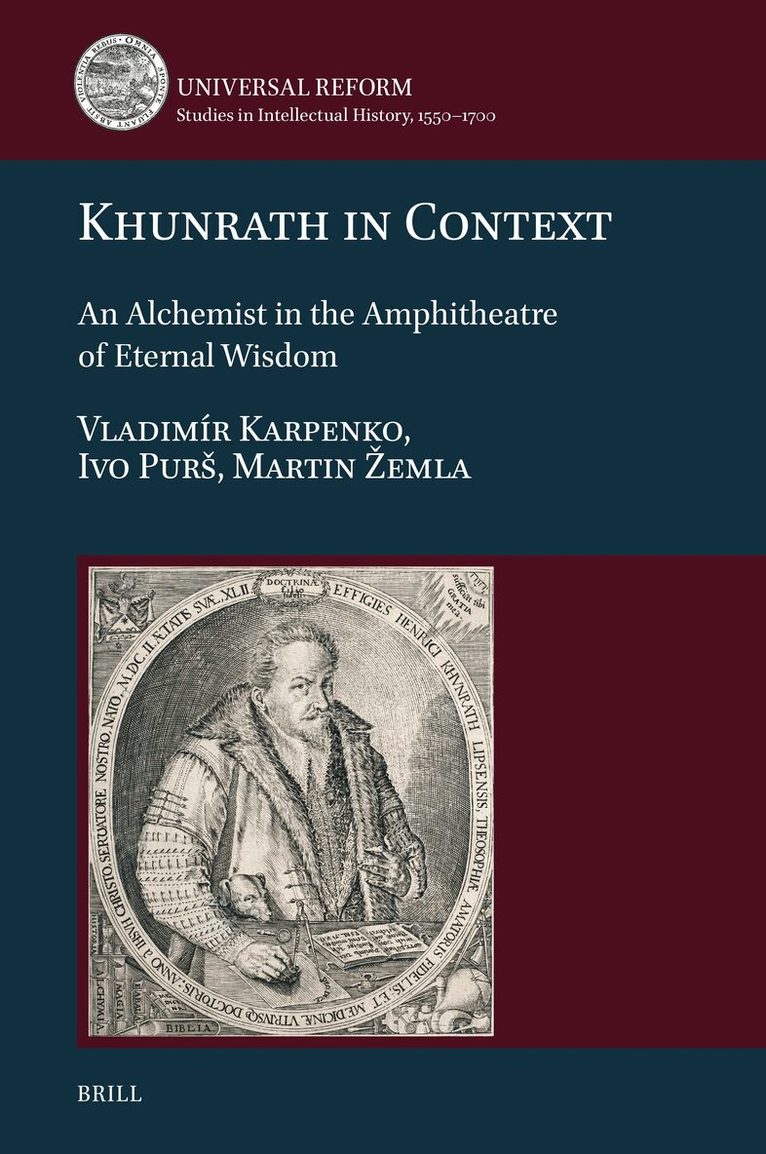
    Khunrath in Context

    An Alchemist in the Amphitheatre of Eternal Wisdom

    AvVladimir Karpenko,Ivo Purš

    Inbunden, Engelska, 2024

    Del 4 i serien Universal Reform

    3 235 kr

    Beställningsvara. Skickas inom 3-6 vardagar. Fri frakt över 249 kr.

    Beskrivning

    The German physician, alchemist, kabbalist, and theosopher Heinrich Khunrath (ca. 1560–1605) is one of the most remarkable figures in the intellectual history of the Renaissance. His work, combining text and images in a new way, is a fusion of the contemporary currents of thought in which alchemy went hand-in-hand with philosophy and Lutheran heterodox theology. As a follower of Paracelsus, Khunrath was in search of both the secrets of nature and the knowledge of God—the “theosophy”. Books on Khunrath are rare, and the present study will appeal to scholars of the Renaissance, historians of science and alchemy, and early modernists in general.

    Produktinformation

    • Utgivningsdatum:2024-12-19
    • Mått:155 x 235 x 47 mm
    • Vikt:1 193 g
    • Format:Inbunden
    • Språk:Engelska
    • Serie:Universal Reform
    • Antal sidor:630
    • Förlag:Brill
    • ISBN:9789004221703

    Utforska kategorier

    • Filosofiska discipliner inom Filosofi och religion
    • Religion och tro inom Filosofi och religion

    Mer om författaren

    Vladimir Karpenko, Ph.D. (1975), Professor Emeritus of Charles University, Prague, studied biophysical chemistry and history of chemistry. He has published in scientific journals and authored a textbook and monographs on both physical chemistry and the history of alchemy.Ivo Purš, Ph.D. (2011, Charles University, Prague) is a Researcher at the Institute of Art History, Czech Academy of Sciences. He has published articles and monographs on the visual art of the Late Renaissance, alchemical iconography, and illustration in science literature.Martin Žemla, Ph.D. (2010, Charles University, Prague) is a Research Fellow at Palacký University, Olomouc, and teaches at the Charles University. He has published articles, translations, and monographs on German mysticism, Paracelsianism, and Renaissance Neoplatonism.

    Innehållsförteckning

    • List of FiguresIntroduction1 Khunrath in the Context of History: Life and Work1 Peregrinatio Alchemica2 Education in Basel and the Thesis De signatura rerum naturalium3 Stay in Bohemia and the De Interpraetatione Quorundam Accidentium4 Overview of Works4.1 Confessio de chao physico-chemicorum catholico4.2 Symbolum physico-chymicum4.3 Magnesia catholica philosophorum4.4 Warhafftiger Bericht vom philosophischen Athanor4.5 De igne magorum philosophorumque secreto externo et visibili2 Khunrath in the Context of Renaissance Thought1 Khunrath as a Paracelsian2 The Metaphysics of Light3 The Two Lights4 Magic5 Kabbalah6 Alchemy3 Khunrath in the Context of the Reformation1 The Reformation and the “German Mysticism”2 Paracelsus3 Valentin Weigel4 Heinrich Khunrath4.1 Personal Revelations4.2 Visions4.3 Sophiology4.4 Exegesis of the Bible and Genesis4.5 The Three Divine Books4.6 Allegory4.7 The Deification of the Human and the “Performing of Miracles”4.8 Rebirth of Man and Renovation of Things5 Theosophy, and Rosicrucianism4 Khunrath in the Context of Laboratory Alchemy (Von hylealischen Chaos)1 The Theoretical Basis – Theosophical and Philosophical Aspects1.1 Introduction1.2 Primordial Matter, Magnesia and Chaos1.3 The Recognition and Acquisition of Primordial Matter1.4 Chaos, Light and Christ1.5 The Green Lion and the Universal and Particular Stone1.6 Two Ways of Working and the Methods Used1.7 Primordial Matter, Adam and Sal Armoniacum1.8 Mercurial Water and the Universal Solvent1.9 The Philosophers’ Stone and Theological Symbolism1.10 Laboratory Procedures and their Wrong Variants1.11 “Be the way you want the stone to be”2 The Practical Basis – the Alchemical and Chemical Aspects2.1 Introduction2.2 The World of Alchemy2.3 Khunrath and the Tradition of Alchemical Secrecy3 Khunrath as an Alchemist3.1 Alchemical Theories4 Magnesia, Vitriol, Antimonium4.1 Magnesia4.2 Vitriol4.3 Antimonium5 Alchemical Practice5.1 “The Seeds of Metals”5.2 The Effect of the Sun on the “Maturing” of Metals5.3 Argenteitas and Aureitas5.4 The Role of Fire and Furnaces5.6 Some Laboratory Activities6 Khunrath and Maier6.1 Maier’s Case Against Fraudulent Alchemists6.2 Comparing the Texts of Khunrath and Maier6.3 An Examination of the Tools Used for Committing Fraud6.4 The Differences between Khunrath’s and Maier’s Opening Statements6.5 Descriptions of Various Fraudulent Techniques6.6 Fraudster’s Explanations Based on Alchemical Theories6.7 The Homunculus6.8 Aurum Potabile7 Conclusion5 Khunrath in the Context of Alchemical Symbolism (Amphitheatrum sapientiae aeternae)1 Introduction2 Prologue to the Amphitheatrum2.1 The First Level of the Prologue2.2 The Second Level of the Prologue2.3 The Third Level of the Prologue2.4 The Fourth Level of the Prologue2.5 The Fifth Level of the Prologue2.6 The Sixth Level of the Prologue2.7 The Seventh Level of the Prologue3 The Iconography of the Engravings in the Amphitheatrum – the First Edition of 15953.1 Amphitheatrum and the Tradition of Medieval Educational Schemata3.2 Text and Image in the Amphitheatrum’s Circular Engravings3.3 Summary – Engravings One to Four4 The Iconography of the Engravings in the Amphitheatrum – the Second Edition of 16094.1 Citadel of Alchemy4.2 Crystal and Seal 4.3 Hermes’ Emerald Tablet4.4 Gymnasium of Nature4.5 Gate of the Amphitheatre of Wisdom4.6 Summary – Engravings Five to Nine4.7 Title Page, Khunrath’s Portrait and the Owl with Torches5 The Engravings of the Amphitheatrum in the Context of Alchemical Iconography5.1 An Overview of the Development of Alchemical Iconography up to the Seventeenth Century5.2 Borrowed Elements in the Alchemical Iconography of the Amphitheatrum5.3 Khunrath’s Alchemical Authorities6 The Influence of Khunrath’s Educational Images on the Development of Alchemical IconographyConclusionBibliographyIndex