• Fri frakt över 249 kr
  • •
  • Snabba leveranser
  • •
  • Billiga böcker
Kundservice

Du är på sajten för privatpersoner.

Företag, bibliotek eller offentlig verksamhet?

Du handlar på classic.bokus.com, där alla dina funktioner finns intakta.
Till classic.bokus.com
Bokus logotyp. Gå till startsidan.
  • Erbjudanden
  • Nyheter
  • Student
  • Topplistor
  • Barn & ungdom
  • Bokus Play
  • E-böcker
  • Pocketböcker
  • Spel & pussel

10% studentrabatt med kod TERM26

Sidfot

Mina sidor

    Hjälp

    • Kundservice
    • Vanliga frågor och svar
    • Frakt och leverans
    • Retur vid ångerrätt
    • Reklamera vara
    • Betalning
    • Köpvillkor
    • Allmänna villkor
    • Information om webbplatsens tillgänglighet

    Om Bokus

    • Om oss
    • Pressrum
    • För studenter
    • För företag
    • För bibliotek och offentlig verksamhet
    • För leverantörer
    • Hållbarhet

    Populärt

    • Aktuella erbjudanden
    • Presentkort
    • Studentlitteratur
    • Nya böcker
    • Topplistor
    • Signerade böcker
    • Engelska böcker

    Inspiration

    • Boktips
    • BookTok
    • Populära bokserier
    • Barnbokskaraktärer
    • Populära författare
    Logotyp för Bokus
    Följ oss på Facebook (extern länk)Följ oss på Instagram (extern länk)Följ oss på YouTube (extern länk)Följ oss på TikTok (extern länk)
    bokus @ CookiesAnpassa cookiesIntegritetspolicyKöpvillkor
    Till Citymail hemsida (extern länk)Till Budbee hemsida (extern länk)Till Postnord hemsida (extern länk)Till Schenker hemsida (extern länk)Till Early Bird hemsida (extern länk)Till Walleys hemsida (extern länk)
    1. Juridik
    2. Internationell rätt
    3. Folkrätt

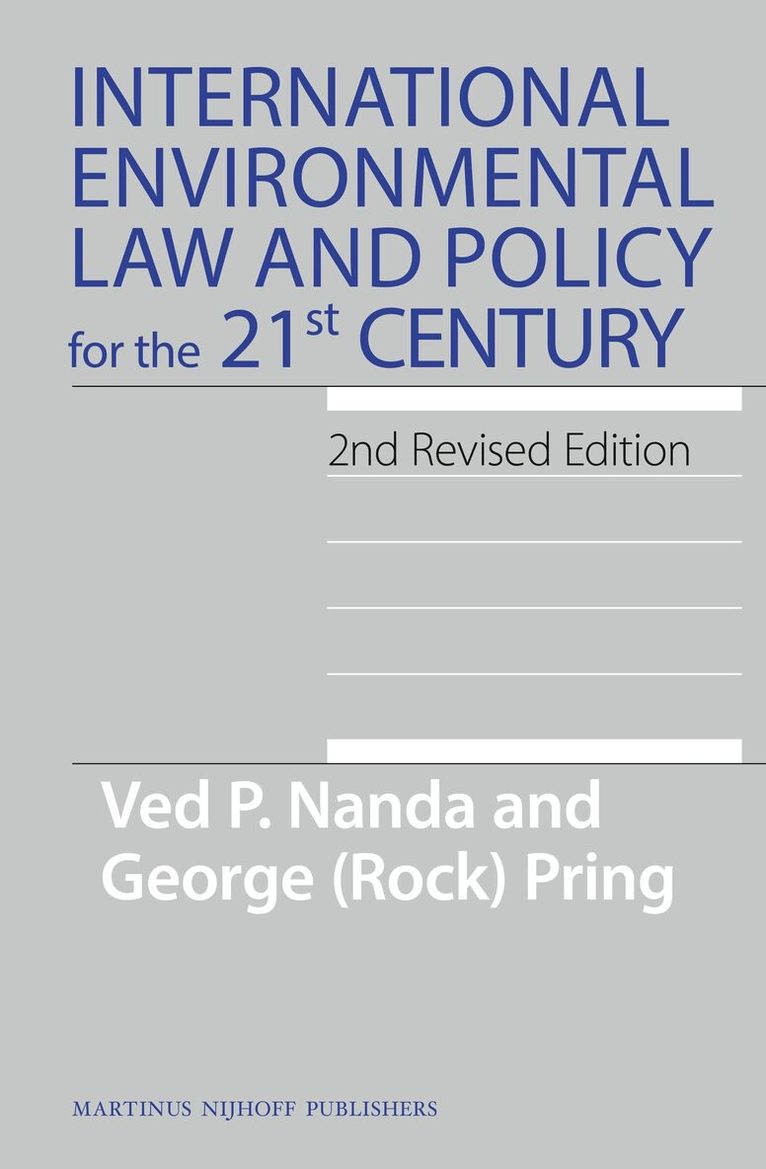
    International Environmental Law and Policy for the 21st Century

    2nd Revised Edition

    AvVed Nanda,George (Rock) Pring

    Inbunden, Engelska, 2012

    Del 9 i serien International Environmental Law

    4 020 kr

    Beställningsvara. Skickas inom 5-8 vardagar. Fri frakt över 249 kr.

    Beskrivning

    In the 21st century, anthropogenic (human-caused) environmental change is widespread and serious on the global, regional/transboundary, and local levels. Emphasizing the environmental, social, and human damage caused by non-sustainable development, International Environmental Law and Policy for the 21st Century, Second Revised Edition by Nanda and Pring, provides readers with an incisive and integrated approach to the political, economic, scientific, and technological realities and challenges facing international environmental law and policy today. This provocative new book offers innovative chapters on such crucial current imperatives as: • the nature and scope of the challenge; • first principles of international environmental law; • environment and human rights; • environment and the nexus of international trade, finance and debt; and • the unfinished agenda. Traditional subjects covered include the history of international environmental law, the law of the sea, international freshwater resources, cross-border air pollution, ozone depletion and climate change, the technology of chemicals manufacture and transport, disposal of hazardous waste, preservation ofand biodiversity, environmental impact analysis, and regulation of nuclear energy. The book also features a critical examination of the UN’s activities on the environment, starting from the 1972 Stockholm Convention on the Environment, up to and including the 2012 Rio+20 Conference on Sustainable Development.With new chapters devoted to critical energy and population issues, and a new section on corporate social responsibility, International Environmental Law & Policy for the 21st Century is an essential resource for students, scholars, lawyers, public officials, corporate decision-makers, and technical consultants concerned with environmental issues.

    Produktinformation

    • Utgivningsdatum:2012-10-12
    • Mått:155 x 235 x 44 mm
    • Vikt:1 134 g
    • Format:Inbunden
    • Språk:Engelska
    • Serie:International Environmental Law
    • Antal sidor:668
    • Upplaga:2
    • Förlag:Brill
    • ISBN:9789004242869

    Utforska kategorier

    • Folkrätt inom Juridik

    Mer om författaren

    Ved P. Nanda, BA, MA (1952) Punjab University, India; LLB (1955), LLM (1958) Delhi University, India; LLM (1962) Northwestern University, is the Evans University Professor, Thompson G. Marsh Professor, and Director of the International Legal Studies Program at the University of Denver Sturm College of Law; biography and publications at www.law.du.edu/index.php/profile/ved-nanda.George (Rock) Pring, BA hons. (1963) Harvard University; JD hons (1968) University of Michigan, is a Professor of Law at the University of Denver Sturm College of Law; biography and publications at www.law.du.edu/index.php/profile/george-pring.

    Innehållsförteckning

    • AcknowledgementsPart I: IntroductionChapter One: International Environmental Law: The Nature and Scope of the Challenge1.0: Introduction1.1: The Sources or Bases of International Environmental Law1.1.1: International Conventional Law1.1.2: International Customary Law1.1.3: General Principles of Law1.1.4: Judicial Decisions1.1.5: Scholarly Writings1.1.6: New Sources of International LawChapter Two: The Fundamental Principles of International Environmental Law2.0: Introduction2.1 Fundamental Substantive Principles2.1.1: State Sovereignty2.1.2: “Good Neighborliness” – The Duty to Cooperate2.1.3: The No-Harm Rule2.1.4: Sustainable Development2.1.5: Right to Development2.1.6: Right to a Clean, Healthful Environment2.1.7: Environmental Justice: Intergenerational and Intragenerational Equity2.1.8: Equitable Utilization of Shared Resources2.1.9: Conservation2.1.10: The Common Heritage of Humankind - “The Global Commons”2.1.11: The Common Concern of Humankind – Erga Omnes2.1.12: Common but Differentiated Responsibilities2.1.13: The Polluter-Pays Principle2.1.14: State Responsibility and Liability2.2 Fundamental Procedural Principles2.2.1: Public Participation2.2.2: Prior Notification, Consultation, and Negotiation Duties2.2.3: The Prevention Principle2.2.4: The Precautionary Principle2.2.5: Duty to Do Environmental Impact Assessment2.2.6: Duty to Adopt Effective National Law—The Duty to Enforce2.2.7: The Integration PrinciplePart II: LawmakingChapter Three: The Early Years3.0: Introduction3.1: International Agreements3.1.1: Early 20th Century Agreements3.1.2: The 1909 Boundary Waters Treaty3.1.3: Other Agreements3.2: Case Law3.2.1: Bering Sea Fur Seals Arbitration3.2.2: The Trail Smelter Arbitration3.2.3: The Corfu Channel Case3.2.4: The Lac Lanoux Arbitration3.2.5: The Japanese Fishermen Case3.2.6: The 1958 US Pacific Nuclear Tests3.2.7: Nuclear Tests Cases (Australia v. France and New Zealand v. France)3.2.8: Pollution of Ciudad Juarez3.2.9: The 1969 Gut Dam Case3.2.10: Legality of the Threat or Use of Nuclear Weapons, Advisory Opinion3.2.11: Case Concerning the Gabcikovo-Nagymaros Project3.2.12: The MOX Plant Case (Ireland v. UK)3.2.13: Iron Rhine Railway Arbitration (Belg. v. Neth.)3.2.14: Case Concerning Pulp Mills on the River Uruguay (Argentina v. Uruguay)3.3: AppraisalChapter Four: The Next 40 Years: The Evolution of International Environmental Policy from 1972 to the Present4.0: Introduction4.1: The Stockholm Conference and Declaration4.1.1: Analysis4.1.2: Appraisal4.2: The Post-Stockholm Period: The Flowering of UNEP4.2.1: Introduction4.2.2: Environmental Assessment4.2.3: Environmental Management4.2.4: Environmental Law4.2.5: Appraisal4.3: The Rio Conference on Environment and Development4.3.1: Introduction4.3.2: The Rio Declaration on Environment and Development4.3.3: Agenda 214.3.4: The Commission on Sustainable Development4.3.5: Appraisal4.4.: The Uneven Road from Rio to Rio (1992-2012)4.4.1: The CSD and “Rio+5”4.4.2: UNEP Reforms for the New Century4.4.3: The 2002 Johannesburg World Summit on Sustainable Development4.4.4: “Rio+20” – the Return to Rio4.5: International Environmental Law, Multilateral Environmental Agreements, and International Environmental Governance4.5.1: UNEP and International Environmental Law4.5.2: UNEP and Multilateral Environmental Agreements4.5.3: UNEP and International Environmental GovernanceChapter Five: International Environmental Institutions and Organizations5.0: Introduction5.1: The United Nations “Family”5.2: International Financial Organizations5.3: Other International IGOs5.4: Regional International IGOs5.5: Nonstate Entities: NGOs and Business Interests5.5.1: International NGOs5.5.2: Multinational Corporations and Other Business Interests5.5.3: Corporate Social ResponsibilityPart III: The Key IssuesChapter Six: Environmental Impact Assessment6.0: Introduction6.1: EIA Procedures: The Common Requirements6.2: The Development of EIA Requirements in International Law6.3: IFIs’ EIA Requirements6.4: The Future of EIAChapter Seven: Energy and the Environment: An International Perspective7.0: Introduction7.1: Energy, Economic Development, and the Environment7.1.1: Energy Availability and Usage and Economic Development7.1.2: Tension Between Energy Generation and Consumption and the Environment7.1.3: Energy and Related Trends7.2: The Evolution of Energy and Environmental Law in an International Context7.3: International Law Related to Energy and the Environment7.3.1: Introduction7.3.2: Nuclear Energy7.3.3: Marine Oil Pollution from Ships7.3.4: Energy Charter Treaty7.4: Looking Ahead7.4.1: Introduction7.4.2: A New Paradigm for Regulating Energy? Global Energy Governance7.5: ConclusionChapter Eight: Preservation8.0: Introduction8.1: Preservation Laws Prior to the 1970s8.1.1: The Early Wildlife Laws8.1.2: The Western Hemisphere Conservation Convention8.2: Preservation Efforts: The Stockholm Era: 1972-19928.2.1: Ecosystems8.2.2: Natural and Cultural Resources8.2.3: Endangered Species8.2.4: The Global Commons8.3: Preservation Efforts: Rio and the 21st Century8.3.1: The Convention on Biological Diversity8.3.2: Forests8.3.3: Desertification8.4: ConclusionChapter Nine: International Freshwater Resources9.0: Introduction9.1: Development of Customary International Law9.1.1: The Major Cases9.1.2: The Key “Soft Law” Developments9.2: The 1997 UN Convention on International Watercourses9.2.1: Adoption of the “Ecosystem” Concept9.2.2: Conflict Between the Principles of “Equitable Utilization” and “No Significant Harm”9.2.3: Pollution Control9.2.4: Other Important Provisions of the International Watercourses Convention9.3: Bilateral, Multilateral, and Regional Regimes of International Freshwater Regulation9.4: Groundwater9.5: ConclusionChapter Ten: International Air Pollution10.0: Introduction10.1: Transboundary Air Pollution10.1.1: Introduction10.1.2: Customary International Law Governing Transboundary Air Pollution10.1.3: Regional Treaty and Planning Regimes10.2: Stratospheric Ozone Depletion10.2.1: Introduction10.2.2: The Problem10.2.3: Evidence of Loss10.2.4: Long-Term Consequences10.2.5: Policy Implications10.2.6: Prior to the 1985 Vienna Convention10.2.7: The 1985 Vienna Ozone Convention10.2.8: The 1987 Montreal Protocol and Subsequent Amendments10.2.9: Developments in the United States and the European Union10.2.10: Appraisal and Recommendations10.3: Global Climate Change10.3.1: Introduction10.3.2: The “Greenhouse” Effect10.3.3: Preventive Strategies and Problems10.3.4: The Framework Convention on Climate Change10.3.5: The Kyoto Protocol10.3.6: Negotiating the Implementation of Kyoto 1998-200510.3.7: An Assessment of the Kyoto Protocol10.3.8: Developing a Post-Kyoto FrameworkChapter Eleven: The Marine Environment11.0: Introduction11.1: Framework of the Convention11.2: Contribution of the Convention to International Environmental Law11.2.1: Environmental Assessment Provisions11.2.2: Law-Making and Law Enforcement Provisions11.2.3: Special Status of Developing States11.2.4: Protection of Living Resources11.2.5: Dispute Settlement Provisions11.2.6: The Relationship of the Convention and Customary Law11.2.7: Appraisal11.3: International and Regional Conventions11.3.1: Regional Conventions11.3.2: International Conventions and Actions11.4: International Tribunal for the Law of the Sea11.5: ConclusionChapter Twelve: Hazardous Waste, Chemicals, and Technology12.0: Introduction12.1: The International Environmental Laws Governing Hazardous Waste12.1.1: Developments Leading up to the Basel Convention12.1.2: The Basel Convention12.1.3: Post-Basel Developments: The “Banners” vs. the “Boosters” of Hazardous Waste Trade12.2: International Controls on Chemicals12.2.1: Introduction12.2.2: The Beginnings: Voluntary International Chemical Control Effects12.2.3: The Recent Development of Binding Chemical Treaties12.3: International Controls on Hazardous Technologies, Industries, and Activities12.4: ConclusionChapter Thirteen: Biotechnology in Food and the Biosafety Protocol13.0: Introduction13.1: Background13.1.1: The Process13.1.2: The Controversy13.2: Regulation of Genetically-Modified Foods--The Key Concepts13.2.1: The Precautionary Principle13.2.2: Substantial Evidence13.2.3: Generally Recognized as Safe (GRAS)13.2.4: The Consumer’s Right to Know13.3: The International Standards for Genetically Modified Foods--The Codex Alimentarius Commission13.4: Efforts to Regulate GMOS13.4.1: The European Union13.4.2: The United States13.5: Cartagena Protocol on Biosafety to the Convention on Biological Diversity13.5.1: Events Leading up to the Biosafety Protocol13.5.2: Content and Analysis13.5.3: AppraisalChapter Fourteen: International Trade and the Environment14.0: Introduction14.1: The 1992 United Nations Conference on Environment and Development--Agenda 2114.2: General Agreement on Tariffs and Trade and the World Trade Organization14.2.1: Environmental Trade Measures14.2.2: GATT Panel Decisions Before the Establishment of the WTO14.2.3: WTO Cases14.2.4: WTO’s Trade and Environment Committee14.2.5: Appraisal14.3: North American Free Trade Agreement14.3.1: Overview14.3.2: Review of the Pertinent NAFTA Provisions14.3.3: Criticisms of NAFTA14.3.4: North American Agreement on Environmental Cooperation14.4: ConclusionChapter Fifteen: The Environment and Human Rights15.0: Introduction15.1: The Challenge of Environmental Degradation15.2: Historical Progression15.3: Developments in the United States15.4: The Right to Environmental Protection15.4.1: The Nexus Between Environmental Protection and Internationally Recognized Human Rights15.4.2: International and National Tribunals and the Right to a Healthy Environment15.5: Operationalizing the Right to Environment15.6: Appraisal and Recommendations15.7: Rights of Indigenous Peoples15.7.1: Introduction: A Case Study15.7.2: What is “Indigenous”?15.7.3: Early International Legal Protection15.7.4: The Universal Declaration on the Rights of Indigenous Peoples15.8: Population, Human Rights, and the Environment15.8.1: Introduction15.8.2: The Nature and Scope of the Problem15.8.3: The Population – Human Rights Nexus15.8.4: The ICPD Program of Action and Subsequent Developments15.8.5: ConclusionPart IV: ConclusionChapter Sixteen: The Unfinished Agenda16.0: The Challenge16.1: Addressing the Challenge16.2: A Final Word