• Fri frakt över 249 kr
  • •
  • Snabba leveranser
  • •
  • Billiga böcker
Kundservice

Du är på sajten för privatpersoner.

Företag, bibliotek eller offentlig verksamhet?

Du handlar på classic.bokus.com, där alla dina funktioner finns intakta.
Till classic.bokus.com
Bokus logotyp. Gå till startsidan.
  • Erbjudanden
  • Student
  • Topplistor
  • Barn & ungdom
  • Bokus Play
  • E-böcker
  • Ljudböcker
  • Pocketböcker
  • Spel och pussel

Pocketfynda! Hundratals böcker för 49 kr/st →

Sidfot

Mina sidor

    Hjälp

    • Kundservice
    • Vanliga frågor och svar
    • Frakt och leverans
    • Retur vid ångerrätt
    • Reklamera vara
    • Betalning
    • Köpvillkor
    • Allmänna villkor
    • Information om webbplatsens tillgänglighet

    Om Bokus

    • Om oss
    • Pressrum
    • För studenter
    • För företag
    • För bibliotek och offentlig verksamhet
    • För leverantörer
    • Hållbarhet

    Populärt

    • Aktuella erbjudanden
    • Presentkort
    • Studentlitteratur
    • Nya böcker
    • Topplistor
    • Signerade böcker
    • Engelska böcker

    Inspiration

    • Boktips
    • BookTok
    • Barnbokskaraktärer
    • Populära författare
    Logotyp för Bokus
    Följ oss på Facebook (extern länk)Följ oss på Instagram (extern länk)Följ oss på YouTube (extern länk)Följ oss på TikTok (extern länk)
    bokus @ CookiesAnpassa cookiesIntegritetspolicyKöpvillkor
    Till Citymail hemsida (extern länk)Till Budbee hemsida (extern länk)Till Postnord hemsida (extern länk)Till Schenker hemsida (extern länk)Till Early Bird hemsida (extern länk)Till Walleys hemsida (extern länk)
    1. Historia och arkeologi
    2. Historia
    3. Forntidens historia

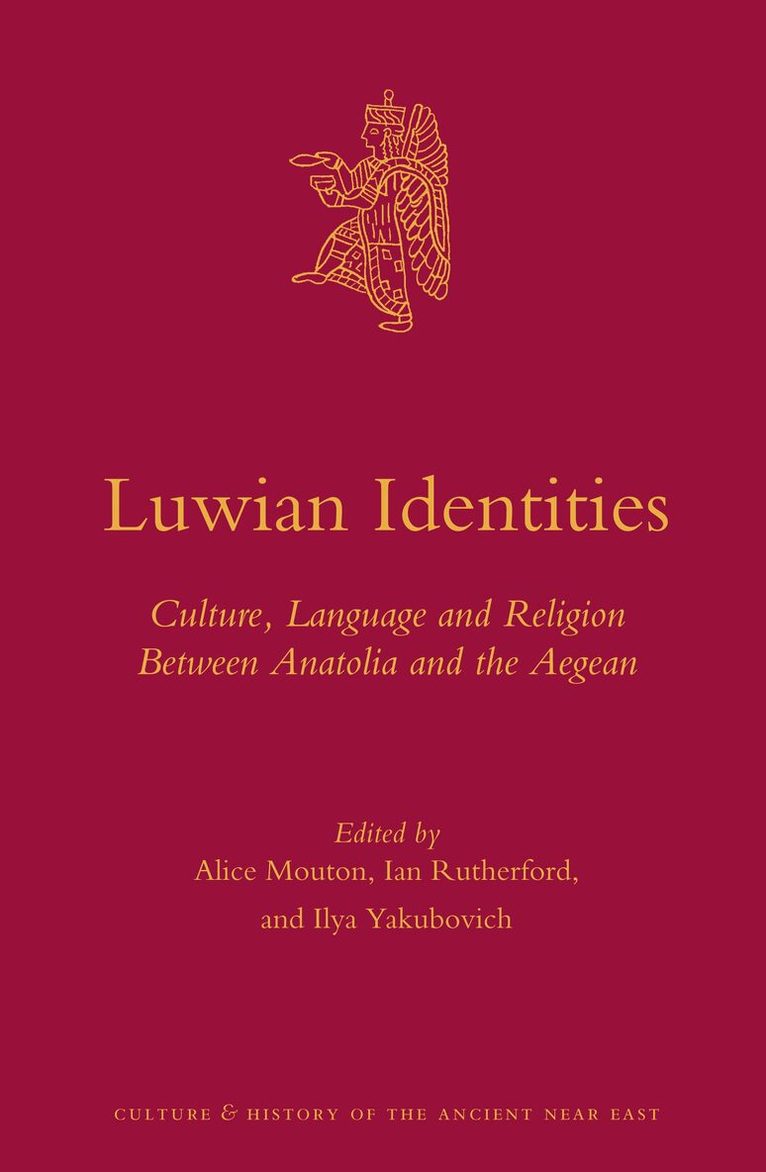
    Luwian Identities

    Culture, Language and Religion Between Anatolia and the Aegean

    AvAlice Mouton,Ian Rutherford

    Inbunden, Engelska, 2013

    Del 64 i serien Culture and History of the Ancient Near East

    4 201 kr

    Beställningsvara. Skickas inom 5-8 vardagar. Fri frakt över 249 kr.

    Beskrivning

    The Luwians inhabited Anatolia and Syria in late second through early first millennium BC. They are mainly known through their Indo-European language, preserved on cuneiform tablets and hieroglyphic stelae. However, where the Luwians lived or came from, how they coexisted with their Hittite and Greek neighbors, and the peculiarities of their religion and material culture, are all debatable matters. A conference convened in Reading in June 2011 in order to discuss the current state of the debate, summarize points of disagreement, and outline ways of addressing them in future research. The papers presented at this conference were collected in the present volume, whose goal is to bring into being a new interdisciplinary field, Luwian Studies."To conclude, the editors of this volume on Luwian identities and the authors of the individual papers are to be congratulatedwith a successful sequel to TheLuwians of 2003 edited by Melchert and with yet another substantial brick in the foundation of the incipient discipline of Luwian studies." Fred C. Woudhuizen

    Produktinformation

    • Utgivningsdatum:2013-06-07
    • Mått:155 x 235 x 40 mm
    • Vikt:1 061 g
    • Format:Inbunden
    • Språk:Engelska
    • Serie:Culture and History of the Ancient Near East
    • Antal sidor:604
    • Förlag:Brill
    • ISBN:9789004252790

    Utforska kategorier

    • Forntidens historia inom Historia och arkeologi

    Mer om författaren

    Alice Mouton (Ph.D. EPHE, Sorbonne, Paris and Leiden University, 2003) is a CNRS full time researcher in Hittitology since 2005. She teaches Hittite cuneiform writing and language at the Institut Catholique de Paris. She wrote two monographs; the first one on Hittite dream reports (Brill, 2007), the second one on South Anatolian birth rituals (De Boccard, 2008). She also edited a collective volume on nightmares in antiquity (De Boccard, 2010). Ian Rutherford (DPhil Oxford 1986) is Professor of Greek at the University of Reading. In 2013-4 he is a visiting research scholar at the Institute for the Study of the Ancient World in New York. His main research interests are in the literature and religion of ancient Greece, Anatolia and Egypt. He was a joint editor of Anatolian Interfaces. Hittites, Greeks and Their Neighbours (Oxbow 2008). His most recent monograph is State Pilgrims and Sacred Observers. Study of Theoriai and Theoroi (Cambridge, 2013).Ilya Yakubovich (Ph.D. University of Chicago, 2008) currently holds research positions at the Moscow State University and the Russian Academy of Sciences. He is an author of the monograph Sociolinguistics of the Luwian Language (Brill, 2010).

    Innehållsförteckning

    • INTRODUCTION A. Mouton, I. Rutherford and I. YakubovichPART ONE. PRESENT STATE OF THE LUWIAN STUDIESLuwian Hieroglyphs, “Luwians versus Hittites” J. David HawkinsPeoples and Maps – Nomenclature and Definitions Stephen DurnfordPART TWO. LUWIAN COMMUNITIES OF CENTRAL ANATOLIANames on Seals, Names in Texts. Who Were These People? Mark WeedenAnatolian Names in wiya- and the Structure of Empire Luwian Onomastics Ilya YakubovichLuwian Words in Hittite Festivals Susanne GörkeCTH 767.7 – The Birth Ritual of Pittei: Its Occasion and the Use of Luwianisms Mary Bachvarova‘Luwian’ Religious Texts in the Archives of Hattusa Daliah BawanypeckThe Luwian Cult of the Goddess Huwassanna vs. Her Position in the ‘Hittite State Cult’ Manfred HutterPART THREE. LUWIAN CULTURE IN SOUTH-EATHERN ANATOLIAA Luwian Shrine? The Stele Building at Kilise Tepe Nicholas Postgate and Adam StoneA New Luwian Rock Inscription from Kahramanmaraş Meltem and Metin AlparslanCarchemish Before and After 1200 BC Sanna AroPART FOUR. LUWIAN AND LUWIC GROUPS OF WESTERN ANATOLIAJames Mellaart and the Luwians: A Culture-(Pre)history Christoph BachhuberThe Cultural Development of Western Anatolia in the Third and Second Millennia BC and its Relationship with Migration Theories Deniz SarıLuwian Religion, a Research Project: The Case of ‘Hittite’ Augury Alice Mouton and Ian RutherfordHieroglyphic Inscriptions of Western Anatolia: Long Arm of the Empire or Vernacular Tradition(s)? Rostislav OreschkoGreek (and our) Views on the Karians Alexander HerdaPART FIVE. CULTURAL CONTACTS BETWEEN LUWIAN OR LUWIC GROUPS AND THE AEGEANDivine Things: Ivories from the Artemision and the Luwian Identity of Ephesos Alan GreavesIyarri at the Interface: the Origins of Ares Alexander MillingtonSingers of Lazpa: Reconstructing Identities on Bronze Age Lesbos Annette Teffeteller