• Fri frakt över 249 kr
  • •
  • Snabba leveranser
  • •
  • Billiga böcker
Kundservice

Du är på sajten för privatpersoner.

Företag, bibliotek eller offentlig verksamhet?

Du handlar på classic.bokus.com, där alla dina funktioner finns intakta.
Till classic.bokus.com
Bokus logotyp. Gå till startsidan.
  • Erbjudanden
  • Nyheter
  • Student
  • Topplistor
  • Barn & ungdom
  • Bokus Play
  • E-böcker
  • Pocketböcker
  • Spel & pussel

10% studentrabatt med kod TERM26

Sidfot

Mina sidor

    Hjälp

    • Kundservice
    • Vanliga frågor och svar
    • Frakt och leverans
    • Retur vid ångerrätt
    • Reklamera vara
    • Betalning
    • Köpvillkor
    • Allmänna villkor
    • Information om webbplatsens tillgänglighet

    Om Bokus

    • Om oss
    • Pressrum
    • För studenter
    • För företag
    • För bibliotek och offentlig verksamhet
    • För leverantörer
    • Hållbarhet

    Populärt

    • Aktuella erbjudanden
    • Presentkort
    • Studentlitteratur
    • Nya böcker
    • Topplistor
    • Signerade böcker
    • Engelska böcker

    Inspiration

    • Boktips
    • BookTok
    • Populära bokserier
    • Barnbokskaraktärer
    • Populära författare
    Logotyp för Bokus
    Följ oss på Facebook (extern länk)Följ oss på Instagram (extern länk)Följ oss på YouTube (extern länk)Följ oss på TikTok (extern länk)
    bokus @ CookiesAnpassa cookiesIntegritetspolicyKöpvillkor
    Till Citymail hemsida (extern länk)Till Budbee hemsida (extern länk)Till Postnord hemsida (extern länk)Till Schenker hemsida (extern länk)Till Early Bird hemsida (extern länk)Till Walleys hemsida (extern länk)
    1. Skönlitteratur
    2. Litteraturvetenskap
    3. Litteraturvetenskap

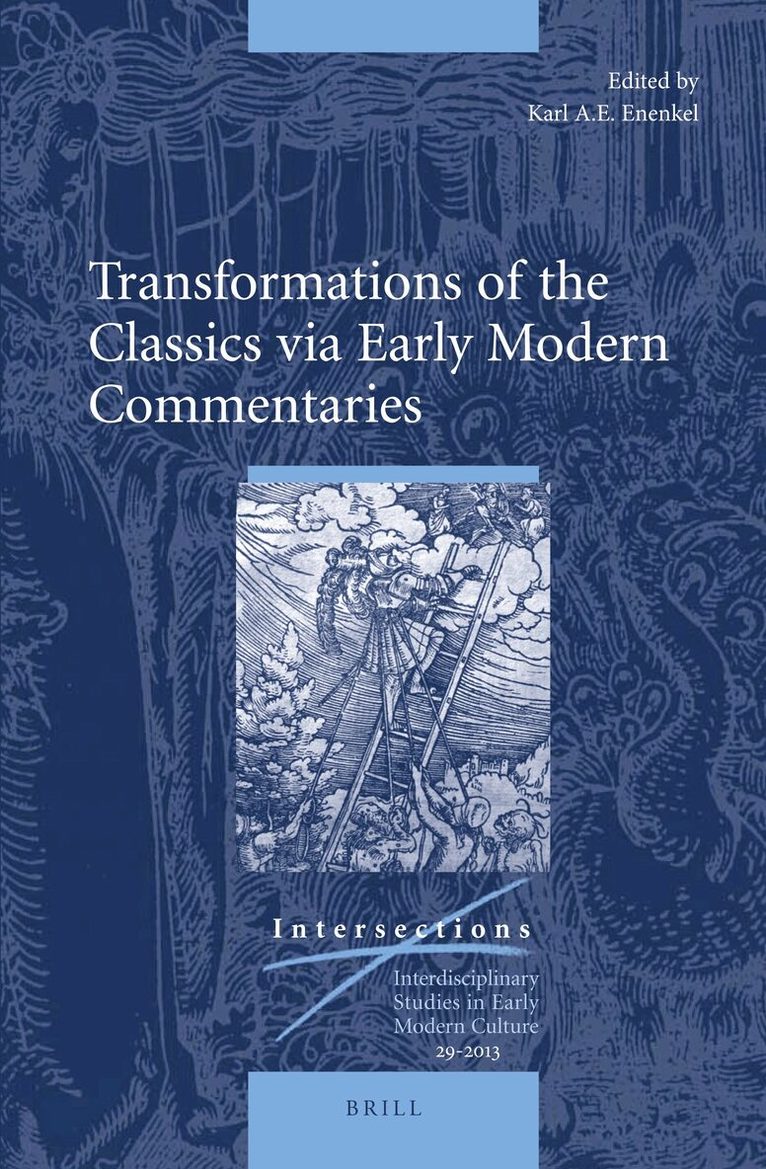
    Transformations of the Classics via Early Modern Commentaries

    AvKarl A. E. Enenkel

    Inbunden, Engelska, 2013

    Del 29 i serien Intersections

    3 555 kr

    Beställningsvara. Skickas inom 5-8 vardagar. Fri frakt över 249 kr.

    Beskrivning

    Commentaries played an important role in the transmission of the classical heritage. Early modern intellectuals rarely read classical authors in a simple and “direct” form, but generally via intermediary paratexts, especially all kinds of commentaries. Commentaries presented the classical texts in certain ways that determined and guided the readers’ perception and usages of the texts being commented upon. Early modern commentaries shaped not only school and university education and professional scholarship, but also intellectual and cultural life in the broadest sense, including politics, religion, art, entertainment, health care, geographical discoveries etc., and even various professional activities and segments of life that were seemingly far removed from scholarship and learning, such as warfare and engineering.Contributors include: Susanna de Beer, Valéry Berlincourt, Marijke Crab, Jeanine De Landtsheer, Karl Enenkel, Gergő Gellérfi, Trine Arlund Hass, Ekaterina Ilyushechkina, Ronny Kaiser, Marc Laureys, Christoph Pieper, Katharina Suter-Meyer, and Floris Verhaart.

    Produktinformation

    • Utgivningsdatum:2013-11-29
    • Mått:155 x 235 x 30 mm
    • Vikt:798 g
    • Format:Inbunden
    • Språk:Engelska
    • Serie:Intersections
    • Antal sidor:418
    • Förlag:Brill
    • ISBN:9789004260771

    Utforska kategorier

    • Litteraturvetenskap inom Skönlitteratur
    • Kulturvetenskap inom Samhälle och politik
    • Historia inom Historia och arkeologi

    Mer om författaren

    Karl Enenkel is Professor of Medieval Latin and Neo-Latin at the Westfälische Wilhelms-Universität Münster (Germany). Previously he was Professor of Neo-Latin at the University of Leiden (Netherlands). He has published widely on international Humanism, early modern organisation of knowledge, literary genres 1300-1600, and emblem studies.

    Recensioner i media

    “The real tour de force in the volume is the ninety-four-page essay of its editor, Karl Enenkel, who also wrote the grant to the Dutch Organization for Scientific Research that supported five of the authors ... Enenkel argues (quite convincingly) that illustrations to early modern printed editions can also serve as a kind of commentary … We owe thanks to him for the vision and hard work that has produced what is considerably more on the scholarly level than just another set of conference papers, and to Brill for producing a well-printed volume that is enriched with dozens of illustrations (over forty in Enenkel’s article alone).”Craig Kallendorf, Texas A&M University. In: Renaissance Quarterly, Vol. 67, No. 4 (Winter 2014), pp. 1303-1305.“enormously helpful … beautifully presented, well-made … an excellent collection of thoughtful and stimulating essays.”Jon Balserak, University of Bristol. In: Sixteenth Century Journal, Vol. 46, No. 2 (2015), pp. 430-431.

    Innehållsförteckning

    • Acknowledgements ......................................................................................... viiNotes on the Editor ......................................................................................... ixNotes on the Contributors ............................................................................ xiList of Illustrations ........................................................................................... xvIntroduction – The Transformation of the Classics. Practices,Forms, and Functions of Early Modern Commenting .................... 1. Karl A.E. EnenkelPOETRYHorace and Ramist Dialectics: Pierre Gaultier Chabot’s(1516–1598?) Commentaries ..................................................................... 15. Floris B. VerhaartChanging Metatexts and Changing Poetic Ideals .................................. 47. Trine Arlund HassHoraz als Schulfibel und als elitärer Gründungstext des deutschenHumanismus. Die illustrierte Horazausgabe des Jakob Locher(1498) .............................................................................................................. 61. Christoph PieperPetrus Nannius als Philologe und Literaturkritiker im Lichte seinesKommentars zur Ars Poetica des Horaz .............................................. 91. Marc LaureysScholarly Polemic: Bartolomeo Fonzio’s Forgotten Commentaryon Juvenal ..................................................................................................... 111. Gergő GellérfiCommenting on Claudian’s ‘Political Poems’, 1612/1650 ...................... 125. ValÉry BerlincourtHISTORY AND MORAL PHILOSOPHYJosse Bade’s Familiaris Commentarius on Valerius Maximus (1510):A School Commentary? ............................................................................ 153. Marijke CrabIllustrations as Commentary and Readers’ Guidance.The Transformation of Cicero’s De Officiis into a GermanEmblem Book by Johann von Schwarzenberg, Heinrich Steiner,and Christian Egenolff (1517–1520; 1530/1531; 1550) ........................... 167. Karl A.E. EnenkelUnderstanding National Antiquity. Transformations of Tacitus’sGermania in Beatus Rhenanus’s Commentariolus ............................ 261. Ronny KaiserAnnotating Tacitus: The Case of Justus Lipsius ..................................... 279. Jeanine De LandtsheerNATURAL HISTORY AND GEOGRAPHYThe Survival of Pliny in Padua. Transforming Classical Scholarshipduring the Botanical Renaissance ......................................................... 329. Susanna de BeerElephants and Bears through the Eyes of Scholars: A Case Studyof Pliny’s Zoology in the 15th–16th Centuries .................................... 363. Ekaterina IlyushechkinaFrühneuzeitliche Landesbeschreibung in einer antikenGeographie – Der Rhein aus persönlicher Perspektive inVadians Kommentar zu Pomponius Mela (1522) .............................. 389. Katharina Suter-MeyerIndex Nominum ............................................................................................... 411