• Fri frakt över 249 kr
  • •
  • Snabba leveranser
  • •
  • Billiga böcker
Kundservice

Du är på sajten för privatpersoner.

Företag, bibliotek eller offentlig verksamhet?

Du handlar på classic.bokus.com, där alla dina funktioner finns intakta.
Till classic.bokus.com
Bokus logotyp. Gå till startsidan.
  • Erbjudanden
  • Nyheter
  • Student
  • Topplistor
  • Barn & ungdom
  • Bokus Play
  • E-böcker
  • Pocketböcker
  • Spel & pussel

10% rabatt på allt med kod NYSTART10 →

Sidfot

Mina sidor

    Hjälp

    • Kundservice
    • Vanliga frågor och svar
    • Frakt och leverans
    • Retur vid ångerrätt
    • Reklamera vara
    • Betalning
    • Köpvillkor
    • Allmänna villkor
    • Information om webbplatsens tillgänglighet

    Om Bokus

    • Om oss
    • Pressrum
    • För studenter
    • För företag
    • För bibliotek och offentlig verksamhet
    • För leverantörer
    • Hållbarhet

    Populärt

    • Aktuella erbjudanden
    • Presentkort
    • Studentlitteratur
    • Nya böcker
    • Topplistor
    • Signerade böcker
    • Engelska böcker

    Inspiration

    • Boktips
    • BookTok
    • Populära bokserier
    • Barnbokskaraktärer
    • Populära författare
    Logotyp för Bokus
    Följ oss på Facebook (extern länk)Följ oss på Instagram (extern länk)Följ oss på YouTube (extern länk)Följ oss på TikTok (extern länk)
    bokus @ CookiesAnpassa cookiesIntegritetspolicyKöpvillkor
    Till Citymail hemsida (extern länk)Till Budbee hemsida (extern länk)Till Postnord hemsida (extern länk)Till Schenker hemsida (extern länk)Till Early Bird hemsida (extern länk)Till Walleys hemsida (extern länk)
    1. Skönlitteratur
    2. Litteraturvetenskap
    3. Litteraturvetenskap

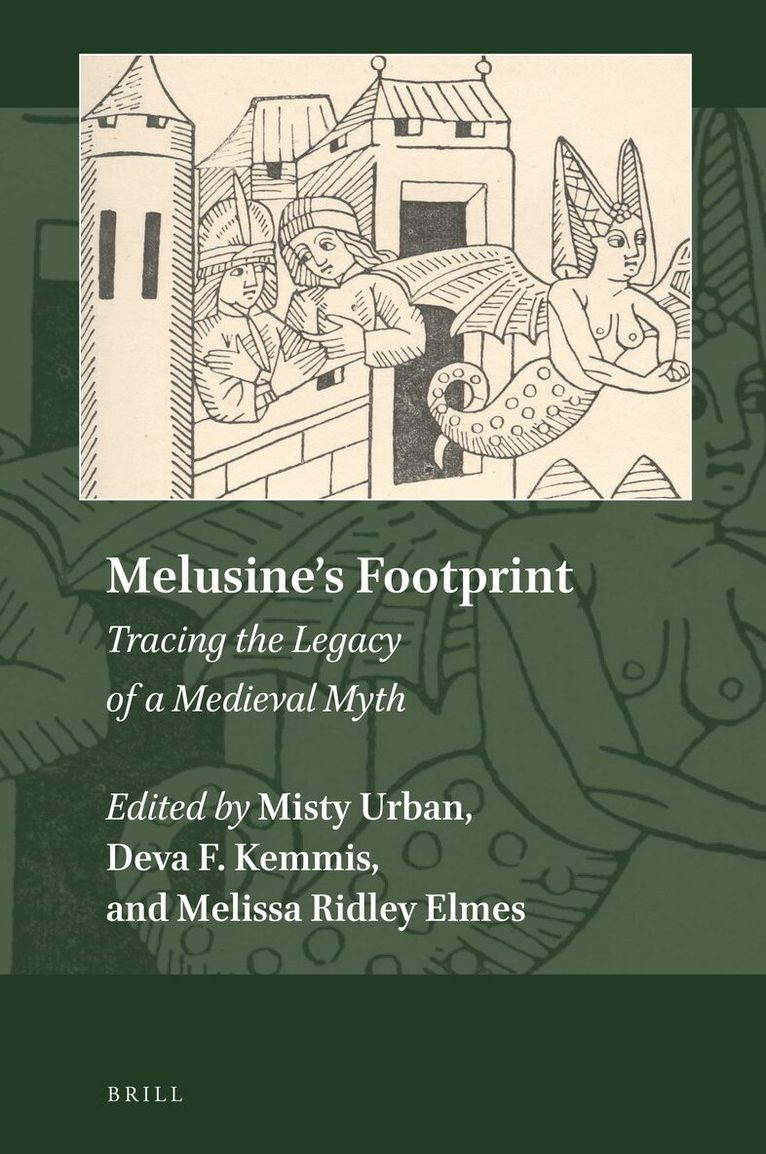
    Melusine's Footprint

    Tracing the Legacy of a Medieval Myth

    AvMisty Urban

    Inbunden, Engelska, 2017

    Del 4 i serien Explorations in Medieval Culture

    2 449 kr

    Beställningsvara. Skickas inom 5-8 vardagar. Fri frakt över 249 kr.

    Beskrivning

    In Melusine’s Footprint: Tracing the Legacy of a Medieval Myth, editors Misty Urban, Deva Kemmis, and Melissa Ridley Elmes offer an invigorating international and interdisciplinary examination of the legendary fairy Melusine. Along with fresh insights into the popular French and German traditions, these essays investigate Melusine’s English, Dutch, Spanish, and Chinese counterparts and explore her roots in philosophy, folklore, and classical myth.Combining approaches from art history, history, alchemy, literature, cultural studies, and medievalism, applying rigorous critical lenses ranging from feminism and comparative literature to film and monster theory, this volume brings Melusine scholarship into the twenty-first century with twenty lively and evocative essays that reassess this powerful figure’s multiple meanings and illuminate her dynamic resonances across cultures and time.Contributors are Anna Casas Aguilar, Jennifer Alberghini, Frederika Bain, Anna-Lisa Baumeister, Albrecht Classen, Chera A. Cole, Tania M. Colwell, Zoë Enstone, Stacey L. Hahn, Deva F. Kemmis, Ana Pairet, Pit Péporté, Simone Pfleger, Caroline Prud’Homme, Melissa Ridley Elmes, Renata Schellenberg, Misty Urban, Angela Jane Weisl, Lydia Zeldenrust, and Zifeng Zhao.

    Produktinformation

    • Utgivningsdatum:2017-11-23
    • Mått:155 x 235 x 31 mm
    • Vikt:836 g
    • Format:Inbunden
    • Språk:Engelska
    • Serie:Explorations in Medieval Culture
    • Antal sidor:438
    • Förlag:Brill
    • ISBN:9789004315082

    Utforska kategorier

    • Litteraturvetenskap inom Skönlitteratur
    • Sociala och etiska frågor inom Samhälle och politik
    • Socialhistoria och kulturhistoria inom Historia och arkeologi

    Mer om författaren

    Misty Urban (Ph.D., Cornell University, 2008) coordinates the Writing Center at Muscatine Community College. She is the author of Monstrous Women in Middle English Romance (Lewiston, NY: Edwin Mellen, 2010).Deva F. Kemmis (Ph.D., Georgetown University, 2012) is an instructor of German language and culture at the Goethe-Institut in Washington, DC. Her publications include an essay on self-forgiveness in the Nibelungenlied and a forthcoming article in the Yearbook of the Society for Medieval German Studies.Melissa Ridley Elmes (Ph.D., University of North Carolina at Greensboro, 2016) is Assistant Professor of English at Lindenwood University. She has essays published or forthcoming on the Arthurian legend, Chaucer, teaching medieval literature, medievalism, the Robin Hood legend, and violence at the feast in medieval texts.

    Recensioner i media

    "This magnificent book combines the research of twenty interdisciplinary scholars who meticulously investigate the eponymous footprint of Melusine from a wide variety of literary as well as artistic approaches. It illustrates how richly this theriomorphic monstrous snake woman has contributed to the culture of so many European countries, and extends as far afield as China, in a study that clearly indicates the continuing fascination of this most enchanting and threatening figure. Melusine is here variously discussed as an instructive exemplar of Christian piety, a powerful mother who desires to humanize herself through marriage into the chivalric, religious order of her age, a transformative figure unifying humanity with nature, an abject object of the gaze, a fairy who functions as a monstrous Other in the mirror of romance, and a metaphor for transgressive feminine prowess. This enthralling work contributes extensively to Melusinia, reading the fairy serpentine hybrid as a symbolic force who never remains contained within any boundaries that may attempt to inscribe her."Gillian M. E. Alban (author of Melusine the Serpent Goddess in A. S. Byatt’s Possession and in Mythology (2003) and The Medusa Gaze in Contemporary Women’s Fiction: Petrifying, Maternal and Redemptive (2017)."Essential reading not only for medievalists, but also for scholars focused on fairy tale and folklore studies, cultural studies, feminist theory, gender theory, and postmodernist theory. Melusine’s Footprint reinvigorates the study of the Melusine tale and her depiction in various texts from the Medieval period through contemporary representations. The analyses vary theoretically and render new interpretations, keeping Melusine alive for scholars in the humanities and the social sciences". Sylvia Veronica Morin, in Journal of the Fantastic in the Arts, 30 (1), (2019).

    Innehållsförteckning

    • AcknowledgementsList of IllustrationsNotes on ContributorsIntroductionPart I. Bodies and Texts: Mapping Melusine in Art and Print1 The Tail of Melusine: Hybridity, Mutability, and the Accessible OtherFrederika Bain2 Polycorporality and Heteromorphia: Untangling Melusine's Mixed BodiesAna Pairet3 Mermaid, Mother, Monster, and More: Portraits of the Fairy Woman in Fifteenth- and Sixteenth-Century Melusine NarrativesCaroline Prud'Homme4 The Melusine Figure in Fifteenth- and Sixteenth-Century German Literature and Art: Cultural-Historical Information within the Pictorial ProgramAlbrecht Classen5 The Alchemical Transformation of MelusineMelissa Ridley ElmesPart II. Mother, Muse: Melusine and Political Identity6 Architecture and Empire in Historia de la linda MelosinaAnna Casas Aguilar7 The Lady with the Serpent's Tail: Hybridity and the Dutch MeluzineLydia Zeldenrust8 Matriarchs and Mother Tongues: The Middle English Romans of PartenayJennifer Alberghini9 Melusine and Luxembourg: A Double MemoryPit PéportéPart III. Theoretical Transformations: Readings and Refigurations10 Youth and Rebellion in Jean d'Arras' Roman de MélusineStacey L. Hahn11 The Promise of (Un)Happiness in Thüring von Ringoltingen's MelusineSimone Pfleger12 Half Lady, Half Serpent: Melusine's Monstrous Body and the Discourse of RomanceAngela Jane Weisl13 Passing as a "Humayn Woman": Hybridity and Salvation in the Middle English MelusineChera A. Cole14 Melusine and Purgatorial Punishment: The Changing Nature of FaysZoë Enstone15 Metamorphoses of Snake Women: Melusine and Madam WhiteZifeng ZhaoPart IV. Melusines Medieval to Modern16 Goethe and Die neue Melusine: A Critical ReinterpretationRenata Schellenberg17 "Listening Down the Hall": An Epistemological Consideration of the Encounter with Melusine in the Germanic Literary TraditionDeva F. Kemmis18 Woman, Abject, Animal: Refigurations of Melusine in Frischmuth, Jelinek, and EXPORTAnna-Lisa Baumeister19 How the Dragon Ate the Woman: The Fate of Melusine in EnglishMisty Urban20 Melusines Past, Present, and Future: An AfterwordTania M. ColwellSelected BibliographyIndex