• Fri frakt över 249 kr
  • •
  • Snabba leveranser
  • •
  • Billiga böcker
Kundservice

Du är på sajten för privatpersoner.

Företag, bibliotek eller offentlig verksamhet?

Du handlar på classic.bokus.com, där alla dina funktioner finns intakta.
Till classic.bokus.com
Bokus logotyp. Gå till startsidan.
  • Erbjudanden
  • Nyheter
  • Student
  • Topplistor
  • Barn & ungdom
  • Bokus Play
  • E-böcker
  • Pocketböcker
  • Spel & pussel

10% rabatt på allt med kod NYSTART10 →

Sidfot

Mina sidor

    Hjälp

    • Kundservice
    • Vanliga frågor och svar
    • Frakt och leverans
    • Retur vid ångerrätt
    • Reklamera vara
    • Betalning
    • Köpvillkor
    • Allmänna villkor
    • Information om webbplatsens tillgänglighet

    Om Bokus

    • Om oss
    • Pressrum
    • För studenter
    • För företag
    • För bibliotek och offentlig verksamhet
    • För leverantörer
    • Hållbarhet

    Populärt

    • Aktuella erbjudanden
    • Presentkort
    • Studentlitteratur
    • Nya böcker
    • Topplistor
    • Signerade böcker
    • Engelska böcker

    Inspiration

    • Boktips
    • BookTok
    • Populära bokserier
    • Barnbokskaraktärer
    • Populära författare
    Logotyp för Bokus
    Följ oss på Facebook (extern länk)Följ oss på Instagram (extern länk)Följ oss på YouTube (extern länk)Följ oss på TikTok (extern länk)
    bokus @ CookiesAnpassa cookiesIntegritetspolicyKöpvillkor
    Till Citymail hemsida (extern länk)Till Budbee hemsida (extern länk)Till Postnord hemsida (extern länk)Till Schenker hemsida (extern länk)Till Early Bird hemsida (extern länk)Till Walleys hemsida (extern länk)
    1. Historia och arkeologi
    2. Historia

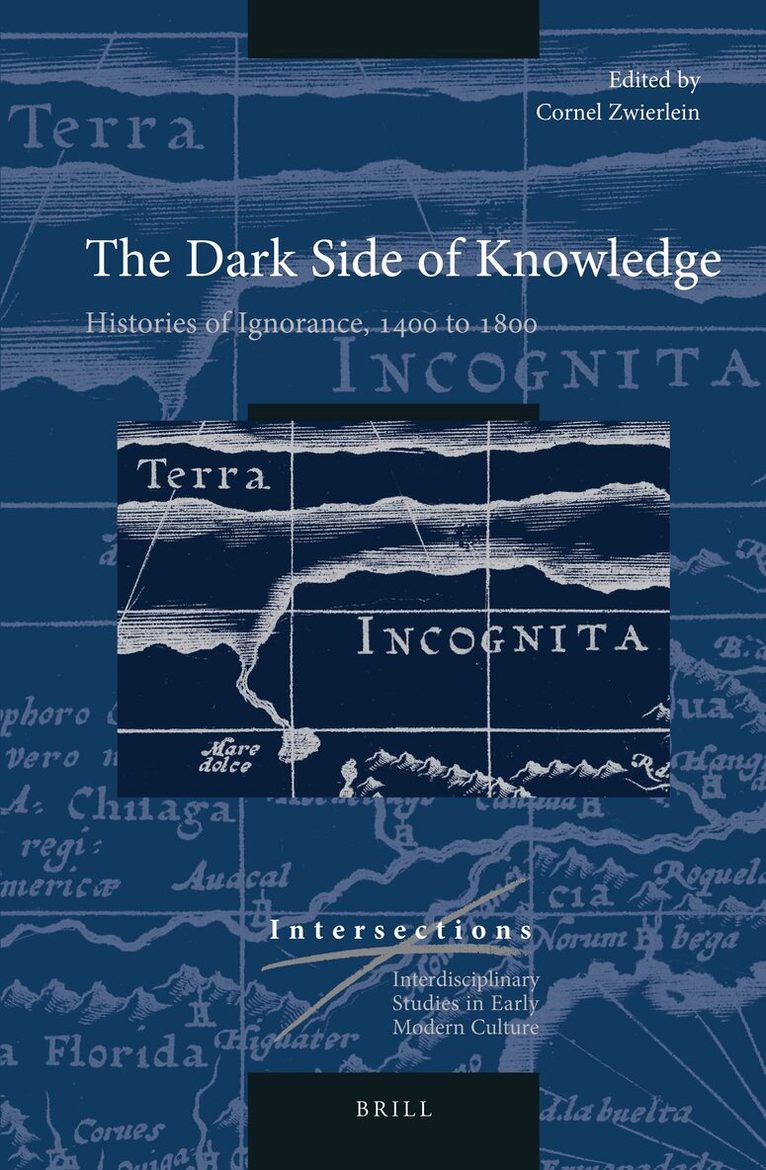
    Dark Side of Knowledge

    Histories of Ignorance, 1400 to 1800

    AvCornel Zwierlein,Cornel Zwierlein

    Inbunden, Engelska, 2016

    Del 46 i serien Intersections

    3 448 kr

    Beställningsvara. Skickas inom 5-8 vardagar. Fri frakt över 249 kr.

    Beskrivning

    How can one study the absence of knowledge, the voids, the conscious and unconscious unknowns through history? Investigations into late medieval and early modern practices of measuring, of risk calculation, of ignorance within financial administrations, of conceiving the docta ignorantia as well as the silence of the illiterate are combined with contributions regarding knowledge gaps within identification procedures and political decision-making, with the emergence of consciously delimited blanks on geographical maps, with ignorance as a factor embedded in iconographic programs, in translation processes and the semantic potentials of reading. Based on thorough archival analysis, these selected contributions from conferences at Harvard and Paris are tightly framed by new theoretical elaborations that have implications beyond these cases and epochal focus. Contributors: Giovanni Ceccarelli, Taylor Cowdery, Lucile Haguet, John T. Hamilton, Lucian Hölscher, Moritz Isenmann, Adam J. Kosto, Marie-Laure Legay, Andrew McKenzie-McHarg, Fabrice Micallef, William T. O´Reilly, Eleonora Rohland, Mathias Schmoeckel, Daniel L. Smail, Govind P. Sreenivasan, and Cornel Zwierlein.

    Produktinformation

    • Utgivningsdatum:2016-06-23
    • Mått:155 x 235 x 30 mm
    • Vikt:812 g
    • Format:Inbunden
    • Språk:Engelska
    • Serie:Intersections
    • Antal sidor:436
    • Förlag:Brill
    • ISBN:9789004325128

    Utforska kategorier

    • Historia inom Historia och arkeologi
    • Filosofiska discipliner inom Filosofi och religion

    Mer om författaren

    Prof. Dr. Cornel Zwierlein, since 2008 Univ. Bochum, PhD 2003 LMU Munich/CESR Tours; Fellow Harvard History 2013-2016. Monographs Discorso und Lex Dei, 2006; Der gezähmte Prometheus, 2011; forthcoming The Political Thought of the French League (Droz, Geneva) and Imperial Unknowns (Cambridge UP).

    Recensioner i media

    "Our ignorance, [Zwierlein] notes, can take different forms. “Nescience” or “unspecified ignorance” names a condition in which we are unaware of what we don’t know; we are, in other words, ignorant of our ignorance. Unspecified ignorance transforms into “specified ignorance” as we become aware of things we don’t know. Ignorance can be willful or accidental, the product of censorship or planned political coercion. However it exists, Zwierlein contends that attention to the existence and role of ignorance in bureaucratic, economic, scientific, and artistic settings will deepen our understanding of knowledge production in the early modern world." - Dallas Denery, Bowdoin College, in: Renaissance Quarterly LXX.4"Mehr Wissen erzeugt immer zugleich mehr Nichtwissen. Absolutes Nichtwissen – „unknown unknowns“, also das, wovon man nicht weiß, dass man es nicht weiß – lässt sich nicht thematisieren. Spezifisches Nichtwissen – „known unknowns“, also das, wovon man weiß, dass man es nicht weiß – hingegen schon. Nichtwissen lässt sich nur identifizieren, insofern es sich auf ein Wissen bezieht: das Allwissen Gottes, das Wissen der anderen, das zukünftige oder das vergangene Wissen, das verbotene, das unterdrückte, das verdrängte, das verlorene Wissen usw. Jedes Wissen definiert ja zugleich seine Grenzen und zeigt an, was noch nicht oder nicht mehr zugänglich ist." - Barbara Stollberg-Rilinger, Münster / Berlin, in: Zeitschrift für Historische Forschung 46.3

    Innehållsförteckning

    • Notes on the Editor and the ContributorsList of IllustrationsIntroduction: Towards a History of IgnoranceCornel ZwierleinPART 1: LAW1 Law and the Uncertainty of Value in Late Medieval Marseille and Lucca Daniel L. Smail2 Nescience and the Conscience of Judges. An example of Religion’s influence on Legal procedureMathias Schmoeckel3 Speaking Nothing to Power in early modern Germany: Making Sense of Peasant Silence in the Ius CommuneGovind P. SreenivasanPART 2: ECONOMY4Coping with unkown Risks in Renaissance Florence: Insurance, Friars and Abacus TeachersGiovanni Ceccarelli5(Non-)Knowledge, Political Economy and Trade Policy in Seventeenth-Century France: The Problem of Trade BalancesMoritz Isenmann6Ignorance in Europe’s State Financial Culture (Eighteenth Century)Marie-Laure LegayPART 3: SEMANTICS7 Voluptas carnis. Allegory and Non-Knowledge in Pieter Aertsen’s Still-Life PaintingsJohn T. Hamilton8Humanist Styles of Reading in the Prologues and Epilogues of William CaxtonTaylor Cowdery9Coexistence and Ignorance: What Europeans in the Levant did not read (ca. 1620 to 1750)Cornel ZwierleinPART 4: POLITICAL AND SCIENTIFIC COMMUNICATION10Ignorance about the Traveler: Documenting Safe Conduct in the European Middle AgesAdam J. Kosto11International Crises as Experience of Non-Knowledge: European Powers and the ‘Affairs of Provence’ (1589-1598)Fabrice Micallef12Dealing with Hurricanes and Mississippi Floods in Early French New Orleans. Environmental (Non-) Knowledge in a Colonial ContextEleonora Rohland13‘Unknown Sciences’ and Unknown Superiors. The Problem of Non-Knowledge in Eighteenth-Century Secret SocietiesAndrew McKenzie-McHarg14Specifying Ignorance in Eighteenth-Century Cartography, a powerful way to promote the Geographer’s Work: The example of Jean-Baptiste d’AnvilleLucile HaguetPART 5: THEORY15Semantics of the Void Empty Spaces in Eighteenth-Century German Historiography – A First Sketch of a Semiotic TheoryLucian Hölscher16Non-Knowledge and Decision Making: The Challenge for the HistorianWilliam O’ReillyIndex nominumIndex rerum