• Fri frakt över 249 kr
  • •
  • Snabba leveranser
  • •
  • Billiga böcker
Kundservice

Du är på sajten för privatpersoner.

Företag, bibliotek eller offentlig verksamhet?

Du handlar på classic.bokus.com, där alla dina funktioner finns intakta.
Till classic.bokus.com
Bokus logotyp. Gå till startsidan.
  • Erbjudanden
  • Nyheter
  • Student
  • Topplistor
  • Barn & ungdom
  • Bokus Play
  • E-böcker
  • Pocketböcker
  • Spel & pussel

10% studentrabatt med kod TERM26

Sidfot

Mina sidor

    Hjälp

    • Kundservice
    • Vanliga frågor och svar
    • Frakt och leverans
    • Retur vid ångerrätt
    • Reklamera vara
    • Betalning
    • Köpvillkor
    • Allmänna villkor
    • Information om webbplatsens tillgänglighet

    Om Bokus

    • Om oss
    • Pressrum
    • För studenter
    • För företag
    • För bibliotek och offentlig verksamhet
    • För leverantörer
    • Hållbarhet

    Populärt

    • Aktuella erbjudanden
    • Presentkort
    • Studentlitteratur
    • Nya böcker
    • Topplistor
    • Signerade böcker
    • Engelska böcker

    Inspiration

    • Boktips
    • BookTok
    • Populära bokserier
    • Barnbokskaraktärer
    • Populära författare
    Logotyp för Bokus
    Följ oss på Facebook (extern länk)Följ oss på Instagram (extern länk)Följ oss på YouTube (extern länk)Följ oss på TikTok (extern länk)
    bokus @ CookiesAnpassa cookiesIntegritetspolicyKöpvillkor
    Till Citymail hemsida (extern länk)Till Budbee hemsida (extern länk)Till Postnord hemsida (extern länk)Till Schenker hemsida (extern länk)Till Early Bird hemsida (extern länk)Till Walleys hemsida (extern länk)
    1. Historia och arkeologi
    2. Historia

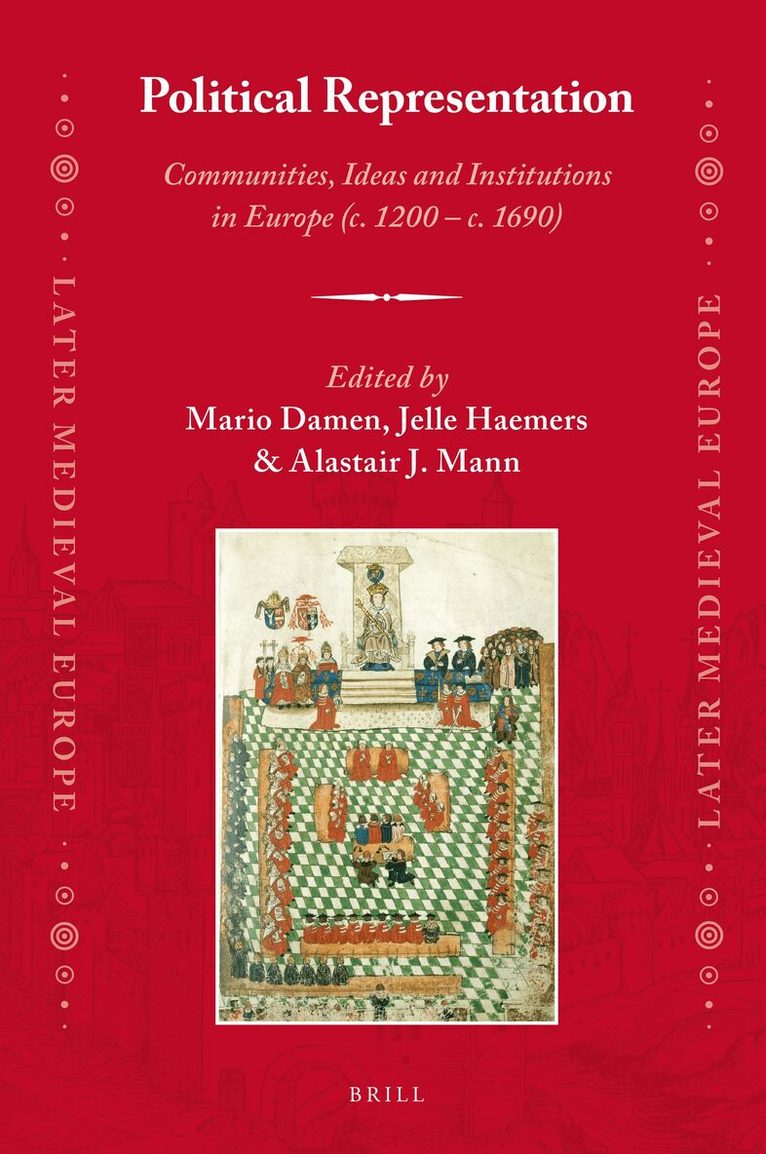
    Political Representation: Communities, Ideas and Institutions in Europe (c. 1200 - c. 1690)

    AvMario Damen

    Inbunden, Engelska, 2018

    Del 15 i serien Later Medieval Europe

    2 589 kr

    Beställningsvara. Skickas inom 5-8 vardagar. Fri frakt över 249 kr.

    Beskrivning

    Political Representation: Communities, Ideas and Institutions in Europe (c. 1200 - c. 1690), a scholarly collection on representation in medieval and early modern Europe, opens up the field of institutional and parliamentary history to new paradigms of representation across a wide geography and chronology – as testified by the volume’s studies on assemblies ranging from Burgundy and Brabant to Ireland and Italy. The focus is on three areas: institutional developments of representative institutions in Western Europe; the composition of these institutions concerning interest groups and individual participants; and the ideological environment of representatives in time and space. By analysing the balance between bottom-up and top-down approaches to the functioning of institutions of representation; by studying the actors behind the representative institutions linking prosopographical research with changes in political dialogue; and by exploring the ideological world of representation, this volume makes a key contribution to the historiography of pre-modern government and political culture.Contributors are María Asenjo-González, Wim Blockmans, Mario Damen, Coleman A. Dennehy, Jan Dumolyn, Marco Gentile, David Grummitt, Peter Hoppenbrouwers, Alastair J. Mann, Tim Neu, Ida Nijenhuis, Michael Penman, Graeme Small, Robert Stein and Marie Van Eeckenrode.See inside the book.

    Produktinformation

    • Utgivningsdatum:2018-08-30
    • Mått:155 x 235 x 26 mm
    • Vikt:685 g
    • Format:Inbunden
    • Språk:Engelska
    • Serie:Later Medieval Europe
    • Antal sidor:334
    • Förlag:Brill
    • ISBN:9789004352414

    Utforska kategorier

    • Historia inom Historia och arkeologi
    • Rättshistoria inom Juridik

    Mer om författaren

    Dr Mario Damen is Senior Lecturer at the University of Amsterdam. He is especially interested in social, political and cultural history of the late medieval Low Countries and the princes, nobles and administrative elites of the Burgundian and Habsburg composite state. His publications include Prelaten, edelen en steden. De samenstelling van de Staten van Brabant in de vijftiende eeuw (2016) and ‘The knighthood in and around fifteenth century Brussels’, Journal of Medieval History 43, (2017). Dr Jelle Haemers is Senior Lecturer at the University of Leuven (KU Leuven). Apart from urban history his research interests encompass social and political conflicts in the late medieval town, notably in the Low Countries (1100-1550). Among others he published For the Common Good. State Power and Urban Revolts in the Reign of Mary of Burgundy, 1477-1482 (2009). Dr Alastair Mann is Senior Lecturer at Stirling University, Scotland. He researches parliamentary history, the Restoration, and book history. He is co-editor of The Records of the Parliaments of Scotland to 1707 (2008-) and author of the biography James VII: duke and king of Scots (2014).

    Recensioner i media

    "Dem Band gelingt es mithin, einem Thema, zu dem schon viel gesagt worden ist, inhaltliche Elemente und methodische Ideen hinzuzufügen, die weniger auf grundstürzend Neues aus sind, sondern vielmehr klassische Analyseinstrumente mit solchen vor allem aus dem weiten Feld der Ideen- und Kulturgeschichte verbinden.Olaf Mörke, Kiel in Zeitschrift für Historische Forschung 47 (2020), 2''Insgesamt gesehen liefert das Buch einen sehr fundierten Überblick zum Stand der vergleichenden und der auf unterschiedliche Reiche und Territorien bezogenen Forschungen zu politischer Repräsentation und Ständeversammlungen. Es leistet einen wichtigen Beitrag zur Diskussion neuerer Forschungsansätze und theoretischer Modelle und gibt äußerst vertiefenswerte Anregungen für künftige Forschungen''. Gisela Naegle in Francia Recensio , 4 (2019). "On the whole I very much welcome these two new volumes, because they usefully unite different approaches to the study of pre-modern political representation. Moreover, because of the serendipity of their publication and the editors’ shared commitment to using the perspective of empowering interactions in the study of representative institutions – especially since the potential to do so seems not to have been fully realized yet in the volumes themselves – the books set a clear agenda for future research. Joris Oddens (University of Padova, Italy/Huygens-ING) in European History Quarterly, 2019, Vol. 49(3) 491–547"This deeply researched collection raises many profound questions about the nature of representation and explores them with great care and sensitivity. Political scientists, economists, and historians of all periods will find much of value in the collection; many of the chapters require readers to acquaint themselves with very specific circumstances and institutions, but the authors do a fine job of explaining why these details matter and what light they shed on specific aspects of representation. Lastly, the editors at Brill deserve praise for their care in publishing the work; too often excellent volumes suffer from typos and thoughtless errors, but happily such was not the case here". Alison Williams Lewin, in The Medieval Review , June 2020. "Throughout its fourteen chapters, the book presents how political representation was instituted in Europe between 1200 and 1690. [...] This book is of interest not only for medieval and early modern historians, who will find a new and more accurate approach to the classical topic of estates and representative assemblies, but also for political theorists, who will benefit from a genealogical approach to political representation, a key topic in political theory indeed". Montserrat Herrero, Renaissance Quarterly, 73 (2), pp. 640-641.

    Innehållsförteckning

    • AcknowledgementsList of IllustrationsContributors and EditorsAn Introduction: Political Representation Communities, Ideas and Institutions in Europe (c. 1200–c. 1650) Mario Damen, Jelle Haemers and Alastair J. MannPart 1: Top-down or Bottom-up? Princes, Communities and Representation1Assemblies of Estates and Parliamentarism in Late Medieval EuropePeter Hoppenbrouwers2Political Representation and the Fiscal State in Late Medieval and Early Modern CastileMaría Asenjo-González3Forms of Political Representation in Late Medieval Northern Italy: Merits and Shortcomings of the City-State Paradigm (14th–early 16th Century)Marco Gentile4Representation in Later Medieval and Early Modern IrelandColeman A. Dennehy5Speaking in the Name of: Collective Action, Claim-making, and the Development of Pre-modern Representative InstitutionsTim NeuPart 2: Prelates, Nobles and Patricians: The Composition of the Representative Institutions6“The King wishes and commands?” Reassessing Representative Assembly in Scotland, c.1286–1329Michael Penman7Officers of State and Representation in the Pre-modern Scottish ParliamentAlastair J. Mann8The Nobility in the Estates of the Late Medieval Duchy of BrabantMario Damen9Representation by Numbers: How Attendance and Experience Helped Holland to Control the Dutch States General (1626–1630)Ida NijenhuisPart 3: Controlling the State: Ideas and Discourses10The Antwerp Clerk Jan van Boendale and the Creation of a Brabantine IdeologyRobert Stein11Rituals of Unanimity and Balance: Deliberation in 15th- to 16th-century Hainaut: A Fool’s Game?Marie Van Eeckenrode12Speech Acts and Political Communication in the Estates-General of Valois and Habsburg Burgundy c. 1370–1530: Towards a Shared Political Language Jan Dumolyn and Graeme Small13Parliament, War and the “Public Sphere” in Late Medieval England: The Experience of Lancastrian KentDavid Grummitt14Who has a Say? The Conditions for the Emergence and Maintenance of Political Participation in Europe before 1800Wim BlockmansConclusion: Reconsidering Political Representation in Europe, 1400–1700Selective Bibliography Index