• Fri frakt över 249 kr
  • •
  • Snabba leveranser
  • •
  • Billiga böcker
Kundservice

Du är på sajten för privatpersoner.

Företag, bibliotek eller offentlig verksamhet?

Du handlar på classic.bokus.com, där alla dina funktioner finns intakta.
Till classic.bokus.com
Bokus logotyp. Gå till startsidan.
  • Erbjudanden
  • Nyheter
  • Student
  • Topplistor
  • Barn & ungdom
  • Bokus Play
  • E-böcker
  • Pocketböcker
  • Spel & pussel

10% rabatt på allt med kod NYSTART10 →

Sidfot

Mina sidor

    Hjälp

    • Kundservice
    • Vanliga frågor och svar
    • Frakt och leverans
    • Retur vid ångerrätt
    • Reklamera vara
    • Betalning
    • Köpvillkor
    • Allmänna villkor
    • Information om webbplatsens tillgänglighet

    Om Bokus

    • Om oss
    • Pressrum
    • För studenter
    • För företag
    • För bibliotek och offentlig verksamhet
    • För leverantörer
    • Hållbarhet

    Populärt

    • Aktuella erbjudanden
    • Presentkort
    • Studentlitteratur
    • Nya böcker
    • Topplistor
    • Signerade böcker
    • Engelska böcker

    Inspiration

    • Boktips
    • BookTok
    • Populära bokserier
    • Barnbokskaraktärer
    • Populära författare
    Logotyp för Bokus
    Följ oss på Facebook (extern länk)Följ oss på Instagram (extern länk)Följ oss på YouTube (extern länk)Följ oss på TikTok (extern länk)
    bokus @ CookiesAnpassa cookiesIntegritetspolicyKöpvillkor
    Till Citymail hemsida (extern länk)Till Budbee hemsida (extern länk)Till Postnord hemsida (extern länk)Till Schenker hemsida (extern länk)Till Early Bird hemsida (extern länk)Till Walleys hemsida (extern länk)
    1. Psykologi och pedagogik
    2. Pedagogik
    3. Pedagogisk metodik

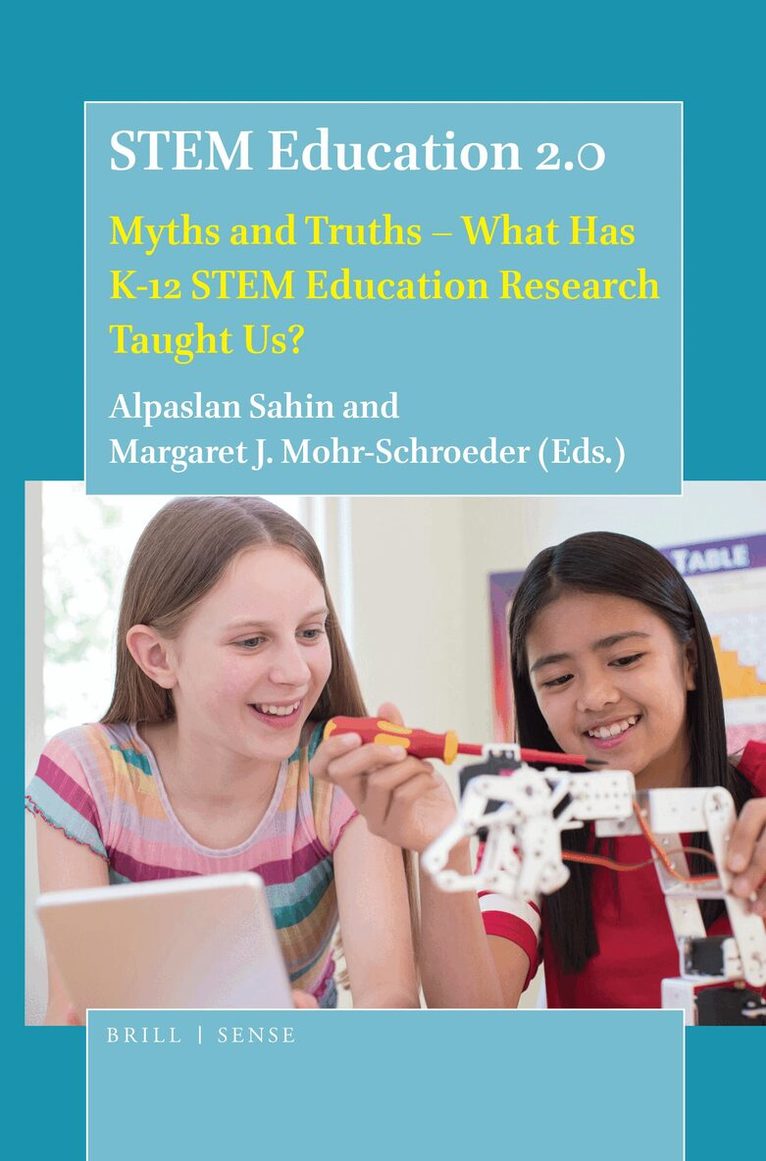
    STEM Education 2.0

    Myths and Truths – What Has K-12 STEM Education Research Taught Us?

    AvAlpaslan Sahin,Margaret J. Mohr-Schroeder

    Häftad, Engelska, 2019

    Del i serien Brill

    900 kr

    Beställningsvara. Skickas inom 5-8 vardagar. Fri frakt över 249 kr.

    Beskrivning

    STEM Education 2.0 discusses the most recent research on important selected K-12 STEM topics by synthesizing previous research and offering new research questions. The contributions range from analysis of key STEM issues that have been studied for more than two decades to topics that have more recently became popular, such as maker space and robotics. In each chapter, nationally and internationally known STEM experts review key literature in the field, share findings of their own research with its implications for K-12 STEM education, and finally offer future research areas and questions in the respected area they have been studying. This volume provides diverse and leading voices in the future of STEM education and STEM education research.

    Produktinformation

    • Utgivningsdatum:2019-08-22
    • Mått:155 x 235 x 21 mm
    • Vikt:621 g
    • Format:Häftad
    • Språk:Engelska
    • Serie:Brill
    • Antal sidor:368
    • Förlag:Brill
    • ISBN:9789004405387

    Utforska kategorier

    • Pedagogisk metodik inom Psykologi och pedagogik
    • Pedagogik inom Psykologi och pedagogik

    Mer om författaren

    Alpaslan Sahin, Ph.D. (2007), is a Research Scientist at Harmony Public Schools. He has published a book, book chapters, and many articles on STEM education, teachers’ questioning techniques, and informal STEM learning, including A Practice-based Model of STEM Teaching: STEM Students on the Stage (SOS).Margaret J. Mohr-Schroeder, Ph.D. (2006), is a Professor of STEM Education and Associate Dean in the College of Education at the University of Kentucky. She has a variety of publications and grants related to using informal learning environments to improve opportunity and access to STEM education, including K12 STEM Education: Why Does It Matter and Where Are We Now? (Teachers College Record, 2018).

    Recensioner i media

    "This edited collection explores the current state of science, technology, engineering, and mathematics (STEM) education, primarily in the US, covering the breadth of STEM education, including the often- overlooked areas of technology and engineering. Most chapters are written as reviews of previous research on key aspects of STEM education (e.g., diversity and inclusion, integrated learning, and project-based curricula) with some original research also included. The contributing authors represent a broad cross section of educational researchers working in this field, bringing a variety of expertise to the volume. Perhaps the greatest strength of the collection is each chapter's references to current literature. However, the book would have benefited from stronger editing to help connect each chapter to the overall theme rather than the somewhat scattershot approach of alternating between reviews and new research. This text's primary audiences are graduate students, researchers, and practitioners, who can use the individual chapters as reference points for situating current and future research projects. Advanced undergraduates wanting an entrée into the research areas mentioned will also benefit from this collection." - R. A. Kolvoord, James Madison University in CHOICE 57:11 (2020).

    Innehållsförteckning

    • ForewordJoseph KrajcikAcknowledgementsList of Figures and TablesNotes on ContributorsPART 1: Setting Stage for STEM Education: Updates on STEM Education1 STEM Literacy: Where Are We Now?Maureen Cavalcanti and Margaret J. Mohr-Schroeder2 Getting to the Bottom of the Truth: STEM Shortage OR STEM Surplus?Cathrine Maiorca, Micah Stohlmann and Emily Dreissen3 Underrepresentation of Women and Students of Color in STEMDionne Cross Francis, Kerrie G. Wilkins-Yel, Kelli M. Paul and Adam V. Maltese4 Teaching and Learning Integrated STEM: Using Andragogy to Foster an Entrepreneurial Mindset in the Age of SynthesisLouis S. Nadelson and Anne L. Seifert5 National Reports on STEM Education: What Are the Implications for K-12?Sarah BushPART 2: How to Provide Rigorous STEM Education: Means and Ways to Educate More STEM Literate STEM Professionals: PBL, Inclusive STEM Schools, and Informal STEM Learning Opportunities6 The Role of Interdisciplinary Project-Based Learning in Integrated STEM EducationAlpaslan Sahin7 Inclusive STEM Schools: Origins, Exemplars, and PromiseSharon J. Lynch8 Inclusive STEM School Models: A Review of Characteristics & ImpactJustin M. Bathon9 Informal Learning in STEM EducationSoledad Yao and Margaret J. Mohr-Schroeder10 Bringing out the “T” in STEM EducationBulent Dogan and Susie GronsethPART 3: Bringing out the “E” in STEM in K-12 Settings11 Engineering Education in K-12: A Look Back and ForthChristine Guy Schnittka12 Classroom Assessment in the Service of Integrated STEM Education ReformCarol L. Stuessy and Luke C. Lyons13 A Shared Language: Two Worlds Speaking to One Another through Making and Tinkering ActivitiesAmber Simpson, Jackie Barnes and Adam V. Maltese14 Educational Robotics as a Tool for Youth Leadership Development and STEM EngagementKathleen Morgan, Bradley Barker, Gwen Nugent and Neal GrandgenettPART 4: Factors Affecting Students’ Choice of STEM Majors15 Factors Affecting Students’ STEM Choice and Persistence: A Synthesis of Research and Findings from the Second Year of a Longitudinal High School STEM Tracking StudyAdem Ekmekci, Alpaslan Sahin and Hersh Waxman16 Reaching Youth with Science: A Look at Some Data on When Science Interest Develops and How it Might Be SustainedRobert H. TaiPART 5: Community Partnerships and Innovation to Improve K-12 Students’ 21st Century Skills17 Crossing Borders and Stretching Boundaries: A Look at Community-Education Partnerships and Their Impact on K-12 STEM EducationBrett Criswell, Theodore Hodgson, Carol Hanley and Kimberly Yates18 What Skills Do 21st Century High School Graduates Need to Have to Be Successful in College and Life?Kristina Kaufman19 An International View of STEM EducationBrigid Freeman, Simon Marginson and Russell Tytler20 Conclusions and Next DirectionsMargaret J. Mohr-Schroeder and Alpaslan Sahin