• Fri frakt över 249 kr
  • •
  • Snabba leveranser
  • •
  • Billiga böcker
Kundservice

Du är på sajten för privatpersoner.

Företag, bibliotek eller offentlig verksamhet?

Du handlar på classic.bokus.com, där alla dina funktioner finns intakta.
Till classic.bokus.com
Bokus logotyp. Gå till startsidan.
  • Erbjudanden
  • Nyheter
  • Student
  • Topplistor
  • Barn & ungdom
  • Bokus Play
  • E-böcker
  • Pocketböcker
  • Spel & pussel

10% rabatt på allt med kod: NYSTART10 →

Sidfot

Mina sidor

    Hjälp

    • Kundservice
    • Vanliga frågor och svar
    • Frakt och leverans
    • Retur vid ångerrätt
    • Reklamera vara
    • Betalning
    • Köpvillkor
    • Allmänna villkor
    • Information om webbplatsens tillgänglighet

    Om Bokus

    • Om oss
    • Pressrum
    • För studenter
    • För företag
    • För bibliotek och offentlig verksamhet
    • För leverantörer
    • Hållbarhet

    Populärt

    • Aktuella erbjudanden
    • Presentkort
    • Studentlitteratur
    • Nya böcker
    • Topplistor
    • Signerade böcker
    • Engelska böcker

    Inspiration

    • Boktips
    • BookTok
    • Populära bokserier
    • Barnbokskaraktärer
    • Populära författare
    Logotyp för Bokus
    Följ oss på Facebook (extern länk)Följ oss på Instagram (extern länk)Följ oss på YouTube (extern länk)Följ oss på TikTok (extern länk)
    bokus @ CookiesAnpassa cookiesIntegritetspolicyKöpvillkor
    Till Citymail hemsida (extern länk)Till Budbee hemsida (extern länk)Till Postnord hemsida (extern länk)Till Schenker hemsida (extern länk)Till Early Bird hemsida (extern länk)Till Walleys hemsida (extern länk)
    1. Skönlitteratur
    2. Litteraturvetenskap
    3. Litteraturvetenskap

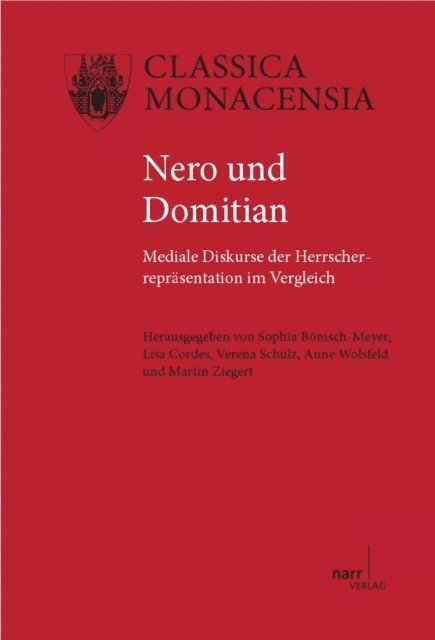
    Deconstructing Imperial Representation: Tacitus, Cassius Dio, and Suetonius on Nero and Domitian

    AvVerena Schulz

    Inbunden, Engelska, 2019

    Del 427 i serien Mnemosyne, Supplements

    2 670 kr

    Beställningsvara. Skickas inom 5-8 vardagar. Fri frakt över 249 kr.

    Beskrivning

    What literary strategies do Tacitus, Cassius Dio, and Suetonius apply in portraying Nero and Domitian? This book argues that the three authors respond to and deconstruct the positive accounts of imperial representation that were prevalent during the lifetimes of the two controversial emperors. They take up motifs from these earlier accounts, which they re-interpret to construct their own negative portraits.Although Tacitus, Cassius Dio, and Suetonius discuss the same historical figures and events of early imperial Rome, they are rarely examined together in one volume. Verena Schulz offers the first combined reading of their works from a philological viewpoint, analysing the various rhetorical techniques and narratological devices that they display, and the different literary and historical discourses in which they are embedded.

    Produktinformation

    • Utgivningsdatum:2019-07-11
    • Mått:155 x 235 x 30 mm
    • Vikt:788 g
    • Format:Inbunden
    • Språk:Engelska
    • Serie:Mnemosyne, Supplements
    • Antal sidor:410
    • Förlag:Brill
    • ISBN:9789004407213

    Utforska kategorier

    • Litteraturvetenskap inom Skönlitteratur

    Mer om författaren

    Verena Schulz is a Classical Philologist at the Ludwig-Maximilians-Universität München. She has published a monograph (Die Stimme in der antiken Rhetorik, 2014), an edited volume, and many articles on Roman historiography and ancient rhetoric.

    Recensioner i media

    ''S[chultz] sets out to show that a full understanding of Imperial obloquy entails a due appreciation of its relationship to Imperial praise. In this enterprise, she is successful. Students of all three authors, and both emperors, will find her analyses illuminating.'' - Luke Pitcher, in: Gnomon 94.2 (2022), pp. 119-122Zusammenfassend lässt sich konstatieren, dass Schulz vor allem durch die klare Darlegung ihrer Methodik ein inspirierendes Buch vorgelegt hat, das für Philologen und Historiker wertvoll sein dürfte. Doch ihr Beitrag beschränkt sich nicht allein auf methodische Ausdifferenzierungen, sondern auch inhaltlich hat sie einen Beitrag zum besseren Verständnis der Zeit von Nero bis Cassius Dio, seinem größten Kritiker, geleistet. - Frank Ursin, in: Frankfurter elektronische Rundschau zur Altertumskunde 39 (2019)''so hat Schulz mit ihrer Monographie etwas erreicht, was noch lange nicht jeder wissenschaftlichen Studie beschieden ist. Besonders überzeugen dabei die Passagen ihrer Untersuchung, in denen sie die unterschiedlichen Dekonstruktionsverfahren des Tacitus, Cassius Dio und Sueton anhand einzelner Episoden, die bei allen dreien überliefert sind, zueinander in Bezug setzt und dabei die Spezifika der jeweiligen Autoren herausarbeiten kann. Gerade dieser unmittelbare Vergleich zeigt eindrücklich den Wert einer narratologischen Betrachtung historiographischer Texte.'' - Isabelle Künzer, in: Plekos vol. 24 (2022), pp. 79-118

    Innehållsförteckning

    • PrefaceIntroduction: Content and Purpose of This StudyPart 1 Constructing the Emperor in Historiography and Panegyric1 Texts and Stories: on ‘Dinners with the Emperor’1 An Example: Constructing Imperial Dinners2 Ingredients for a Good Imperial Dinner3 Critical Texts: Digesting Bad Dinners4 Conclusions Drawn from This Case Study2 Theory and History1 Imperial Representation: Nero and Domitian2 Discourse and Deconstruction3 Literature and PersuasivenessPart 2 Tacitus: Deconstruction and UncertaintyIntroduction3 Imperial Representation and Topics of Deconstruction1 Military Actions: from Peace to Inactivity, from Victory to Hypocrisy2 Building Endeavours: from Construction to Destruction3 Public Entertainment: from Popular to Eccentric Performances4 Nero’s Speeches: Gaining Rhetorical Power5 Divinity: from God-Like to Unhuman6 Atmosphere: From Golden Age to the Dynamics of Bad Times4 Strategies of Deconstruction in Tacitus1 Overview: How to Deconstruct Imperial Representation2 Negative Connotations: ‘Facts’, Additions, and Foils3 Causation and Character4 New Forms of Logic5 Creating Uncertainty1 Tacitus and Theories of Uncertainty2 Playing with Variants3 Playing with Oppositions4 Uncertainty and InterpretationConclusionPart 3 Cassius Dio: Deconstruction and TypologiesIntroduction6 Writing Historiography under the Severans1 The Roman History and the Early Third Century2 Imperial Representation in the Roman History7 Strategies of Deconstruction in Cassius Dio1 Negative Connotations2 Persuasive Characters3 The Rhetoric of Combination4 Selection and Focus5 Spoiling the Atmosphere8 Deconstruction and the Construction of Memory1 Typologies of Bad Emperors2 Hot Memory: Why Nero and Domitian?3 Genealogies versus TypologiesConclusionPart 4 Suetonius: Deconstruction and EntertainmentIntroduction9 Biography and Eccentric Representation1 Structure and Criticism: Current Debates on Suetonius2 Rubrics and Representation: Fragmentation and Re-Contextualization10 Strategies of Deconstruction in Suetonius1 Historiographical Techniques in Imperial Biographies2 Suetonian Techniques: the Effect of Rubrics3 Ambivalent Techniques and a Weaker Form of Deconstruction11 Deconstructed Elements and Miscellanism1 Beyond Tacitus and Cassius Dio: Suetonian Deconstruction and the Historiographical Discourse2 Between Pliny the Elder and Aulus Gellius: Suetonian Deconstruction and the Non-Historiographical DiscourseConclusionPart 5 ConclusionConclusion: Three Modes of DeconstructionAppendix: Deconstruction and Rhetorical StrategiesBibliographyIndex