• Fri frakt över 249 kr
  • •
  • Snabba leveranser
  • •
  • Billiga böcker
Kundservice

Du är på sajten för privatpersoner.

Företag, bibliotek eller offentlig verksamhet?

Du handlar på classic.bokus.com, där alla dina funktioner finns intakta.
Till classic.bokus.com
Bokus logotyp. Gå till startsidan.
  • Erbjudanden
  • Nyheter
  • Student
  • Topplistor
  • Barn & ungdom
  • Bokus Play
  • E-böcker
  • Pocketböcker
  • Spel & pussel

10% rabatt på allt med kod: NYSTART10 →

Sidfot

Mina sidor

    Hjälp

    • Kundservice
    • Vanliga frågor och svar
    • Frakt och leverans
    • Retur vid ångerrätt
    • Reklamera vara
    • Betalning
    • Köpvillkor
    • Allmänna villkor
    • Information om webbplatsens tillgänglighet

    Om Bokus

    • Om oss
    • Pressrum
    • För studenter
    • För företag
    • För bibliotek och offentlig verksamhet
    • För leverantörer
    • Hållbarhet

    Populärt

    • Aktuella erbjudanden
    • Presentkort
    • Studentlitteratur
    • Nya böcker
    • Topplistor
    • Signerade böcker
    • Engelska böcker

    Inspiration

    • Boktips
    • BookTok
    • Populära bokserier
    • Barnbokskaraktärer
    • Populära författare
    Logotyp för Bokus
    Följ oss på Facebook (extern länk)Följ oss på Instagram (extern länk)Följ oss på YouTube (extern länk)Följ oss på TikTok (extern länk)
    bokus @ CookiesAnpassa cookiesIntegritetspolicyKöpvillkor
    Till Citymail hemsida (extern länk)Till Budbee hemsida (extern länk)Till Postnord hemsida (extern länk)Till Schenker hemsida (extern länk)Till Early Bird hemsida (extern länk)Till Walleys hemsida (extern länk)
    1. Medicin
    2. Medicin: allmänt
    3. Medicinhistoria

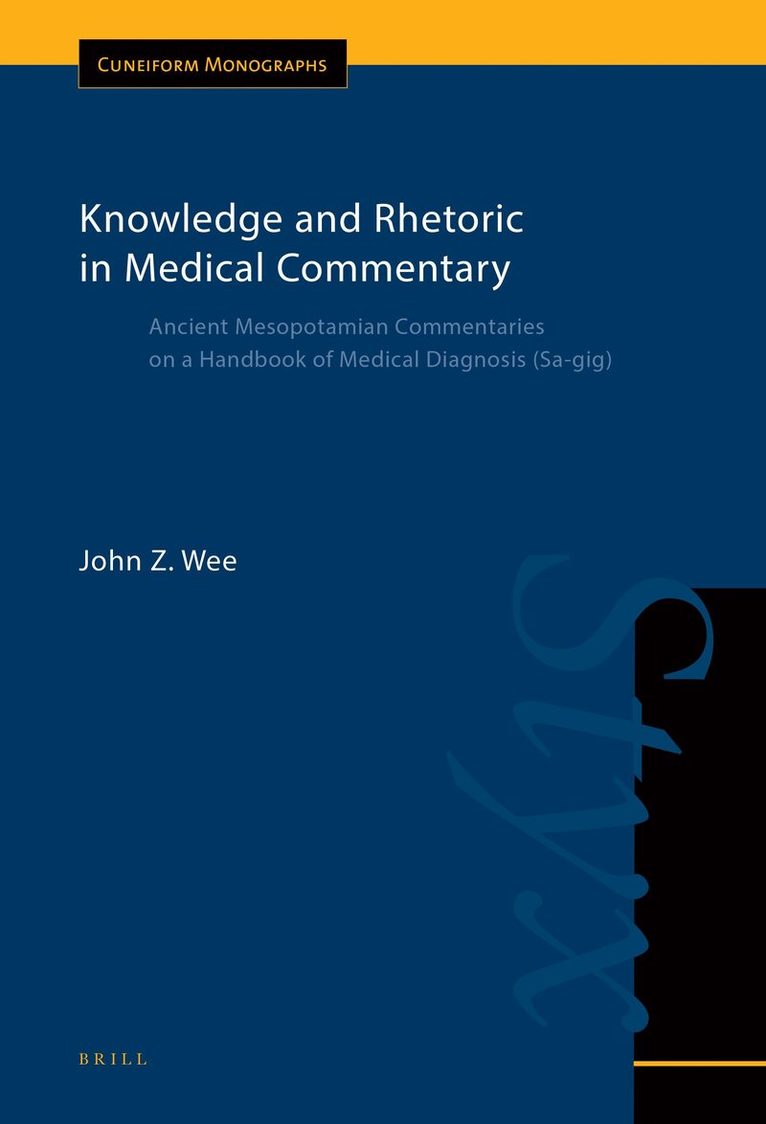
    Knowledge and Rhetoric in Medical Commentary

    Ancient Mesopotamian Commentaries on a Handbook of Medical Diagnosis (Sa-gig), Cuneiform Monographs vol. 49/1

    AvJohn Z Wee

    Inbunden, Engelska, 2019

    Del 49 i serien Cuneiform Monographs

    2 966 kr

    Beställningsvara. Skickas inom 5-8 vardagar. Fri frakt över 249 kr.

    Beskrivning

    Knowledge and Rhetoric in Medical Commentary is intended for historians of medicine and interpretation, and explores the dynamic between scholastic rhetoric and medical knowledge in ancient commentaries on a Mesopotamian Diagnostic Handbook.In line with commentators self-fashioning as experts of diverse disciplines, commentaries display intertextuality involving a variety of lexical, astronomical, religious, magic, and literary compositions, while employing patterns of argumentation that resist categorization within any single branch of knowledge. Commentators choices of topics and comments, however, sought to harmonize atypical language and ideas in the Handbook with conventional ways of perceiving and describing the sick body in therapeutic recipes. Scholastic rhetoricsupposedly unfettered to any disciplineserved in fact as a pretext for affirming current forms of medical knowledge.

    Produktinformation

    • Utgivningsdatum:2019-12-30
    • Mått:155 x 235 x 35 mm
    • Vikt:953 g
    • Format:Inbunden
    • Språk:Engelska
    • Serie:Cuneiform Monographs
    • Antal sidor:493
    • Förlag:Brill
    • ISBN:9789004417540

    Utforska kategorier

    • Medicinhistoria inom Medicin
    • Forntidens historia inom Historia och arkeologi

    Mer om författaren

    John Z. Wee, Ph.D. (2012), Yale University, is Assistant Professor of Assyriology at the University of Chicago. He is author of books and articles on medicine and astronomy in Mesopotamian and Greco-Roman antiquity, and editor of The Comparable Body (Brill, 2017).

    Recensioner i media

    "The two-volume work of John Z. Wee is a welcome new contribution to the discussion of Babylonian and Assyrian cuneiform commentariesan at times complex and, to readers unaware of its intricacies, often opaque textual genre, mainly known from the late time of Cuneiform Culture. (...) The first volume addresses not only Assyriologists but also scholars interested in the history of medicine and the history of interpretation and science. The study presented here includes a great many detailed discussions and presentations of interrelated issues within Mesopotamian commentary literature particularly in relation to the DH and its structure, as well as the context of these commentaries and their arguments in respect to their use and institutional background. Volume two provides the relevant data, presenting a collective edition of all commentaries on the DH so far known. This offers the particular advantage of making all relevant data accessible in a printed, citable form together with detailed philological commentaries and discussions on difficult or peculiar words and phrases."- Eric Schmidtchen, Universit de Genve, in Bibliotheca Orientalis LXXVIII N 3-4 (2021)."In short, John Wees Knowledge and Rhetorical in Medical Commentary in an erudite and refreshing analysis of Sa-gig and its commentaries. Although a highly specialized subject, some of his broader observations about serialization, canonization, textual sources of authority, and embedded variants may be helpful for folks in religious studies thinking about so-called canon, interpretive practices and textual sources of authority, and the boundaries in the ancient world of what we often designate science and literature."- William Brown, in The Biblical Review, 2021.

    Innehållsförteckning

    • I. Knowledge and Rhetoric in Medical CommentaryPrefaceAcknowledgementsContents (Two Volumes)List of FiguresMedical Text Labels and AbbreviationsFormat and Translation IssuesGlossaryI.1 Introduction to the Sa-gig CommentariesI.1.1 The Situatedness of CommentariesI.1.2 The Diagnostic Handbook Sa-gig and Its SerializationI.1.3 Serialized Variants and Their InterpretationI.1.4 The Presentation of Alternatives in Text Series and CommentariesChapter Two: Commentary and Scholastic RhetoricI.2.1 Commentary Designations and Scribal ActorsI.2.1.1 “Glossary” (ṣâtu)I.2.1.2 “Oral Lore” (šūt pî)I.2.1.3 “Readings” (malsûtu)I.2.1.4 “Questionings” (mašʾaltu)I.2.1.5 “From the Mouth of the Ummânu-scholar” (ša pî ummâni)I.2.1.6 Patterns of Commentary DesignationsI.2.2 Textual Sources of AuthorityI.2.2.1 Lexical Text CitationsI.2.2.2 Narratival IntertextualityI.2.2 Forms of ArgumentationI.2.3.1 Two-Member ArgumentsI.2.3.2 Multiple Member ArgumentsI.2.3.3 Single Member ArgumentsI.2.4 Exemplar and License in Scholastic HermeneuticsChapter Three: Commentary and Medical KnowledgeI.3.1 Epistemic Progression in Medical Practice and TextsI.3.1.1 The Therapeutic TraditionI.3.1.2 Structuring the Diagnostic HandbookI.3.2 Harmonizing Texts and PhenomenaI.3.2.1 Knowledge Assumptions in Topic ChoiceI.3.2.2 The Pericope and Omissions from TopicsI.3.2.3 Comment Choice and Argument as PretextI.3.1 Habits of Use and the Cuneiform HandbookI.4 Conclusion: Scholasticism and the Boundaries for InterpretationAppendix One: Embedded Variants in the Diagnostic Handbook Sa-gigAppendix Two: Transliterations of Medical TextsBibliographyIndex of Excerpts (Two Volumes)II. Mesopotamian Commentaries on the Diagnostic Handbook Sa-gigPrefaceAcknowledgementsContents (Two Volumes)Medical Text Labels and AbbreviationsFormat and Translation IssuesChapter One: Edition of the Sa-gig CommentariesII.1.1 Commentary Sa-gig 1AII.1.2 Commentary Sa-gig 1BII.1.3 Commentary Sa-gig 1CII.1.4 Commentary Sa-gig 1DII.1.5 Commentary Sa-gig 1–3II.1.6 Commentary Sa-gig 3AII.1.7 Commentary Sa-gig 3BII.1.8 Commentary Sa-gig 3CII.1.9 Commentary Sa-gig 4AII.1.10 Commentary Sa-gig 4BII.1.11 Commentary Sa-gig 4CII.1.12 Commentary Sa-gig 5II.1.13 Commentary Sa-gig 7AII.1.14 Commentary Sa-gig 7BII.1.15 Commentary Sa-gig 7CaII.1.16 Commentary Sa-gig 7CbII.1.17 Commentary Sa-gig 7Cc (?)II.1.18 Commentary Sa-gig 10 & 11II.1.19 Commentary Sa-gig 13+II.1.20 Commentary Sa-gig 14II.1.21 Commentary Sa-gig 18II.1.22 Commentary Sa-gig 19II.1.23 Commentary Sa-gig 21 & 22aII.1.24 Commentary Sa-gig 23II.1.25 Commentary Sa-gig 29II.1.26 Commentary Sa-gig 34II.1.27 Commentary Sa-gig 36II.1.28 Commentary Sa-gig 39II.1.29 Commentary Sa-gig 40AII.1.30 Commentary Sa-gig 40BChapter Two: Commentary NotationsII.2.1 Disjunction SignII.2.2 “The Case of / Where” (ša)II.2.3 “Which It Said” (ša iqbû)II.2.4 “As in” (libbû)II.2.5 “Complement to” (IGI / pāni)II.2.6 “(Points) to” (ana)II.2.7 “The Usual (Meaning)” (kayyān)II.2.8 Other NotationsPhotographsBibliographyIndex of Excerpts (Two Volumes)