• Fri frakt över 249 kr
  • •
  • Snabba leveranser
  • •
  • Billiga böcker
Kundservice

Du är på sajten för privatpersoner.

Företag, bibliotek eller offentlig verksamhet?

Du handlar på classic.bokus.com, där alla dina funktioner finns intakta.
Till classic.bokus.com
Bokus logotyp. Gå till startsidan.
  • Erbjudanden
  • Nyheter
  • Student
  • Topplistor
  • Barn & ungdom
  • Bokus Play
  • E-böcker
  • Pocketböcker
  • Spel & pussel

10% rabatt på allt med kod: NYSTART10 →

Sidfot

Mina sidor

    Hjälp

    • Kundservice
    • Vanliga frågor och svar
    • Frakt och leverans
    • Retur vid ångerrätt
    • Reklamera vara
    • Betalning
    • Köpvillkor
    • Allmänna villkor
    • Information om webbplatsens tillgänglighet

    Om Bokus

    • Om oss
    • Pressrum
    • För studenter
    • För företag
    • För bibliotek och offentlig verksamhet
    • För leverantörer
    • Hållbarhet

    Populärt

    • Aktuella erbjudanden
    • Presentkort
    • Studentlitteratur
    • Nya böcker
    • Topplistor
    • Signerade böcker
    • Engelska böcker

    Inspiration

    • Boktips
    • BookTok
    • Populära bokserier
    • Barnbokskaraktärer
    • Populära författare
    Logotyp för Bokus
    Följ oss på Facebook (extern länk)Följ oss på Instagram (extern länk)Följ oss på YouTube (extern länk)Följ oss på TikTok (extern länk)
    bokus @ CookiesAnpassa cookiesIntegritetspolicyKöpvillkor
    Till Citymail hemsida (extern länk)Till Budbee hemsida (extern länk)Till Postnord hemsida (extern länk)Till Schenker hemsida (extern länk)Till Early Bird hemsida (extern länk)Till Walleys hemsida (extern länk)
    1. Filosofi och religion
    2. Religion och tro
    3. Religion: allmänt

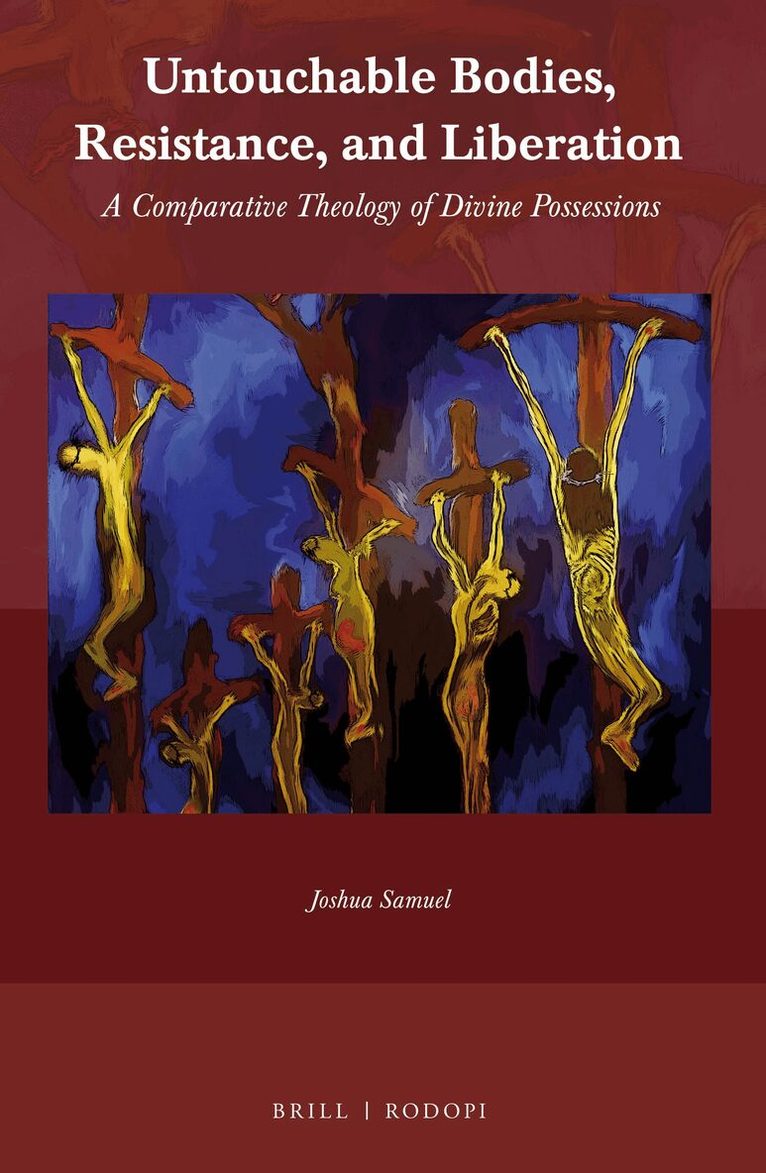
    Untouchable Bodies, Resistance, and Liberation

    A Comparative Theology of Divine Possessions

    AvJoshua Samuel

    Häftad, Engelska, 2020

    Del 61 i serien Currents of Encounter

    999 kr

    Beställningsvara. Skickas inom 5-8 vardagar. Fri frakt över 249 kr.

    Beskrivning

    In Untouchable Bodies, Resistance, and Liberation, Joshua Samuel constructs an embodied comparative theology of liberation by comparing divine possessions among Hindu and Christian Dalits in South India. Critiquing the problems inherent in prioritizing texts when studying religious traditions, Samuel calls for the need to engage in body and people centered interreligious learning. This comparative theological reading of ecstatic experiences of the divine in Dalit bodies in Hinduism and Christianity brings out the powerful liberative potential inherent in the bodies of the oppressed, enabling us to identify alternative modes of resistance and new avenues of liberation among those who are dehumanized and discriminated, and to find deeper and meaningful ways of speaking about God in the context of oppression.

    Produktinformation

    • Utgivningsdatum:2020-02-27
    • Mått:155 x 235 x 15 mm
    • Vikt:422 g
    • Format:Häftad
    • Språk:Engelska
    • Serie:Currents of Encounter
    • Antal sidor:262
    • Förlag:Brill
    • ISBN:9789004420038

    Utforska kategorier

    • Religion: allmänt inom Filosofi och religion

    Mer om författaren

    Joshua Samuel, Ph.D. is Visiting Lecturer for Theology, Global Christianity, and Mission at Episcopal Divinity School at Union Theological Seminary, New York. Previously Samuel taught in the Department of Philosophy and Religious Studies at Marymount Manhattan College, New York.

    Recensioner i media

    "Samuel’s book is provocative, insightful, and generative. With its bridge-building methodology, it enriches Dalit theology and comparative theology, honors the subtly powerful resistance of India’s “outcastes,” and provides glimmers of hope for further liberation." Andrew Ronnevik, Ph.D. Student, Baylor University, in: Reading Religion, June 2021."This comparative theological reading of ecstatic experiences of the divine in Dalit bodies in Hinduismand Christianity brings out the powerful liberative potential inherent in the bodies of the oppressed, enabling us to identify alternative modes of resistance and new avenues of liberation among those who are dehumanized and discriminated, and to find deeper and meaningful ways of speaking about God in the context of oppression." in: Salzburger Theologische Zeitschrift, Volume 24.2 (2020)."Samuel's work, in the end, is a most refreshing theological treatise. This book is a must-read." Sunder John Boopalan, Assistant Professor Biblical and Theological Studies, Canadian Mennonite Universrity, in: The Ecumenical Review, Volume 72.5 (2020). This book is an example of Comparative Theology at its best. Through a careful, particularized, and personal (he is himself a Dalit) analysis and comparison, Samuel illustrates how the oppressed bodies of both Hindu and Christian “untouchable” Dalits of South India have become sacraments of liberation that, in their diversity, reflect and enhance each other. For both students and scholars -- illuminating and inspiring. – Paul F. Knitter, Paul Tillich Emeritus Professor of World Religions and Theology, Union Theological Seminary, NYI love this book. It is refreshing and honest, a painstakingly argued inquiry into the possibility of a comparative Hindu and Christian theology centered on the Dalit experience of the untouchable, outcaste body. Based on extensive surveys of prior literature, as well as his own ethnographic work in Tamil Nadu, Samuel proposes that the embodied experience of divine possession is a “kairos moment,” a means of Dalit hope and liberation, not only for Christians but also for Hindus. The generosity of such theological inclusivity is explosive. As a scholar of Hindu goddesses I must take this seriously. – Rachel Fell McDermott, Professor of Asian and Middle Eastern Cultures, Barnard CollegeUntouchable Bodies, Resistance, Liberation is a weighty and absorbing book that carefully observes and creatively interprets Spirit-possessed Dalit bodies as they re-signify power relations though rituals of defiance, catharsis, subversion, and empowerment. Dr. Samuel discerningly and imaginatively draws from an eclectic crowd of theorists to exegete the manner in which subjugated bodies express everyday emancipatory truths through divine possession in Christian and Hindu Dalit communities. The fruition of Dr. Samuel’s labor is a sensitively embedded and ingeniously construed comparative theology of liberation. – Sathianathan Clarke, Bishop Sundo Kim Chair of World Christianity, Wesley Theological Seminary"Samuel (...) contributes a fresh approach by using a more 'complex' multi-layered strategy to adress the problem of oppression using theology, anthropology and history." Adrianus Yosia, Indonesian Journal of Theology 10, no. 1 (July, 2021)

    Innehållsförteckning

    • AcknowledgmentsPart 1Dalit Bodies and Divine PossessionsIntroduction: a Comparative Theology from a Dalit Perspective1 Toward a Comparative Theology of Liberation1 Comparative Theology1.1 Interrogating Comparative Theology1.2 Prioritization of Texts1.2.1 Lingering Western/Christian Supremacy1.2.2 Disregarding Agency of Faith Communities1.2.3 Perpetuation of Hierarchies2 Dalit Theology2.1 New Directions in Dalit Theology2.1.1 Binarism2.1.2 Identitarianism2.1.3 Christian-Centrism3 A Comparative Theology of Liberation from a Dalit Perspective3.1.1 People Centered Theology3.1.2 Non-Othering Theology3.1.3 Comparative Liberation Theology2 Dalit Body—the Untouchable Sacrament1 The Dalit Body1.1 Bodies That ‘Don’t’ Matter1.2 Disciplining the Bodies2 Theological Significance of the Dalit Body2.1 Body in Christianity2.2 Sacramentality of the Dalit Body3 Choosing a Category for Comparison3.1 Divine Possessions as Vague Comparative CategoryPart 2Divine Possessions among Hindu and Christian Dalits3 Dalits and Hinduism1 Dalit Religion and Hinduism1.1 The Modern Birth of Hinduism1.2 The Unity of Traditions within Hinduism1.3 Distinct Features of Dalit Religion2 Hindu Dalit Goddesses2.1 Goddess(es) of Hinduism2.2 Paraiyar Goddesses3 Dalit Goddesses and Liberation3.1 The Ambivalence of the Goddess(es) and Its Impact on Liberation Theology4 Divine Possessions among Hindu Dalits1 Divine Possessions: an Overview1.1 Divine Possessions1.2 Types of Possessions1.2.1 Enduring Possessions1.2.2 Temporary Possessions2 Divine Possessions: a Closer View2.1 Preparing for the Possessions2.2 Experience of Being Possessed3 Divine Possessions: Inferences and Interpretations3.1 Not ‘Possession’ but Grace3.2 Interweaving of Traditions3.3 Background of the Possessed Devotees3.4 Sexual Ambiguity3.5 Body and Collective Memories3.6 Liberative Elements in Possessions5 Dalit Christianity and Theology1 Dalit Christianity1.1 The Beginnings1.1.1 Rajanaiken of Tanjore (1700–1771)1.1.2 Maharasan Vedamanickam of Travancore (1772–1827)1.2 Mass Movements1.3 Dalit Christianity Today2 Dalit ‘God-Talk’2.1 The ‘Broken’ God2.2 Problematizing Dalit God-Talk2.3 New Trends in Dalit Theology: Re-Turning to the Body6 Divine Possessions among Christian Dalits1 Holy Spirit Possessions1.1 Praise as Preparation1.2 Receiving the Spirit1.3 Interpreting Holy Spirit Possessions1.4 After Holy Spirit Anointing, It Is Bible Time2 Embodied Divine Mediation through Avi Kattu3 Divine Embodiment through Sacraments4 Christian Divine Possessions: Prospects and Possibilities4.1 Centering the Body4.2 Dalit Religious Elements4.3 Divine-Human Agency4.4 Possibilities of Resistance and Liberation4.5 Reimagining EvilPart 1Possessions as Kairos: an Embodied Constructive Theology7 Divine Possessions as Dalit Resistance1 Paraiyar Dalit Religion2 Comparing Hindu and Christian Possessions2.1 Setting2.2 Experiences of the Devotees2.3 Role of the Divine3 Possession as Liberation3.1 Bodies That Want to Be Mattered3.2 Looking beyond Protests3.3 Hidden Transcripts and Infra Politics3.4 Divine Possession as Dalit Resistance: Reimagining Liberation3.5 Possessions as Alternative Resistance8 Envisioning an Embodied Comparative Theology of Liberation1 Possessions as Kairos1.1 Kairos1.2 Paul Tillich’s Conceptualization of Kairos1.3 Possessions as Kairoi in/of the Margins1.4 Re-Visioning Kairos Using Divine Possessions2 Toward an Embodied Theology of Kairos2.1 Christ and Kairoi2.2 Spirit Christology2.3 Spirit Christology and Religious Diversity2.4 The Untouchable God in Untouchable Bodies: a Constructive Theological Imagination2.4.1 Possessions as Untouchable Divine Immanence2.4.2 Possessions as Transgressive Creativity2.4.3 Possessions as Empowering Be(Com)ing9 Epilogue: Marginalized Bodies and Comparative Theology1 Re-Visioning Comparative Theology from and at the Margins1.1 Beyond Texts to Bodies1.2 Beyond Borders to Living at the Boundaries2 Some Confessions and Justifications3 Looking AheadBibliographyIndex